The Sarasota art school goes frame-by-frame again, after DreamWorks revives the technique, by way of the Philippines.
By Rhatia Murphy
Original Air Date: October 15, 2026
Host: Everything old is new again. In this case, it’s coming frame by frame. WSLR News reporter Rhatia Murphy puts the focus on the 2D animation renaissance happening at Ringling College of Art and Design.
Rhatia Murphy: There was a time when I dreamed in Flash. Literally.
Back in the 1990s, I was a young Black woman in San Francisco working in the exciting new world of digital animation.
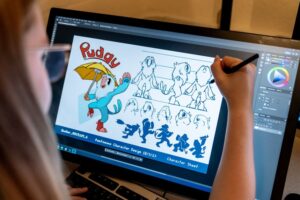
2D animation class at Ringling College. | Photo courtesy RCAD
I wasn’t making cartoons. I was animating letters, logos, websites and those annoying banner ads that used to be everywhere on the internet. Remember those? Yeah. I made those. And I loved it!
Macromedia Flash—which later became Adobe Flash—was my playground. I was making things move, getting paid to be creative and dreaming of someday working for Industrial Light & Magic.
Then technology did what technology does. It moved on.
Flash eventually disappeared, and computer-generated animation became Hollywood’s dominant technique.
Thirty years later, I’m back in art school at Ringling College of Art and Design in Sarasota. And guess what? Traditional 2D animation is getting a new lease on life. Yeah. Everything old is new again.
Inside a classroom at Ringling, animation professor Tammy Zeitler showed me something pretty special: original animation work featuring Mushu, the wisecracking dragon from Disney’s Mulan. The rough animation was created by Disney animator Tom Bancroft. Zeitler worked on the cleanup drawings, helping bring the little dragon to life.
And there it was. Traditional animation, frame by frame, right in front of me.
Zeitler remembers when CGI was the new exciting technology—the new hotness, so to speak. But she thinks audiences have started rediscovering the beauty of hand-drawn animation.
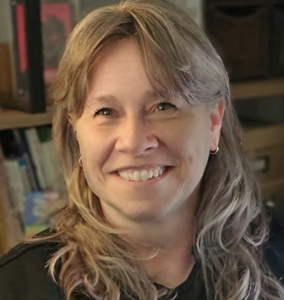
Tammy Zeitler
Tammy Zeitler: Now that everybody’s gotten used to the 3D look, 3D started to move more towards things that looked 2D. They started to use toon shaders and things like that so that it didn’t look like 3D because it was all out there looking the same. I think people just decided—they became impressed again.
RM: And some of today’s filmmakers are discovering that 2D and 3D don’t have to compete. They actually can work together.
Which brings me to a new DreamWorks movie—and a rather wonderful coincidence.
Remember the ’90s? Well, DreamWorks Animation certainly does. Its new feature, Forgotten Island, takes place in the Philippines during the 1990s, complete with the music, fashions and pop culture of the era. We’re talking Montell Jordan’s This Is How We Do It. And yes, they even managed to work in Who Let the Dogs Out on the soundtrack. Technically, that one came out in 2000, but who’s counting?
Here’s the coincidence: While I was learning to animate in Flash in San Francisco, the world depicted in this movie was unfolding halfway around the globe. And now, 30 years later, a Filipino animation studio is helping bring that world to life using hand-drawn animation.

Frame from Snipple Studios’ ‘Forgotten Island’
That studio is Snipple Animation. Based in the Philippines, Snipple specializes in 2D animation and has worked on productions including Phineas and Ferb, DuckTales, Green Eggs and Ham and The Day the Earth Blew Up, featuring Porky Pig and Daffy Duck.
I spoke with Dennis Tomacruz, one of Snipple’s traditional animation project directors. He believes audiences are increasingly interested in animation that looks different from conventional CGI.
Dennis Tomacruz: When they see something that’s hand-drawn, it’s refreshing. It’s like a breath of fresh air.
RM: For Forgotten Island, Snipple produced hand-drawn flashback sequences within a predominantly computer-animated feature.
Dennis admitted that, when the DreamWorks filmmakers first approached the studio, he wasn’t quite sure how the two techniques would fit together.
DT: They said they wanted 2D animation for a CGI movie. I was thinking, “How would that work” How would that blend in?” When they explained that all the flashback sequences will be done in 2D hand-drawn animation, that’s when I thought, “Okay, I get it. Okay. Now I get it.”
RM: The film draws heavily on Filipino folklore and mythology, and Dennis says the opportunity carried special meaning for the studio.
He also hopes Snipple can eventually produce an entirely hand-drawn feature of its own—and help develop an animation style that’s distinctly Filipino.
DT: I hope we can come up with a look and a style of movement that’s really Filipino.
RM: What happens when more animators get the chance to tell stories that come from their own cultures and experiences with art that feels like their own?
This could open the door for a whole new generation to show us something we haven’t seen before.

Ringling students work in an illustration lab. | Courtesy RCAD
Back in Sarasota, Ringling College is preparing to launch a new 2D Character Animation degree program in fall 2027. Students will learn traditional drawing techniques alongside digital tools like Toon Boom Harmony.
But the program isn’t just about getting a job at Disney or Pixar. It’s also about creating your own opportunities.
Paul Downs, head of Ringling’s Computer Animation department, says independent animators can now build audiences and develop projects outside the traditional Hollywood studio system.
Paul Downs: You can have a dream, have an idea, put a team together, create something, upload it to YouTube and really find and build an audience.
RM: Ringling’s new program will incorporate entrepreneurship courses, teaching students how to develop original intellectual property and potentially build businesses around their creations. Students might create an animated television pilot, a commercial or a short scene from a larger film concept.
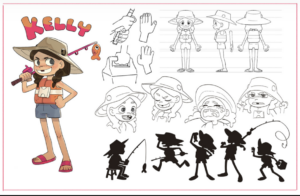
2D animation sketches
Zeitler is also excited about collaboration between majors. Imagine film students combining live-action footage with hand-drawn characters or game designers working with animators to bring their creations to life. And during my classroom visit, I met students already exploring those possibilities.
Andrea, a Computer Animation sophomore, told me she enjoys traditional drawing but doesn’t see 2D and 3D as competing art forms.
Andrea: I don’t really mind the medium. It’s more about—I care about the animation. I don’t mind if it’s either 2D or 3D.
RM: Okay, I love that. The next generation isn’t interested in choosing sides. They just want to make great animation.
Of course, there’s another technology entering the picture: artificial intelligence.
I recently attended a demonstration of StyleFrame AI, and watching new tools accelerate parts of the creative process reminded me of discovering Flash thirty years ago.
But if technology can automate more of the work, what happens to the artists?
Downs says his department has a no-AI policy while students are learning animation fundamentals.
PD: We want to teach you how to make the decisions, how to make the choices and really learn all the aspects from the ground level.
RM: His argument is simple. Technology is going to change, but understanding movement, storytelling, character and artistic expression will always matter.
Walking through Tammy Zeitler’s classroom, watching students bring characters to life on their Cintiq tablets, I couldn’t help thinking about that young woman I used to be—the one animating logos and advertisements in San Francisco, dreaming about working in Hollywood.
I never did become a full-on character animator. Life took me through photography, filmmaking, broadcasting and now journalism. It’s been a crazy journey. These days, I’m more likely to be behind a microphone than a drawing tablet. But I still love animation. And I find it pretty remarkable that a film set in the very decade when I started my creative career has brought me back to the medium I fell in love with.
I may take a couple drawing classes here and there—get my animation chops back. But maybe my real place in this industry is telling the stories of the artists breathing new life into this art form.
Because 2D animation isn’t simply returning to the past. It’s finding new ways to move forward.
Thirty years ago, I was helping make the Internet move. Today, I’m watching animation totally reinvent itself.
And this time, I get to tell the story.
For WSLR News, I’m Rhatia Murphy.
WSLR News aims to keep the local community informed with our 1/2 hour local news show, quarterly newspaper and social media feeds. The local news broadcast airs on Tuesdays and Thursdays at 6pm.
 It's drive week!
Your gift keeps 96.5 on the air. Be one of the people who make it happen.
Donate Now
It's drive week!
Your gift keeps 96.5 on the air. Be one of the people who make it happen.
Donate Now