Florida’s Secretary of Education directs school districts to pre-emptively pull objectionable books from their libraries.
By Gretchen Cochran
Original Air Date: October 1, 2026
Host: Banned Books Week begins Sunday. In Florida, it comes amid renewed state pressure to remove school library books the state and some parents consider objectionable. Gretchen Cochran reports.
Gretchen Cochran: Banned books are in the spotlight next week thanks to the American Library Association’s Banned Book Week.
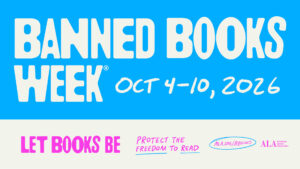 But for some, a list declaring what books they cannot read causes year-round pain.
Just last week, the Florida Secretary of Education sent a missive to school districts. In his September 23 memo, Henry Mack told school district superintendents that reactive removal is not enough. He gave the superintendents 90 days to implement a plan to screen books for what he called “pornographic” content before they make it on library shelves and declared them responsible.
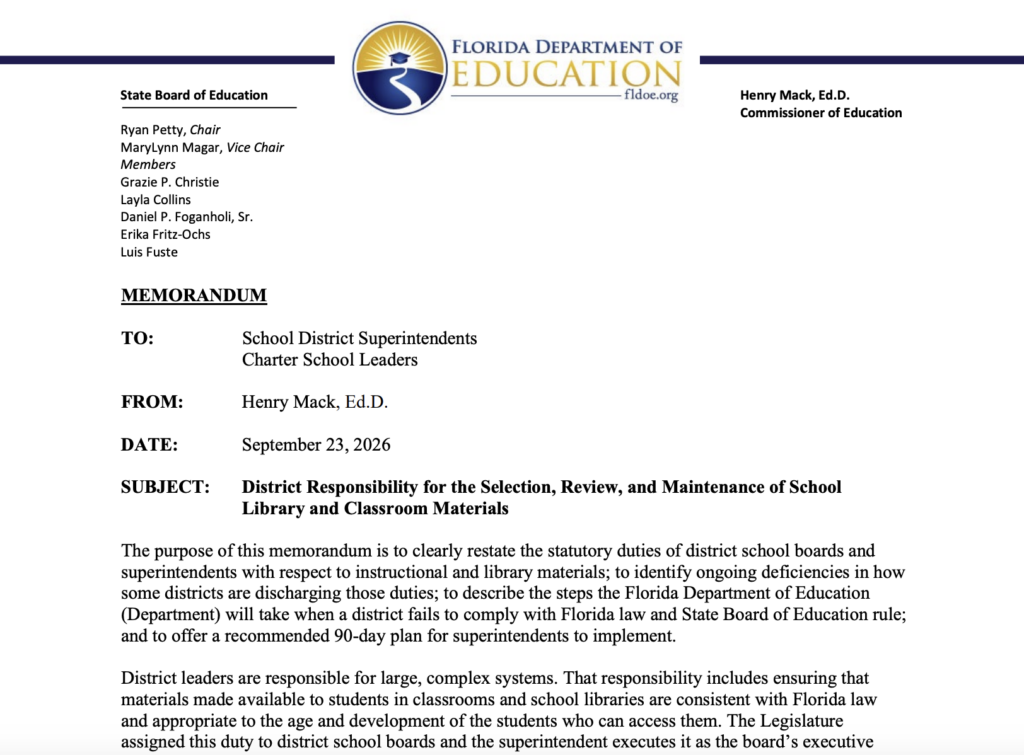
Excerpt from the September 23 memo
Mack ended his memo with this:
“Review your procedures. Review your collections. Ensure that required personnel complete and apply the Department’s training. Use the list the Department has already published. Correct deficiencies before inappropriate materials reach students. Florida law places this responsibility on districts. Make no mistake, the Department will hold districts, and the superintendents who lead them, accountable for failing to protect students from inappropriate content and material.”
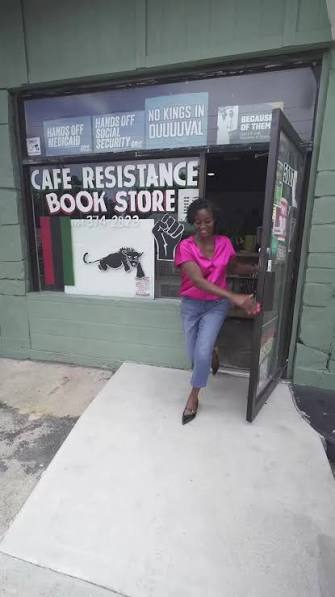
Angie Nixon opened Café Resistance – also known as “The Banned Bookstore” – in Jacksonville two years ago. | Courtesy Café Resistance
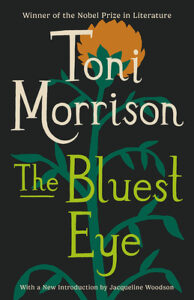
These kinds of measures have prompted pushback. Angie Nixon, the always-pink-clad state representative running for the U.S. Senate, opened her Café Resistance bookstore in Jacksonville two years ago. The place is also known as “The Banned Bookstore,” as it stocks books by Black authors that the Florida Department of Education has tried to ban for grades K-12 across the state. They include volumes like “The Bluest Eye” by Nobel and Pulitzer Prize winner Toni Morrison. It is a novel depicting child sexual abuse decried for its “graphic content.” Nixon’s store also carries the banned “This is Your Time” by Ruby Bridges. Ruby was the lone black child that was escorted into the all-white elementary school in New Orleans in 1960. By the way, Bridges will be here at Booker High School November 12 at a sold-out public town hall.
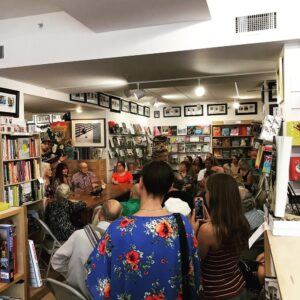
Inside Bookstore1
Speaking of Sarasota—here in downtown, independent BookStore1 has long stocked a banned-book display and hosts a monthly Banned Book Discussion Group. 15 people gathered in a circle there this week to share views on a book titled “The Perks of Being a Wallflower” by Stephen Chbosky.
Written 25 years ago, the story is of a middle-school-aged boy facing the thorny issues of most young people—sexuality, suicide and drugs. It has been reprinted 50 times and was made into a movie. Reviewers praised it, as did the readers at Bookstore1.
But, according to the ALA, it has been challenged across the country. One of the most prominent book challengers has been Moms for Liberty. That’s the group co-founded by Bridget Ziegler, a member of the Sarasota School Board, at least until November 17 when her term ends. The Sarasota chapter’s website lists Conni Brunni as the director. Calls to the phone number were rejected as “mailbox full.”
 When the new five-member board convenes in about three weeks, it will represent a shift from a Republican-dominated board to a Democratic one, although the board is nominally “non-partisan.” The fifth seat remains to be determined.
Heidi Brandt is running for that seat against Jimmy Glover in the November 3 election. Brandt said in a Facebook post in 2021 that she had joined Moms for Liberty. The winner will join Tom Edwards, Megan Tennimon, Liz Barker and Beth Mayberry.
Mayberry has raised three boys educated in the Sarasota school district and was a substitute math and science teacher in its middle schools for 14 years. Many of the banned books have taken aim at that age group. She laments their loss.
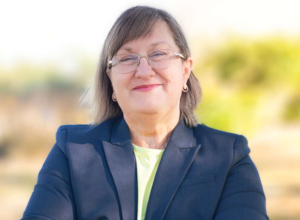
Beth Mayberry
Beth Mayberry: Kids need to be able to see themselves and their daily lives and the daily lives of others in their reading. Whether you’re talking about television or streaming services or whatever, kids are going to be more interested in things that reflect the things they can relate to. In addition to that, they need to be able to relate to other people.
GC: Currently, anyone can bring a complaint about a book. According to the American Library Association, nearly 92% of censorship attempts in 2025 were initiated by pressure groups and decision makers swayed by them. Both Manatee and Sarasota County cancelled their ALA memberships in 2023.
But parents should have status here, Mayberry said.
BM: Parents have every right to say that their child can’t take that book out. Every parent can restrict their children’s access, if that’s what that parent wants to do. That takes effort on the part of the parent versus restricting the access of everybody. We have gotten away from that point where parents are supposed to monitor what their children are doing, and we are instead keeping whole groups of children from reading things that their parents might be happy for them to access because one or two people in the community don’t want their children to access it.
GC: So far, the challenges have been few in Sarasota, Stephana Ferrell of Florida Freedom to Read said. Her small group has become a data hub for what is happening with book bans statewide.
Sarasota has an unusual process, Ferrell said. A form goes home with every child that a parent or guardian must sign authorizing access to the school library. Last year, 7.3% of Sarasota district children were denied school library access by their own parent or guardian.
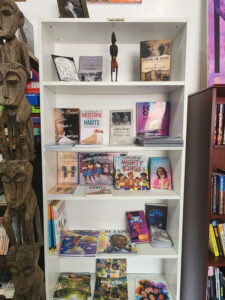
Books on display at Café Resistance
But the Department of Education’s seven-page memo to superintendents made it clear that the superintendents have the ultimate responsibility to screen books—not parents and not teachers.
The school board’s job is to oversee the superintendent. But Mayberry said the state is trying to flex muscle it does not have. She suggests the state cannot issue lists of books for banning and make-up protocols, nor can it apply them to teachers’ personal books in their classrooms.
Mayberry said while teachers may object to examination of their personal books in their classrooms, most—like she did—just take them home so they can tend to the business of teaching.
BM: My understanding is we’ve had a couple of books that were challenged. They did not get banned. We haven’t actually banned any books. They are still on the library shelves. But, as a teacher, I can absolutely tell you that most teachers—certainly in middle school—got rid of their classroom libraries. You had a period of time where libraries were basically shuttered while those certified specialists were going through and making sure that every book was recorded. Most teachers did not go through that effort of having their classroom libraries researched. I brought my books home. That was it.
GC: Mayberry will join others on a panel called “Let Books Be—Protect the Freedom to Read.” That’s Saturday, October 10 at the Church of the Trinity MCC. More information here.
For WSLR, this is Gretchen Cochran.
Banned Book Weeks 2026 starts Sunday Oct. 4. For more information, go to https://bannedbooksweek.org/
WSLR News aims to keep the local community informed with our 1/2 hour local news show, quarterly newspaper and social media feeds. The local news broadcast airs on Tuesdays and Thursdays at 6pm.
 It's drive week!
Your gift keeps 96.5 on the air. Be one of the people who make it happen.
Donate Now
It's drive week!
Your gift keeps 96.5 on the air. Be one of the people who make it happen.
Donate Now