Two weeks before the gubernatorial election, the New College president lets the potential first lady explain the need for school privatization.
By Rhatia Murphy
Original Air Date: October 15, 2026
Host: At a New College of Florida event this week, a discussion of education kept circling back to one word: “competition.” But the two people on stage—Erika Donalds and Richard Corcoran—had a long political history together, and the conversation took place just weeks before voters choose Florida’s next governor, one of them being Erika Donalds’ husband. Rhatia Murphy reports.
Rhatia Murphy: The event, titled “What Happened to American Education?,” featured New College President Richard Corcoran interviewing Erika Donalds, the education activist and entrepreneur who happens to be the wife of Republican gubernatorial nominee Byron Donalds.
Corcoran opened by explaining how their families became friends.
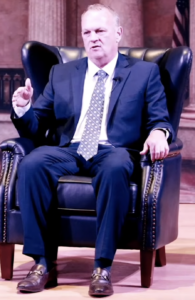
Richard Corcoran
Richard Corcoran: We’ve known each other a very long time. Anne and I—my wife—and Byron and Erika are friends. How we became friends is we both started classical schools—the first two classical schools in the entire state.
RM: Corcoran also recalled appointing Donalds to Florida’s Constitution Revision Commission when he was speaker of the Florida House. Donalds said that appointment helped launch her work on school-choice policy.
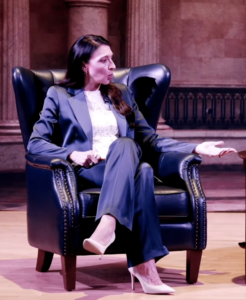
Erika Donalds
Erika Donalds: I really owe Richard for appointing me to this prestigious position.
RM: That personal history sat alongside a strong political argument. Donalds and Corcoran described public education as ideologically unbalanced and resistant to change. They criticized what they view as progressive influence in schools and universities, including how diversity, equity and inclusion are taught.
Corcoran said those subjects belong in education but should not be taught as unquestionable beliefs.
RC: All of those things can be taught—they’re all a part of history—but they need to be taught and not indoctrinated into what you should believe as a fact or as a truth. There is a real truth.
[Applause]
RM: They also returned repeatedly to competition as their proposed remedy. Donalds said that was her conclusion after serving on the Collier County School Board.
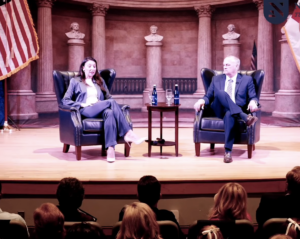 ED: My conclusion at the end of the school board was that competition is the only thing that is going to reform this system. It’s not going to reform itself.
RM: One example she offered was Success Academy, a New York charter-school network planning to open schools in Florida. Donalds said Florida’s Schools of Hope program helped attract the network.
ED: Yay, Florida. We win. They’re coming to Florida, and they’re opening schools starting in Miami. And they’ve taken advantage of Schools of Hope—which started under you? You started that, right?
RM: Indeed, as a state lawmaker Richard Corcoran was the sponsor of the original “Schools of Hope” law, which passed in 2017. The idea is that low-income families should have alternatives, too, and that district schools will improve when they face competition. But the argument also raises a question about public resources: Schools of Hope provides “underused” space in public school buildings to private school operators. Should public money and access to public facilities go to expanding those alternatives, particularly charter schools managed by for-profit businesses?
Florida funds charter schools through its school-finance formula. The state also supports private-school scholarships with public money. In Sarasota County, district documents projected about $45 dollars in taxpayer-funded scholarships for private- and home-schooled students in the 2025-26 school year. And recent changes to Florida’s Schools of Hope law expanded the ability of some charter operators to use space in public school buildings.
The money does not all move through the same program. But together, these policies are changing how public education dollars and public school space are distributed. Supporters say families should be able to choose a school that works for their child. Critics say the expansion will put more financial pressure on district schools and students who most need resources.
Erika Donalds, for that matter, is not just the founder of a foundation promoting school privatization and of four publicly funded charter schools in Florida. She is also a founder of, and investor in, for-profit education businesses. Investigative reports by CBS News and Florida Bulldog show that her schools spent roughly 30% of their government funding on outside companies with ties to Erika Donalds. The argument: The schools got a “good deal”.
The profit motive did not come up during the New College event. But the election context did come into the room during audience questions. One attendee asked Donalds about her role if her husband becomes governor.
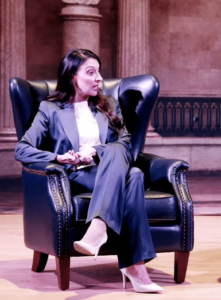 Audience member: As our future First Lady, will you and our future governor try to get our school board elections to be partisan rather than nonpartisan?
[Applause]
ED: Let me tell you something about that. It’s in the constitution that they are nonpartisan, and we now have a 60% threshold to change that. As much as I might agree with you and would like to see it partisan, I don’t think it will ever get 60%.
RM: For WSLR News, I’m Rhatia Murphy.
WSLR News aims to keep the local community informed with our 1/2 hour local news show, quarterly newspaper and social media feeds. The local news broadcast airs on Tuesdays and Thursdays at 6pm.
 It's drive week!
Your gift keeps 96.5 on the air. Be one of the people who make it happen.
Donate Now
It's drive week!
Your gift keeps 96.5 on the air. Be one of the people who make it happen.
Donate Now