The former Sarasota city commissioner and mayor is one of five Democrats running in the August primary.
By Noah Bookstein
Original Air Date: July 10, 2026
Kelly Kirschner is one of five Democrats running in the August primary in District 16. That’s the congressional district just redrawn by the governor and Florida legislature that now includes Manatee, DeSoto and Hardee and parts of Sarasota, Pinellas and Polk counties. Kirschner is a former city commissioner and mayor of Sarasota, and son of a former mayor, who took on FPL and a high-profile restaurant operator during his tenure on the city commission. WSLR News reporter Noah Bookstein sat down with Kirschner for an extended interview.
Noah Bookstein: Kelly Kirschner has been out of elected office for the past 13 years. He left Sarasota City Hall in 2011, going on to help start and run an immigrant integration nonprofit called Unidos Now, and spent over a decade as a dean at Eckerd College in St. Petersburg. Kirschner says the country is facing an inflection point, and this is his moment to re-enter politics.
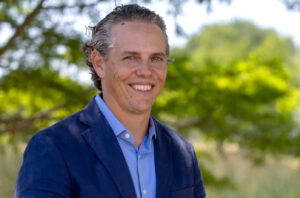
Kelly Kirschner | provided photo
Kelly Kirschner: I’ll be an empty nester in another year. That’s certainly part of it. And I’ve seen 16 years of a steady erosion in national discourse. When I was commissioner and mayor, we passed the most comprehensive campaign finance reform of any municipality in the state of Florida. About two years later, Citizens United passed, and even though 83% of the electorate of Sarasota said “Yes, we want money out of politics. We want to have better conversations”, it was completely overturned by our Supreme Court, which to me is insane. How is that a democracy?
You can see, from local to state to federal, a constant erosion in our politics. It is now literally this metaphor of the vending machine. You put the adequate amount of money in, you’re going to get the policy—you’re going to get the transactional return on investment. The Democratic Party and Republican Party, in many ways, reflecting those same moneyed interests—for me, it’s an inflection point on the future of this country. The stat was, two weeks ago, the top 1% of this country hold as much wealth as 90% of this country. The middle can no longer hold; it’s falling apart. Do we try to take this republic back?
NB: Kirschner is a third-generation Floridian whose family ran a citrus business in Manatee County, near the Sarasota-Bradenton Airport. He grew up around there and then attended Georgetown University.
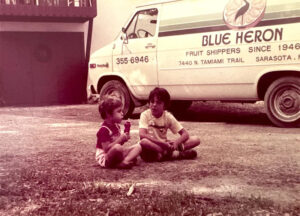
Young Kelly and playmate. | Provided photo
KK: My parents had a business in Manatee County right along the North Trail, and that was back in the day before citrus greening and canker. The two of those have destroyed the citrus industry, as coupled with rampant overdevelopment in the state of Florida.
NB: After Georgetown, Kirschner joined the Peace Corps, spending nearly four years in a rural Guatemalan community working with municipal government. One of his projects was to organize child shoeshine workers into a union and then use it to get them into school for the first time.
Kirschner is a Democrat and former Bernie Sanders delegate running in a district spanning urban and rural counties, redrawn this spring by Florida Republicans to benefit their party at Donald Trump’s request. Trump won the district by roughly 14 points in 2024. But despite the gerrymandering — or because of it — this district is now one of the most competitive in the state, with the Democratic Congressional Campaign Committee considering it to be a district in play.
KK: I’m frankly excited about this district. For me, selfishly, I feel like a rabbit in a briar patch. It reflects my entire lifetime of my family that grew up in the citrus business. This rural area—places like DeSoto County—reflects my life of Sarasota and Manatee County, where my grandfather came to Manatee County in the early 1950s and my dad grew up and the families that I’ve known throughout my entire lifetime in both Sarasota and Manatee, and then the past 14 years of living and working in St. Petersburg and really piecing all these things together and talking about, “What is this nexus of our lived experience and the challenges that we have in this six-county region with the federal government and how the federal government is not working for us?”
NB: Kirschner’s path into politics started with a neighborhood dispute. After returning to Sarasota in the mid-2000s, he got involved in a years-long fight over Payne Park—land the city had promised to develop as a public green space decades earlier but repeatedly failed to fund. Local activism over the park, and frustration with the city commission ended up pushing him toward his first campaign.
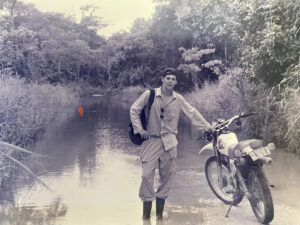
Kelly Kirschner in Guatemala | provided photo
KK: Somebody said, “Kelly, you should run for office.” I hadn’t contemplated running for office, but perhaps some of that experience in Guatemala—particularly, working for a mayor in a municipality and responding to the needs of 200 villages in that municipality—animated me. It was the excitement of being a Peace Corps volunteer. I ran for office against an incumbent who was incredibly well funded, particularly by the development community. He raised three times more than the amount of money that I raised. Long story short, we won with 75% of the vote.
NB: On issues affecting District 16, Kirschner points to the rising cost of property insurance.
KK: We talked about the 78% increase in property insurance here in Florida over the past three years. We need a national catastrophic natural reinsurance fund that is a backstop that then can provide greater stability to property insurance markets throughout this country and hopefully insulate all of these communities—not just the state of Florida but wherever they are—provide greater insulation that does not have these price shocks constantly that that we’re seeing. Also, there’s a lot of state issues with how that is regulated and how extreme profits in years when there’s not storms get to be taken out, and that needs to have regulation, and those monies need to be put back into the system or brought back to ratepayers.
NB: On immigration, an issue he’s worked on for years through Unidos Now, Kirschner argues the district built its economy on immigrant labor, and then politicians like Rick Scott and Donald Trump made that same population a political target.
KK: Every single construction site was 90%-plus Spanish language being spoken. Then you saw in the census data from 1990 through 2010—when I was mayor of the City of Sarasota—the population in Manatee and Sarasota County of our Hispanic population grew by 350%. We had this region that was incredibly complicit and welcoming of this immigrant community to build and be part of that explosive growth that we saw. No one said a word about it. No one said, “Oh, this is crazy” or “We’re bringing in criminals” or anything. Absolutely not.
The nonpartisan Congressional Budget Office right now says, to ensure the vibrancy of our economy—to ensure the solvency of Medicare and Social Security—we have to have, I think, 1.2 to 1.5 million new immigrants per year. Simultaneous to that, you have many members of Congress and the White House celebrating that we have now net negative migration this last year out of the country. It’s this level of insanity of cutting our nose off to spite our face. Right now, this undocumented immigrant population—that, by the way, by virtue of being undocumented, will never have, as law exists now, a claim to Social Security benefits—that population alone is putting an estimated $20 billion-plus a year into Social Security solvency. And what are we doing? We’re saying, “Yeah, get rid of them.”
Most every other Western democracy has figured out in the 21st century, “What does a modern immigration system look like that doesn’t have the demagoguery, the cheap populism? How do you have temporary work visa solutions? How do you recognize where there are needs to bring people in so that you have a vibrant agricultural system?”
NB: Kirschner argues enforcement efforts have been aimed at the wrong people.
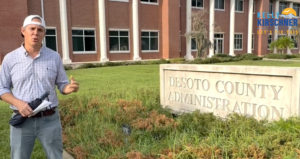
Kelly Kirschner in Arcadia, commenting on data center projects. | Video screenshot
KK: We’re spending, this year, $80 billion on ICE. You could save us $80 billion right now by saying, “We will have a national system that any employer who is caught having undocumented labor on that site”—and I’m not talking about subcontractors. Let’s go to the top—to the master developers who like to have this shield of ignorance, like, “Oh, I didn’t know that there were so many undocumented immigrants that were building these massive planned communities that we see throughout this region.” There needs to be accountability that goes to the top.
NB: And, on the proposed data center in DeSoto County that could become one of the largest facilities of its kind in the world, Kirschner says there’s no federal framework guiding these decisions.
KK: There is a really eloquent Arcadia resident that got up and spoke, and she said to their county commission, “You are putting us in a boxing ring with King Kong, and you’re not even giving us boxing gloves.” We have no federal response guidance for rural communities like that, and they’re trying to mediate these conversations locally with no support at all. What was fascinating in DeSoto County is all of these residents that basically said, one after the other, “We will take silence in our communities. Please say ‘no’ and get this out of here.” There wasn’t one person in DeSoto County that spoke in favor of the data center two weeks ago when I was there. Again, fascinating that these are even getting the traction that they do.
NB: Kirschner connects the region’s delayed disaster recovery funding directly to foreign policy, arguing Washington’s spending priorities are backwards.
KK: I think FEMA should be an incredibly nonpartisan issue. For me, it’s the height of insanity of wars of choice—that we’re approaching $100 billion if not greater right now in Iran—and it looks like our MOU of a peace agreement is falling apart, but that peace agreement included hundreds of billions of dollars to allocate towards the rebuilding of Iran that we did, and yet we have communities here that have yet to be reimbursed for all of the expenses associated following Helene and Milton. Similarly, in Pinellas County, those types of things that still have not come. It is called the Federal Emergency. Management Agency for a reason. We should have, at a core—at a very minimum—you talk about a base of a pyramid. A country with the wealth that we have should have guaranteed funding for FEMA that gets our communities back before we have any conversation about any country in this world.
NB: He draws a similar line to U.S. policy in Cuba.
KK: We have a policy in this country: “Let’s make Cubans suffer more than they’re already suffering under their regime, and if they suffer more, somehow this regime will collapse.” My first child was in a NICU for his first six months of life. Some of the stories that I’m hearing from friends in Cuba right now are, because of their own fuel shortages, generators are not even running in hospitals there. They’re air bag breathing infants in Cuban hospitals. It’s horrific, and the U.S. is part of that. I don’t know that that really helps at all. In similar ways, that bombing Iran is necessarily helping dissidents and Iran somehow rise up and overturn these governments. They’re in many ways inimical to the goals that we profess.
NB: On accountability, Kirshner points to the district’s current representative:
KK: Vern Buchanan—my understanding is he hasn’t had a town hall in over 10 years. My conversation with constituents is, “How do you build that big tent on accountability for all of them?” I think if you want more of the same empty vessels that will just vote with a uniparty vote and represent those corporate interests, it’s probably a smart move to go with the Trump-endorsed candidate. If you want somebody who’s accountable that will go to all six counties and sit, hopefully, with an attentive ear to understand what those issues are and actively engage and represent those and then come back and iterate and talk to the community, regardless of your political affiliation, I’m going to be your candidate that will do that.
NB: For WSLR News, Noah Bookstein.
WSLR News aims to keep the local community informed with our 1/2 hour local news show, quarterly newspaper and social media feeds. The local news broadcast airs on Wednesdays and Fridays at 6pm.