But the DOGE Liaison Committee also tries to explain it with expanded responsibilities.
By Ifhmalee Caceuis
Original Air Date: August 5, 2026
Host: A year after Florida’s Department of Government Efficiency audited Manatee County’s spending and rendered a blistering critique, Manatee County’s own efficiency committee added some perspective last week. It put the spotlight on one particular county department. WSLR’s Ifhmalee Caceuis reports.
Ifhmalee Caceuis: Last week, Manatee County’s Government Efficiency Liaison Committee presented its final report to the Manatee County Commission. This came after crunching county spending numbers from 2022 through 2025, along with population, inflation and departmental budget data.
The county commission created the committee in July 2025 in response to the state’s DOGE audit. State officials argued that Manatee County’s budget had grown faster than the county’s population, raising questions about whether taxpayer dollars were being spent efficiently.
The county’s committee took a closer look.
Rather than relying solely on broad budget totals, the committee compared spending across departments with changes in both population and inflation. The Manatee County population grew by about 3% every year between 2022 and 2025, while inflation averaged about 4%. Combined, the committee established that budgets should have grown by a little more than 7%, reflecting the costs of serving a growing community while keeping pace with rising prices.
The committee’s bottom line: Manatee County’s overall spending growth was largely in line with those economic pressures.
But there were three outliers: Utilities, Public Safety and the Manatee County Sheriff’s Office. Some context: Utilities operates as an enterprise fund. This means it is largely supported through customer fees rather than general property tax revenue.
Meanwhile, Public Safety expenditures were shaped by the responses to major disasters: Hurricanes Ian and Milton.
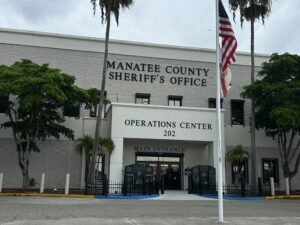
The Manatee County Sheriff’s Office building | Photo: Ifhmalee Caceuis
That leaves the Sheriff’s Office, which accounted for one of the largest increases in county spending.
But rather than characterizing that growth as wasteful, the committee also explained law enforcement’s expanding responsibilities. According to the report, the county added four judges during the period, each requiring eight deputies. The committee also cited the addition of more than 90 school crossing guards to serve a growing student population. Then, there are increased patrol responsibilities resulting from new road construction and development. And finally, there are expanded requests for contracted law enforcement services from churches, synagogues, mosques, homeowners associations and other organizations as well as hurricane response costs.
Committee members concluded that if Public Safety and the Sheriff’s Office were excluded from the analysis, overall county expenditure growth would have been about 8%—close to the committee’s benchmark of 7%.
The committee also issued recommendations aimed at improving efficiency. One would be to study joint purchasing agreements with municipal governments. Another one: Creating a centralized database to better track interlocal agreements between governments. Then, there’s better oversight of capital improvement projects. Next: More transparency surrounding the use of tourism taxes. And finally, providing commissioners with more detailed information on nearly $1 billion in county reserve funds.
During the discussion of those recommendations, Commissioner Jason Bearden zeroed in on the county’s Tourist Development Tax:

Jason Bearden
Jason Bearden: These are funds that we could have been using in the last few years, but I had nobody coming up and advising me on these opportunities. I am appalled that our director of the TDC did not let us know about these.
IC: Commissioner Tal Siddique focused on the committee’s recommendations regarding county reserves and whether reserve requirements should be adjusted based on the needs of different departments.
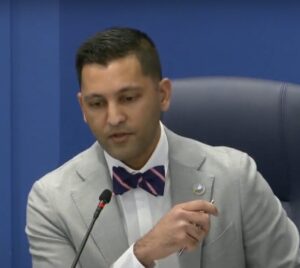
Tal Siddique.
Tal Siddique: Do we need a reserve account for the sheriff’s budget? Do we need a reserve account for beach erosion? Maybe. Maybe not. Or does it all need to be inversely 20%? I will say, each reserve account is different, and not every reserve is drawn from the reserves in a storm. Public Safety, 100%. We have to take loans out for that. But parks? Maybe it could be 10%.
IC: The committee also added one final footnote: understanding the county’s budget requires more than looking at total spending, it said. Only about 34% of Manatee County’s revenues comes from property taxes, which is unrestricted. All other revenues are legally restricted and cannot be used to pay unrelated county services. That includes grants, enterprise funds, voter-approved taxes or other dedicated revenue sources.
WSLR News has reached out to the Manatee County Sheriff’s Office, Commissioner George Kruse, Commissioner Bob McCann and Florida DOGE for comment. Their responses were not available by airtime.
For WSLR News, this is Ifhmalee Caceuis.
WSLR News aims to keep the local community informed with our 1/2 hour local news show, quarterly newspaper and social media feeds. The local news broadcast airs on Wednesdays and Fridays at 6pm.
 It's drive week!
Your gift keeps 96.5 on the air. Be one of the people who make it happen.
Donate Now
It's drive week!
Your gift keeps 96.5 on the air. Be one of the people who make it happen.
Donate Now