Kayla Taylor heads a project that uses drones to keep track of outbreaks.
By Ramon Lopez
Original Air Date: Nov. 26, 2026
Host: Drones are the latest tool to keep track of algae blooms, thanks to a rising engineer with roots in Sarasota. WSLR News reporter Ramon Lopez has a close look.
Ramon Lopez: Kayla Taylor is a Sarasota native who’s pursuing a PhD in Electrical Engineering and Computer Science at Embry-Riddle Aeronautical University in Daytona Beach.
But she’s not there learning to fly jetliners. Instead, the Riverview High grad is researching harmful algal blooms.
Her research team is developing drone-mounted systems that collect water and air samples during harmful algae growth events. This, to help communities better understand and combat the toxins produced.
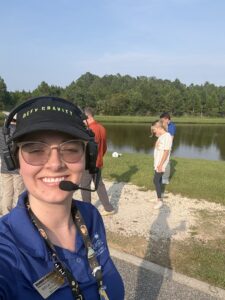
Kayla Taylor | Photo courtesy Taylor/Embry-Riddle
Kayla Taylor: We want to understand at a better level how algal blooms disperse, how they grow, how they change with time so that we can help communities.
RL: This is very personal to Kayla because she grew up watching the effects of red tide on Siesta Key and other local beaches.
KT: I was born and raised here in Sarasota, and we frequented Siesta Key throughout my lifetime. There was often some kind of red tide outbreak. Red tide is, of course, very well known in this area on the Gulf Coast because it kills wildlife—kills dolphins. You would go to the beach, and fish would wash up on shore. It would create all sorts of terrible smells—not only the smell that the algal bloom creates but the dead wildlife that washes up on shore. It really creates this environment of toxins that are itchy and scratchy when you breathe them in, so your eyes start to water and it feels like you need to sneeze the whole time you’re at the beach. I had a lot of personal stake in this research because I had grown up in that environment here in Sarasota, so I was delighted to be asked to join this harmful algal bloom project at Embry-Riddle.
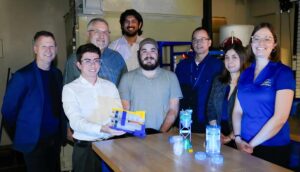
Researchers at Embry-Riddle, including Kayla Taylor (far right), who have begun developing water- and particle-sampling sensors for deployment on uncrewed aerial systems, or drones, to better detect blue-green algae on Lake Okeechobee | Photo courtesy Embry-Riddle
RL: While her research project does specifically cover red tide, the resulting collection system she’s developing has many applications.
Algal blooms, although naturally occurring, can be stimulated by environmental changes that release harmful toxins. They produce large floating toxic algae mats. They can pose significant economic and public health challenges across coastlines and rivers as they can irritate people and kill fish and other wildlife.
Nutrient runoff from agricultural sites, along with extreme weather events, has expanded the presence and negative impacts of these so-called Harmful Algal Blooms, or HABs.
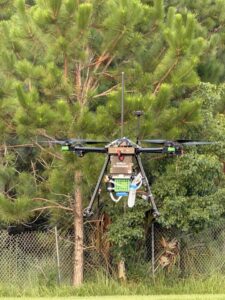
Photo courtesy Embry-Riddle
Freshwater Lake Okeechobee, for one, has suffered persistent HABs for decades. This, due to a specific species of blue-green algae, which produces a type of liver toxin.
KT: Toxins I am looking at with my team are liver toxins. You still don’t want to consume those or have them anywhere near you because it can cause a detriment to your liver. Red tide, on the other hand, creates neurotoxins, which are bad for your nervous system and your brain.
One of the concerns I’ve seen at Lake Okeechobee is the surrounding communities who live in that area have pets, and those pets can get into the water when there’s a bloom, and they lick it off of their fur or they drink the water—they play and splash in the water—and that can be dangerous to pets. So you wouldn’t want to swim in it, and you certainly wouldn’t want to eat anything that came from that water.
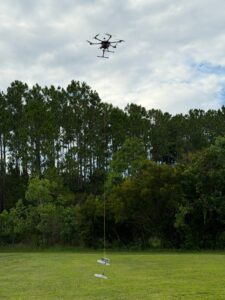
Photo courtesy Embry-Riddle
RL: Traditional harmful bloom sampling has been conducted by boats or from monitoring stations near a shoreline. But that’s labor-intensive, expensive and has safety risks. And satellite-based data collection is limited. That’s where unmanned air vehicles—in this application, quadcopters, four-rotor-bladed unmanned drones—come into play.
The university researchers, along with other HAB Project team members, are working under a $500,000, three-year Environmental Protection Agency (EPA) grant.
The goal? Develop drone-mounted payloads that can collect water and aerosol samples of the nasty stuff at the large Florida lake. At times, it has covered as much as 90% of the lake’s surface. Smelly stuff indeed. And it irritates the throat and lungs.
Their challenge? Increase flight time and range, as carrying liquids reduces drone missions.
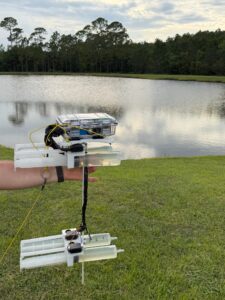
Photo courtesy Embry-Riddle
The ultimate goal is to develop and field an automated observation network and artificial intelligence model to help predict and minimize various toxic algae spread and other environmental threats. The pre-programmed drone would operate on its own without a flight controller on site.
KT: Ultimately, we hope that creating this autonomous sampling system and learning from the data we create will help mitigate the effects of blooms in the future but also such that we’ve created a faster, safer and farther-reaching way of exploring water quality.
RL: In a typical so-called field campaign, the team deploys instrument-laden drones to collect water and aerosol samples. Multiple flights would be conducted to get sufficient data.
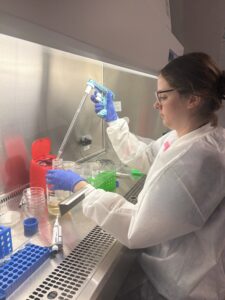
Photo courtesy Embry-Riddle
Taylor said her team conducted the first field campaign on the Saint Johns River back in August. This, because Lake Okeechobee did not experience a major bloom this past summer. The beta site test did not disappoint. She said the river’s condition was absolutely “disgusting.”
KT: The water was just brimming with green algae. The surface of the water was no longer blue; it was green. You could see the clumps of algae in the water—little colonies. It was truly disgusting, and the smell was not great, either.
RL: Kayla says the river test was successful—but not entirely.
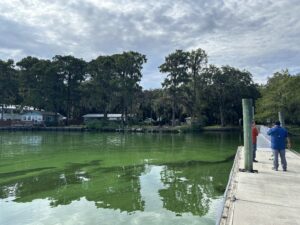
Algal bloom in the St. Johns River. | Photo courtesy of Embry-Riddle
KT: The water sampling has been extremely successful. We were able to detect fairly high levels of toxins in the water at St. Johns, so it shows that that sampling system works as intended. The aerosol sampling system needs more work.
RL: The research team looks forward to actual EPA grant fulfillment at Lake Okeechobee next summer.
Taylor believes the three-year EPA-funded research project that runs through 2028 won’t provide all the answers.
KT: It is very difficult to do scientific research without money. You then are expecting people to come out of pocket or ask their institution. We do foresee this being another grant that we can apply for funding for. Whether or not that’s from the EPA, we don’t yet know. But I would hope to continue this level of research past June 2028. I think strongly that it would be of great social and environmental importance to continue it after three years.
RL: This is Ramon Lopez for WSLR News.
WSLR News aims to keep the local community informed with our 1/2 hour local news show, quarterly newspaper and social media feeds. The local news broadcast airs on Tuesdays and Thursdays at 6pm.
 It's drive week!
Your gift keeps 96.5 on the air. Be one of the people who make it happen.
Donate Now