Archaeologists and illustrators team up to produce a comic on a community of runaway slaves and natives.
By Rhatia Murphy
Original Air Date: Nov. 19, 2026
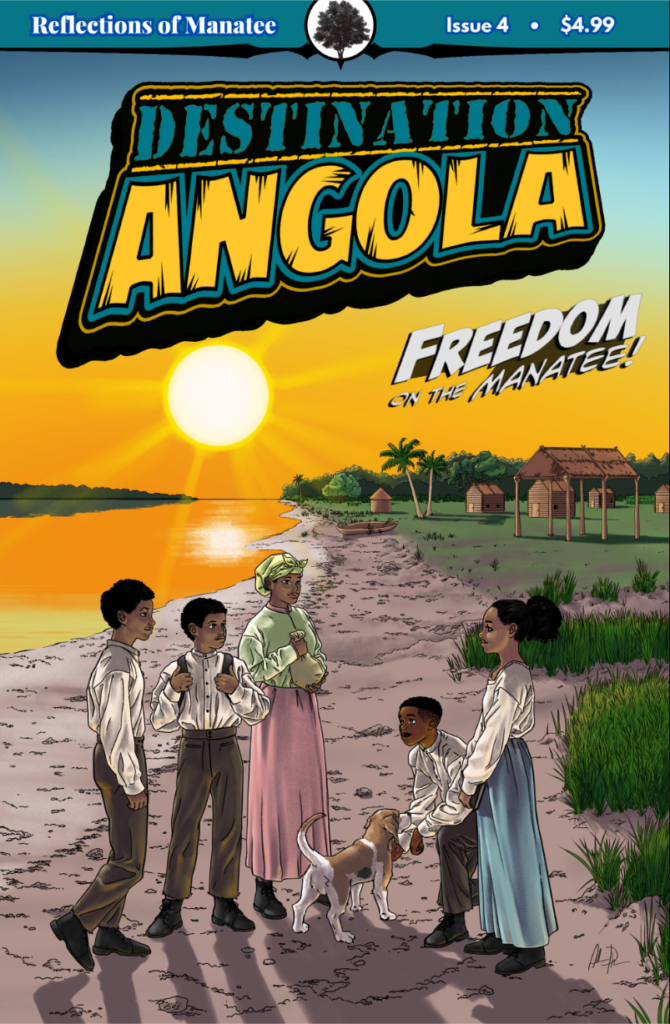
Cover of issue 4 of Destination Angola
Host: Angola is a nation in Africa. It’s also the name of a 200-year old settlement of runaway slaves, Black Seminoles and Native Americans on the shores of the Manatee River. Now, archaeologists and illustrators have teamed up on a comic series about the Angola Underground Railroad Network to Freedom site. Rhatia Murphy brings you the details.
Rhatia Murphy: This Saturday in Bradenton, you can visit the place where archaeologists found evidence of a community called Angola. You can also open a comic book and see what that place might have looked like to a kid who lived there two hundred years ago.
The comic book series is called Destination Angola. I asked Dr. Jean Louise Lammie, executive director of Reflections of Manatee, to open one of the six books and walk me through it. She picked issue four. It takes place right here on the Manatee River.
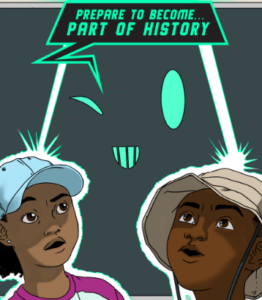
The computer, “T.R.A.M”, prepares main characters Kacee and Felipe for an impromptu trip back in time.
Two kids are visiting their parents at an archaeological dig. When the grown-ups turn their attention elsewhere, the kids get their hands on a computer in the lab. Next thing they know, they’re still on the Manatee River—but the dig is gone. The people who lived here two hundred years ago are right in front of them.
The kids meet some children. They meet a dog named Patch. For a little while, these two strangers from the future get to hang around Angola without anybody asking where they came from. Then Jean gets to this panel.
Jean Lammie: There’s an adult wondering, “Who are these strange kids who just appeared out of nowhere?” Someone finally thought to ask. And they’re like, “Oh, we’ve, we’ve been traveling and running, too.”
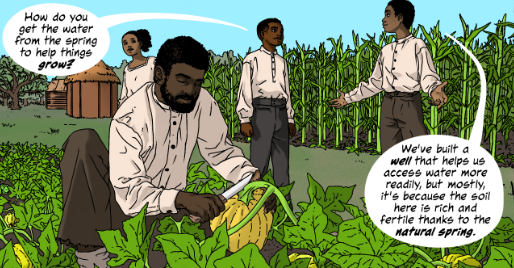
Sam, the kids’ guide to the past, explains agricultural practices.
RM: That answer makes sense to the people they’ve just met. Angola was a Black settlement in what is now Bradenton. People who had escaped slavery settled here, near a freshwater spring. They built homes, grew food and traded along the river.
The kids spend enough time there to see something their parents will recognize. It’s a well. On the last page, the children get home and find the archaeologists have just uncovered it. The artist drew that well from the one excavators actually found. The parents know what it looks like after two centuries in the ground. Their kids have just seen people using it.
And that dog, Patch? Jean says he came from the dig, too.
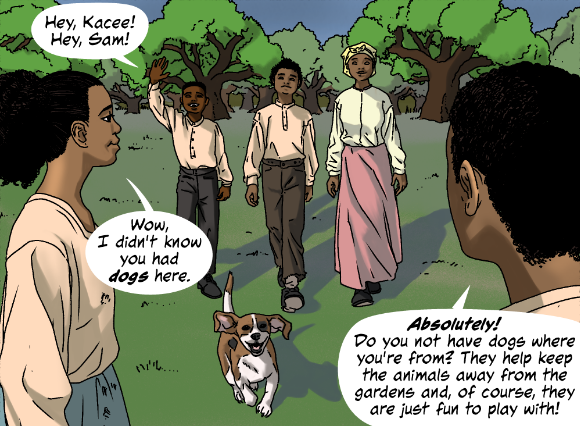
Kacee meets Patch the dog
JL: We actually found the skeleton of a pet burial. It had little pieces of a wooden box it had been buried in, and it was in those deep Angola layers.
RM: Somebody who lived there had taken the trouble to bury a dog in a box. That’s the kind of detail the team wanted a young reader to remember.
Sherry Robinson Svekis is president of the board at Reflections of Manatee. She says the museum had already published a history of people who traveled south to freedom. It reached the kind of reader who already visits a museum. Then one day Jean walked into Bat City Comics, the Bradenton shop where her husband and daughter liked to spend time. Sherry remembers what happened next.
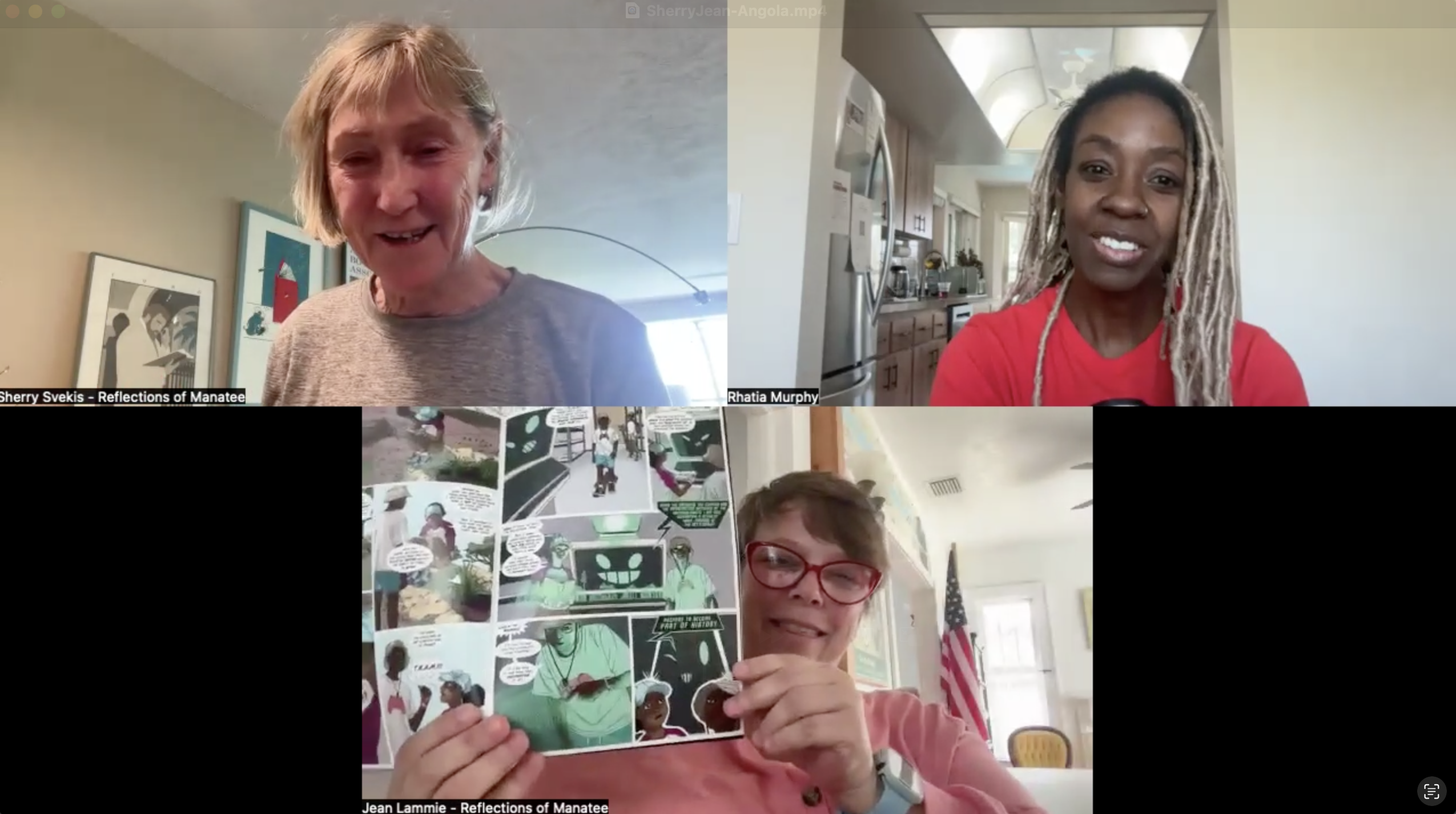
Manatee Reflections president Sherry Robinson Svekis (top left), Dr. Jean Louise Lammie (bottom) and WSLR reporter Rhatia Murphy (top right).
Sherry Svekis: She was looking around at some of their graphic novels, and she brought one back to the museum where I was, and she said, “Sherry, this is how we reach new audiences.”
RM: The museum brought the research. Students at Ringling College of Art and Design helped draw the books. And Shannon Live, the writer at Bat City, had to figure out what one person on the page would actually say to another.
She told me about a couple in one of the books. They’ve escaped slavery and found a place to settle. Over the course of the issue, they build a home and get to know their neighbors. By the time the wife is about to give birth, the reader has spent most of those pages with this family. Listen to what Shannon does with the words they exchange while the father waits for the baby.
Shannon Live: …that emotion in there, and the way we balanced it is the dialogue that I wrote into the scene—when the father, who is waiting for his baby to be born, the dialogue that him and his wife say to each other is the same dialogue he repeats when he’s trying to find her under the rubble of the attack.
RM: In 1821, bounty hunters in search of slaves destroyed Angola. Some of the people who got away made it to the Bahamas. Their children grew up there. And generations later, in one Bahamian family, the elders were still talking about Florida.
Daphney Towns: Growing up in the Bahamas, we knew that our ancestors came from Florida but not exactly where in Florida.
RM: That’s Daphney Towns. She moved to Florida in 1992. Years later, she came across a historical marker in Bradenton. It mentioned Andros Island in the Bahamas. That was her mother’s birthplace. In 2018, Towns started the Back to Angola Festival and helped bring families from the Bahamas to the site. I asked her what she’d want a kid picking up these books to know about the people who once lived here.
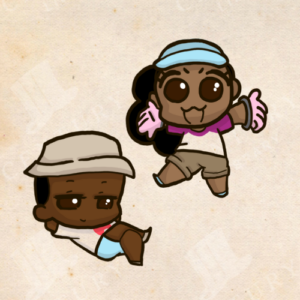
The graphic novel ends with one last doodle of Felipe and Kacee.
DT: I would want them to know that there are still descendants alive of this and that the ancestors that once lived here were persons that were driven out of a community that they thought they were safe in, and they fled to the Bahamas for refuge because Bahamas was still a British territory, and they knew once they got there that it was safe. And now, many descendants come back every year to the place where our ancestors once called home.
RM: You can preview Destination Angola and tour the Archaeology of Angola exhibit this Saturday, November 21, from 4:00 PM to 6:00 PM at the Reflections of Manatee Visitor Center. That’s 1305 4th Avenue East in Bradenton. The open house is free, and you can just drop in. You can find the comics are at the museum and at Bat City.
For WSLR News, I’m Rhatia Murphy.
WSLR News aims to keep the local community informed with our 1/2 hour local news show, quarterly newspaper and social media feeds. The local news broadcast airs on Tuesdays and Thursdays at 6pm.
 It's drive week!
Your gift keeps 96.5 on the air. Be one of the people who make it happen.
Donate Now