An observer who will speak in Sarasota this Friday weighs in.
By Johannes Werner
Original Air Date: Nov. 10, 2026
Host: Let’s start with a reminder: Havana is almost exactly the same distance from Sarasota as Tallahassee. History has taught us that whatever happens in Cuba makes big ripples here. This Friday, the Sarasota World Affairs Council will host a speaker who will give us an update on what’s happening across the Florida Strait.
Johannes Werner: Ted Henken is approaching Cuba from a variety of angles, which makes his perspective quite broad. He is a professor of anthropology and sociology at Baruch College in New York. He is also a past president of the Association for the Study of the Cuban Economy. Henken has closely followed the re-emergence of the private sector in Cuba and published a book about small business. He has studied the impact of the Internet on life in the island, and he has been in close touch with Cuba’s independent journalists.
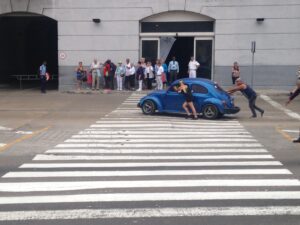
The oil blockade has produced fuel shortages and extended blackouts in the island. | Photo: Werner
As a byproduct of the latter, he is in the process of publishing a book about the decades-long struggle to re-establish a free press in Cuba.
That relationship has not made it easier for Henken to go back and forth. Eight years ago, the Cuban government put his persona on the non grata list, and he has not been to the island since 2018.
But that has not stopped him from doing research with small business owners and independent journalists.

Ted Henken
Ted Henken: Because I have many irons in the fire—many projects—and because of two things—digital technology, the digital revolution—but also because so many of my Cuban contacts have left Cuba—I’ve been able to continue—really deeply plugged into—all things Cuban, without going to Cuba.
JW: For more than six decades, the United States has not only blocked Cuba from doing direct business, but it has also interfered in Cuba’s trade and financial relationships with third countries.
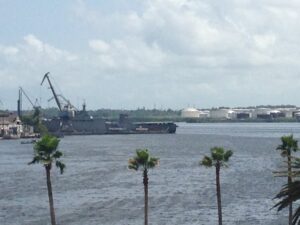
An aging, once U.S.-owned refinery and its storage tanks sit on the southern shore of Havana Bay. Cuba has limited onshore oil production, but most of its energy needs are covered by imported oil. | Photo: Werner
In January, the Trump administration took that to a new level by blockading oil shipments, including from Venezuela, Mexico and Russia. And that is producing not only fuel shortages but extended blackouts that affect everyone.
TH: Everyone that I have relationships with and talk to in Cuba is suffering from that. The energy blockade is a tool that is very blunt and that does not surgically target the government or government enterprises. It hits everybody, and it hits the poorest people—the most vulnerable people—more than anyone else.
JW: It also affects Cuba’s expanding private business sector.
TH: In some ways, it’s doing better than ever, but in other ways, because the general economy is so horrible, it has very little space to work in and very little [cash] flow to take advantage of.
JW: The Cuban economy right now is in the worst shape ever. Henken not only faults U.S. sanctions, but two internal factors as well.
TH: On the one hand, the government of Cuba refuses to reform its command-and-control state socialism structure, because it’s afraid of losing control of the economy and other people gaining power and control through economic prosperity. But that has the result of socializing poverty. Then, at the same time, the other trend is that there has been a gradual takeover of the few profitable parts of the Cuban economy—by the military, by GAESA—that siphons off—privatizes—things that are potentially profitable.
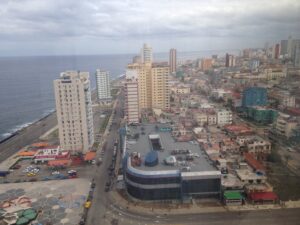
Havna’s Malecón boulevard. | Photo: Werner
JW: Is the Cuban political system on its last leg? Henken is not so sure.
TH: We have the expectation that there is a “poof” moment or a beginning of transition, but countries can just continue to get worse and worse without any turning point or bottom, and the Cuban government has become an expert at weathering the storm—at out-waiting the Americans, waiting for either a change of heart, a change of the political dynamic or a change of party in control. I think that, if you did odds, I would say the odds were very high for the first half of the year that this was the endgame. But, then again, since the summer until now, the odds went way down, and the odds of the regime surviving one way or another have increased.
JW: Henken believes that regular Cubans in the island were receptive even to the idea of a military intervention—which Trump has floated repeatedly. But Henken believes that moment has passed.
TH: The Trump-Rubio brand has eroded. There was a time in late spring when a lot of Cubans that I talked to, both in exile and in Cuba, were hopeful that, finally, something would happen, even if it was through a difficult, arduous, excruciating thing. But they very quickly lost patience and said, “Well, if you’re going to invade us, you should have done it a month ago. The moment has passed. This pain is just neverending.” But, then, I think that, ever since the summer, every day that something didn’t happen—every day, more of suffering in Cuba—every day, more of Iran not being solved or won—and every day that Trump’s political capital evaporated.
And then there were also lots of credible reports that Trump would do in Cuba what he has tried to do in Venezuela which is essentially turn Cuba into some kind of extractive cash cow and turn the page back to gunboat and dollar diplomacy—taking over a country administratively to extract wealth with very little concern for the purported ideals of democracy or human rights or freedom of speech. That’s no surprise with Trump, but there’s a dawning realization among many Cuban-Americans that they’ve been on the wrong horse. And that horse just came in last in the midterms.
JW: Meanwhile, Cubans keep voting with their feet, and that will probably be the biggest effect on us here in Southwest Florida. Henken says Cuban migration right now—most of it to Florida, despite the Trump administration’s best efforts to scare migrants away—is “an exodus of biblical proportions.”
TH: Almost every young person who had started a project that I know of in Cuba has left. So they’ve hemorrhaged much of their human capital and their population. It’s an aging population. Demographically, it is in a very, very bad position.
JW: Preliminary numbers show a dramatic population decline in the island.
TH: Then, if you look in the last five years, that’s when we’re talking the biblical exodus of more than a million people, and estimates have it even beyond that. Cuba is approaching a population that it had in the mid-’60s. Going from 7 million to 11 million and now back to anywhere from 7 to 9 million, projected in the next 10 years. It is this huge structural dilemma that Cuba faces. And, in some ways, it’s not just Cuba’s problem because a big portion of Cuba now lives outside of Cuba in various countries, especially in South Florida.
JW: Ted Henken will speak about Cuba this Friday, 6:30 p.m. at Sainer Hall on the campus of New College of Florida. The event is free, but the Sarasota World Affairs Council strongly suggests RSVPs by emailing to info@sarasotawac.org.
Reporting for WSLR News, Johannes Werner.
WSLR News aims to keep the local community informed with our 1/2 hour local news show, quarterly newspaper and social media feeds. The local news broadcast airs on Tuesdays and Thursdays at 6pm.
 It's drive week!
Your gift keeps 96.5 on the air. Be one of the people who make it happen.
Donate Now