Food prices remain sky-high. Families’ and seniors’ income isn’t budging.
By Nic Steinig
Original Air Date: Nov. 26, 2026
Host: That old rule says, “All that goes up must eventually come down.” But that doesn’t seem to apply to grocery prices. Despite store-bought grocery prices around Tampa Bay staying generally stable this year, with comparatively less inflation locally than nationwide, those high prices never actually fell from their peaks. In part two of our series on soaring cost of living, Nic Steinig has a close look at food prices.
Nic Steinig: While high grocery prices are sticking, many local families and seniors are struggling to navigate this year’s economic challenges and put food on the table. U.S. legislators also made large cuts to federal food assistance programs as part of the One Big Beautiful Bill Act, further complicating the food affordability crisis for locals in need.

Photo courtesy of All Faiths Food Bank
On the day before Thanksgiving, WSLR spoke to 86-year-old retiree Dee as she sat with her dog in a line of cars while waiting to receive a Thanksgiving box at an All Faiths Food Bank distribution. She shared why she was there.
Dee: I come here because I’m 86. I’m retired. I live on Social Security. It doesn’t go up, but my bills do. I don’t know what we would do without this.
NS: According to the Bureau of Labor Statistics, Tampa Bay grocery prices—which are the government department’s nearest regional measurement—have risen over 20% since 2021. All Faiths Food Bank, which serves Sarasota and DeSoto counties, reported about 25% more visits in 2025 than the year before. The nonprofit’s Communications Director Nina Harrelson told WSLR that the driving cause behind the surge is multi-faceted but pointed to the signing of the One Big Beautiful Bill Act in July of last year as a major factor.

Nina Harrelson
Nina Harrelson: An issue that neighbors in our area are facing right now is, number one, the SNAP benefits that decreased when the Big Beautiful Bill Act went into effect. 648,000 Floridians lost that SNAP assistance. That’s a 22% decrease across the state since that bill passed, which is the lowest in 15 years.
NS: The One Big Beautiful Bill Act, signed July 4, 2025, was a massive legislative package widely promoted by the Trump administration with hundreds of provisions affecting huge swathes of government funding and federal law. The portion of the bill that’s relevant here made it harder to receive food stamps and pushed more of the expenses related to funding these programs onto states.
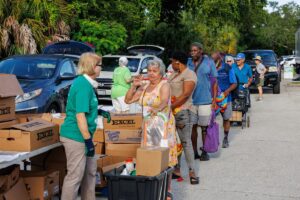
Photo courtesy of All Faiths Food Bank
Adults without an exemption can get food stamps for only a limited time unless they work or train about 20 hours a week. The One Big Beautiful Bill Act narrowed who can receive an exemption to that rule. The law ended exemptions for veterans, homeless people, and former foster youth and narrowed the parent exemption from parents with children under 18 to those with children under 14. It also raised the age of seniors eligible for an exemption from 54 to 64 years.
Harrelson told WSLR that All Faiths Food Bank spoke with a grandmother who adopted all nine of her grandchildren but no longer qualifies for assistance.
Photo courtesy of All Faiths Food Bank
NH: There was a grandmother who came through one of our lines recently who had to adopt all nine of her grandchildren and was getting SNAP benefits, but those benefits were cut. I’m sure you can imagine how hard it is to feed a family of 10, including her, when you’re not getting the benefits that you once were.
NS: In both Sarasota and Manatee counties, the number of residents receiving assistance fell about 20%, according to state counts. That comes out to about 12,500 fewer local participants in the food assistance program. The nature of the federal changes means many of those that lost access to the program are likely to be veterans, homeless, foster youth, parents or the elderly.

Photo courtesy of All Faiths Food Bank
In our last report on affordability, WSLR detailed the link between rising gas prices and the shrinking funds of many families to put food on the table after other fixed bills are paid. Harrelson pointed to that same link, and other compounding factors making this year hard on folks that are skirting the line of just getting by.
NH: The other contributing factors that we see here at the food bank—gas prices, of course, increased unemployment rates, health insurance, medications, homeowners insurance, a household budget in general—and then, on top of that, we’re still seeing an elevated need from people—even though it seems like a long time ago—people who came to us for the pandemic, people who came to us for the hurricanes in 2022, the hurricanes in 2024, who never recovered from that.
Photo courtesy of All Faiths Food Bank
NS: At the All Faiths Food Bank distribution, two seniors told us that they were having a hard time affording sudden emergency payments, which led them to attend the event to seek relief from food costs.
Dee: My air conditioning just went in my car. At my age, I don’t want to buy another car. But now I have to. There isn’t anything that hasn’t gone up except for my income.
Senior: I needed over $5,000 in repairs, and then I needed a knee replacement, and I’m still struggling with that. I live on my social security. Every little bit just chips away. The price of food, the price of bread—I’ve never seen bread, like $6 and $8, $9 dollars a loaf. Incredible.
NS: The prongs of the affordability crisis are all related, with each increase in cost placing pressure on all other financial demands and commitments as ordinary people struggle to meet them. Gas prices, at least, have cooled since our last report. But groceries and healthcare remain an ongoing pain point.
In our next piece on affordability, we dive into rising expenses in healthcare for locals.
Reporting for WSLR, Nic Steinig.
WSLR News aims to keep the local community informed with our 1/2 hour local news show, quarterly newspaper and social media feeds. The local news broadcast airs on Tuesdays and Thursdays at 6pm.
 It's drive week!
Your gift keeps 96.5 on the air. Be one of the people who make it happen.
Donate Now