Will the county have the money to preserve more land? You get a say.
By Noah Bookstein
Original Air Date: October 29, 2026
Host: Sarasota County voters will see two ballot questions this election about the county’s Environmentally Sensitive Lands Protection Program, which has used a property tax to buy and protect natural land since 1999. Reporter Noah Bookstein looks at what the program has done, what it costs and what voters are deciding.
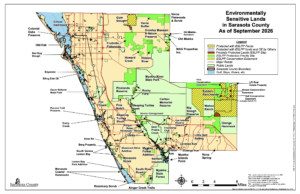 Noah Bookstein: For 26 years, Sarasota County property owners have paid a small tax to buy land and keep it from being developed. After more than 100 purchases, the county says the program has protected about 42,000 acres. Now, voters will decide whether to extend it another two decades.
The program grew out of a citizen advisory committee that spent five years mapping land for protection. Voters approved the tax in 1999, and the first purchase closed in 2001.
Local governments can protect land through mandatory zoning and land-use rules, but Sarasota County’s Environmentally Sensitive Lands Protections Program relies on willing sellers. Brie Ondercin, the county’s land acquisition coordinator, says every deal starts with an owner who wants to sell to the county.
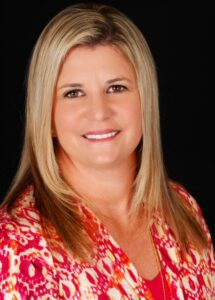
Brie Ondercin | Photo courtesy Sarasota County
Brie Ondercin: We are a willing seller program only, and nominations can come in from citizens that don’t own the properties, so we always have to confirm that the landowner is a willing seller before we proceed.
NB: A citizen oversight committee reviews each purchase, and the County Commission approves it. A deal can take six months to two years. Holdings range from small urban preserves to large tracts of ranchland. Ondercin points to Red Bug Slough Preserve as a favorite.
BO: It is a gem of a preserve located in the heart of Sarasota. A lot of people don’t realize that there’s this beautiful pine flatwoods and mesic hammock habitat with a slough running through it where you can fish and play and walk your dogs. It’s kind-of an oasis in the heart of Sarasota.
NB: There is also Deer Prairie Creek Preserve, more than 7,000 acres on the Myakka River, bought and managed along with the Southwest Florida Water Management District. Ondercin says partnerships and state grants have brought in about $70 million.
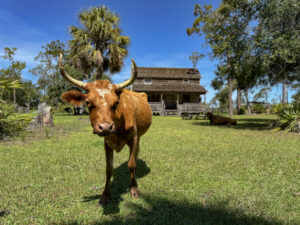
Crowley Museum and Nature Center in Old Miakka. | Photo courtesy Sarasota County
The county does not own all of this land. On many rural properties, especially cattle ranches, it buys a conservation easement instead, paying owners to give up development rights while they keep working the land. That costs less than the land’s market value.
BO: Going forward, the property can never be developed, and that applies to any landowner, whether it changes ownership five times in five years or the same landowner remains in place for 20-plus years.
NB: But land is far more expensive now than when the program started. Ondercin says prices west of I-75 have climbed sharply since 2020, with smaller increases farther east. Agreeing on a price can be hard.
BO: We’re bound to purchase properties based on the appraised value, so we have to work with the landowner on coming up with that adequate price.
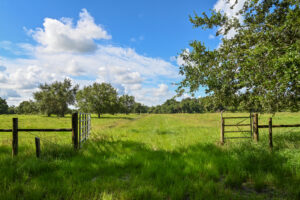
Walton Ranch, one of the properties in the county’s environmental lands program. | Photo courtesy Sarasota County
NB: Private buyers, including developers, are not limited to appraised value. Ondercin says the program has occasionally lost land to development, but its long life lets staff wait out owners who are not ready to sell.
BO: Knowing that we have longevity in our program certainly helps because we can be patient and we can wait until the timing is right.
NB: Ondercin pointed to a 39-acre property on Shamrock Drive in Venice.
BO: The county had attempted to purchase that property for many years, going back to 2002, and then we were finally successful in acquiring it in 2019 after it had changed several times and the landowners had attempted to develop the property. But, eventually, the current landowner that we bought it from at the time realized that there was an opportunity here to protect the property forever.
NB: The county describes these lands as protected in perpetuity. For conservation easements, Ondercin says, that is essentially true; undoing one takes multiple legal steps and approvals. County-owned land is different. If a property is hard to manage or lacks public access, the commission can declare it surplus after advisory board review, then sell or transfer it. Ondercin says that is very rare.
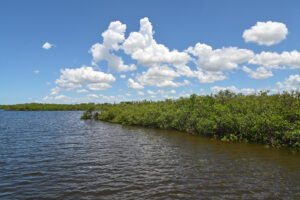
The Berg property | Photo courtesy Sarasota County
Owning land also means maintaining it. The county’s land management budget for environmental lands and neighborhood parks has grown from about $4.5 million two years ago to about $5.7 million this year.
BO: You can’t manage $42,000 acres on a $20,000-acre budget.
NB: The first ballot question would extend the program from the end of 2029 to the end of 2049 at the current tax rate. The second would let the county borrow money for land purchases and repay it from the tax, just as voters approved in 2005.
BO: We are not asking for a new tax. We’re not asking for a new program. We’re not proposing to levy any additional costs other than what has already been occurring for the last 26 years.
NB: In a statement to WSLR News, the county estimated that if Amendment 3 passes, the impact on the program could be about $3 million in 2028 and $5.6 million in 2029, based on current projections.
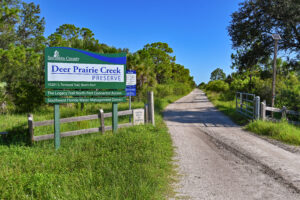
Deer Prairie Creek | Photo courtesy Sarasota County
Ondercin says Sarasota is one of seven Florida counties with land protection measures on the ballot this year, and the county hopes to connect its preserves with protected land in Manatee and DeSoto counties.
BO: Although about a third of the county is under protected status, either through our programs or through the state, there is still plenty of acreage out there worthy of protection. With all those efforts statewide, we’re piecing together corridors of land protection from one county to the next that should have a significant impact statewide.
NB: Whether that work continues past 2029 is now up to voters.
Reporting for WSLR News, Noah Bookstein.
WSLR News aims to keep the local community informed with our 1/2 hour local news show, quarterly newspaper and social media feeds. The local news broadcast airs on Tuesdays and Thursdays at 6pm.
 It's drive week!
Your gift keeps 96.5 on the air. Be one of the people who make it happen.
Donate Now