Our reporter caught up with FBI special agent Robert Wittman at a book presentation.
By Ramon Lopez
Original Air Date: Nov. 17, 2026
Host: FBI special agent Robert Wittman has spent much of his career recovering stolen art and protecting cultural heritage. WSLR News reporter Ramon Lopez caught up with him during a book presentation in Sarasota.
Ramon Lopez: Sarasota County Libraries and Historical Resources recently provided a close-up look at the multibillion dollar international art crime business. Locals got two opportunities to meet the man dubbed “the most famous art detective in the world.”
They heard tales from the trenches of his long career solving art crimes with the FBI, notorious art heists and daring recovery operations, oftentimes undercover.
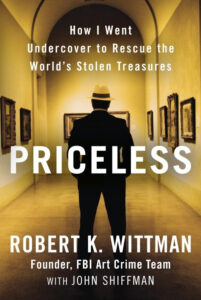
Robert Wittman founded and led the FBI’s National Art Crime Team for two decades before retiring. He’s now a private security investigation consultant, continuing his stolen art sleuthing. Along the way, he authored the New York Times bestseller Priceless: How I Went Undercover to Rescue the World’s Stolen Treasures.
As the top art theft G-man, the 71-year old Wittman recovered more than $300 million in stolen art and so-called cultural property around the world.
On November 5 at Selby Library, Wittman discussed art theft. The next day at Venice Library, he outlined three facets of art crime—frauds, forgeries and fakes. The presentations drew 125 and 144 attendees, respectively.
Wittman provides basic numbers:

Robert Wittman
Robert Wittman: You have to understand the industry of art. It’s a business. It’s basically a $200 billion business worldwide. $200 billion gets bought and sold every year in the art business. At the FBI—and even now—we don’t really call it “the art world.” It’s more the cultural property world. Cultural property. Art, sculpture, prints worldwide is about a $60 billion industry. The rest of that is everything else. It’s comic books, empty cars, watches. Everybody’s a collector.
That’s why it’s a $200 billion industry every year. The United States is the number one consumer country of art and cultural property. $80 billion a year—40% of the entire market in the world—is in the United States. We’re the number one collectors.
$6 billion a year. That’s the cultural property crime business market. $6 billion a year. That makes it one of the top ten international crimes, according to Interpol. So it’s a big crime problem. Frauds, forgeries and fakes—that is 75% of the art crime business. Theft is only 25%—about a quarter of it. Frauds, forgeries and fakes are what’s happening today.
RL: The feature film Thomas Crown Affair depicts art thieves as handsome and debonair. But Wittman says that’s far from the truth.
RW: They’re not handsome, debonair, beautiful, rich, intelligent. They’re just thieves. They’re criminals. They steal stuff.
RL: Wittman’s stories exposed the true nature of art crime: Thieves don’t steal because they love art. They steal to get rich.
90% of art crimes are inside jobs. But not always. In December 2000, three thieves armed with machine guns, car bombs and a high-speed boat looted the Swedish National Museum, taking two Renoir paintings and a self-portrait of Rembrandt valued at $40 million. FBI man Wittman was called in. He went undercover, posing as a crooked art authenticator. It took several years, but one of the Renoir paintings and the Rembrandt were recovered.
Closer to home, he cracked a scam that rocked the PBS series Antiques Roadshow. He told the story about a ring of Civil War military artifact thieves. They created an illegal business enterprise after establishing a reputation as military memorabilia mavens on the show. They would sell consignment items from admiring roadshow watchers at jacked-up prices and keep most of the loot. Some might call it the Antique Rogue Show, but there was nothing illegal about the scam.
 RW: The show really did a good job for them. I have to tell you, it’s not really—them bringing the people onto the show and doing that is just good TV. That’s the idea. But it’s not illegal, so there’s no reason that they can’t do it. It’s not ethical. It’s not moral. But it’s not illegal.
Now, Antiques Roadshow has gotten much better. They pay attention now. They tell people they can’t do this anymore—not allowed to do it. It’s the best that you can probably rely on. You can rely on the show itself and what you see. But, at that time, they could still get away with this material. And this was a pretty audacious one.
RL: The son of a Baltimore antique dealer, Wittman was not particularly interested in art but said it was helpful early in life to have learned how to do a deal in the antique and art world.
After college, he failed to get a foreign service officer job. Second choice was the FBI. Early in his career as an agent, he successfully cracked two art theft cases, and his law enforcement career changed. Wittman found his time investigating art crime gratifying.
RW: I found the work very gratifying because of the fact that we could recover stolen cultural property. That’s so much more important to me than doing drug operations or stolen car thefts and that type of thing. Whenever you recover a stolen artwork, it means so much to the culture. It means so much to civilization, in fact, when it comes to antiquity.
RL: Cross Creek Pictures has optioned the right to Priceless. But no movie deal has emerged. And we have yet to see the launch of Law and Order: Art Crime Unit.
Wittman has a number of prints hanging in his house in Philadelphia done by his artist nephew but nothing of great value.
This is Ramon Lopez for WSLR News.
WSLR News aims to keep the local community informed with our 1/2 hour local news show, quarterly newspaper and social media feeds. The local news broadcast airs on Tuesdays and Thursdays at 6pm.
 It's drive week!
Your gift keeps 96.5 on the air. Be one of the people who make it happen.
Donate Now