He can drive it on Florida roads, but the heavy machine gun is not operable.
By Ramon Lopez
Original Air Date: July 10, 2026
Host: It was simple, it was sturdy, and it was one of the most iconic weapons in the arsenal of the United States’ epic Antifa effort, otherwise known as World War 2. We’re talking about the jeep and one local guy’s way of honoring the vehicle’s history. Here’s Ramon Lopez’s report.
Ramon Lopez: This past Fourth of July, antique car collectors drove their wheeled relics in local parades nationwide. This, to honor the country’s milestone 250th anniversary.
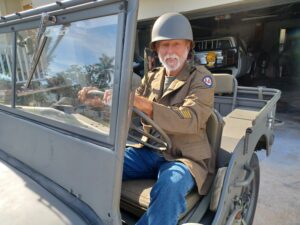
Arnold Popp is allowed to drive his war-tested vehicle on Florida roads. But the heavy machine gun is inoperable. | Photo: Lopez
But one local Palmetto resident instead drove to LECOM Stadium in Bradenton to show off his rebuilt World War II Jeep at a Marauders minor league baseball game.
74-year old Arnold Popp, born and raised in Manatee County, says his wartime Jeep is licensed by the state as an antique car. So he can drive it on the street. But it’s certified as a historic military vehicle, meaning it’s rebuilt to 100% military condition.
All its parts, markings and accessories, including an inoperable 50 caliber heavy machine gun, are legit. He also has a World War 2-era trailer for his Jeep. It also makes the rounds of local car shows, patriotic parades and events conducted by area veterans groups.
An all-around mechanic, Arnold Popp had the skill to rebuild his Jeep while raising with wife Carla a now-grown son and daughter, who provided them with eight grandchildren.
Popp first got interested in Jeeps when still a teenager.
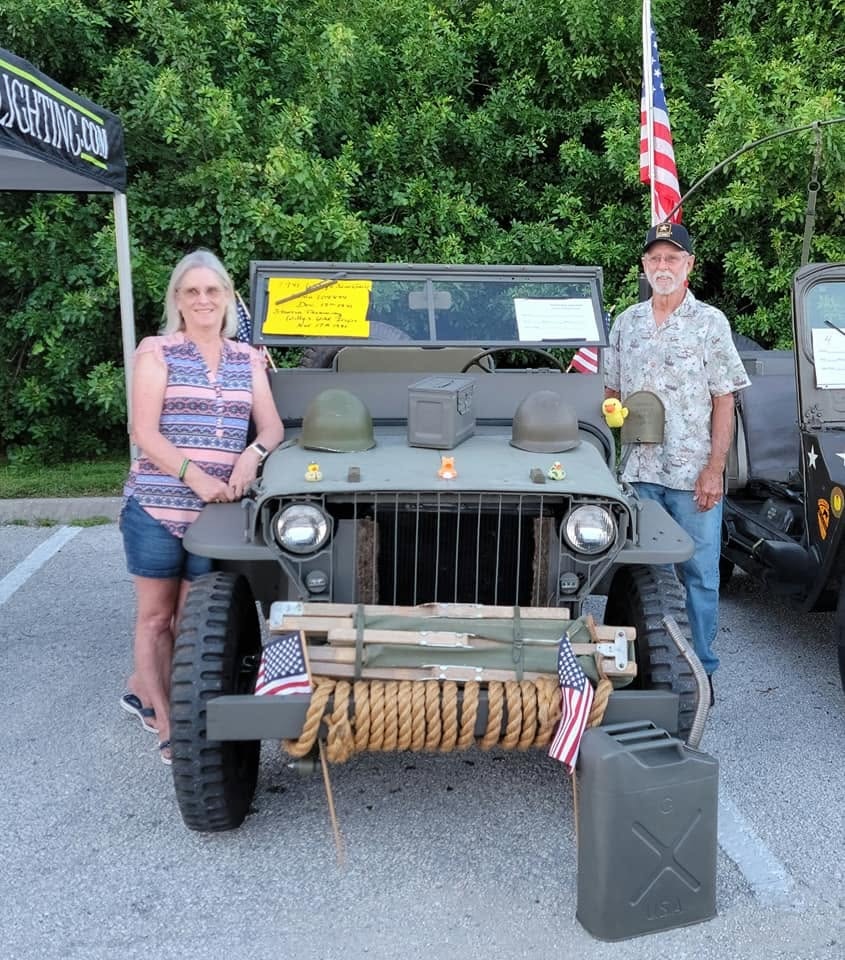
Carla and Arnold Popp with the restored 1941 Jeep.| provided photo
Arnold Popp: When I was a kid—I think about 14—my brother had a Jeep that was converted to a [inaudible], and he lived right next door to the woods, so he let me take it out in the woods by myself, and I drove it around. That was my first experience of having driven a Jeep.
RL: He’s a member of the Military Vehicle Preservation Association. The club provides historic military vehicles, such as Popp’s battle-tested Jeep, and even legendary battle tanks, for display at various events. He does it for free because he loves talking to people.
Although not a veteran himself, Popp is proud of the country’s armed forces. His involvement, he told WSLR News, is due to patriotism, not profit.
We pause for a bit of Jeep history here.
640,000 were built by Willys Overland and the Ford Motor Company. About 150,000 trailers were produced by American Bantam Car Company, doubling the Jeep’s nominal payload. Popp’s Jeep came off Willys’ assembly line in 1941; his trailer, built by Bantam, a year later.
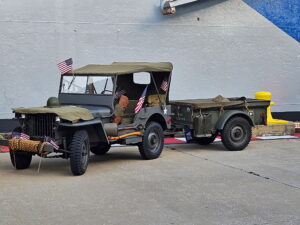
Popp’s Jeep | provided photo
The workhorse Jeep was developed for World War II as a light military utility vehicle, but it remained in U.S. military and allied forces service until the early 2000s.
Historian Charles K. Hyde wrote: “In many respects, the Jeep became the iconic vehicle of World War II, with an almost mythological reputation of toughness, durability, and versatility.”
Jeeps served as pack horses for troop transport and towing supply trailers, carrying water, fuel, and ammunition through the most challenging terrain. They performed scout missions and transported wounded soldiers. Popp’s rusted-out Jeep came with bullet holes, having served in World War II.
He first saw it in 1984, but wasn’t able to buy it until 2009 and didn’t get around to restoring it until 2021. He didn’t keep track of the number of hours he worked on the Jeep.
AP: If I kept track, I wouldn’t want to do it. Lot of hours every day for weeks and weeks at a time sometimes.
RL: There is no consensus among historians as to how the U.S. military vehicle became known as the “Jeep.” Some called it the “peep;” others, the “beep.” But many believe “Jeep” was derived from G.P., for “general purpose” vehicle.
We asked Arnold Popp how long he planned to display his historic Jeep to the public.
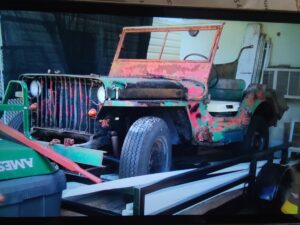
He bought it in 2009. | provided photo
RL: How long are you going to continue doing these displays?
AP: That’s all up in the air. We don’t know.
RL: You’re in your mid-seventies. You’re in good health, it looks like. So you’re going to continue doing the shows indefinitely?
AP: It’s a possibility. [Laugh]
RL: Well, you’re not—you didn’t put a—
AP: Didn’t put a date on it.
RL: You didn’t put a deadline that—“Oh, I’ll stop doing this.”
AP: Actually, that would be correct: Dead. Line.
RL: “Dead” line.
RL: This is Ramon Lopez for WSLR News.
WSLR News aims to keep the local community informed with our 1/2 hour local news show, quarterly newspaper and social media feeds. The local news broadcast airs on Wednesdays and Fridays at 6pm.
 It's drive week!
Your gift keeps 96.5 on the air. Be one of the people who make it happen.
Donate Now
It's drive week!
Your gift keeps 96.5 on the air. Be one of the people who make it happen.
Donate Now