Law enforcement is surveilling grandmothers, landscapers and even kids.
By Alice Herman/Suncoast Searchlight
Original Air Date: August 20, 2026
Host: A new joint investigation by Suncoast Searchlight, the Florida Trident and WGCU reveals how Florida officials have collected information on tens of thousands of people local police suspect lack legal status in the United States. The reporters’ analysis of thousands of entries into a statewide surveillance database shows who Florida’s immigration crackdown has targeted and raises questions about the legality of some agency’s efforts. Alice Herman has the report.

Alice Herman: When a Manatee County Sheriff’s deputy pulled over Jean Gustave in September, the 45-year-old Haitian man had temporary protected status, offering him legal protection from detention and deportation.
An investigation by the deputy who pulled him over for an alleged tag violation later found no probable cause. Gustave was not charged or arrested that night.
But authorities kept him on the side of the road in Bradenton as they snapped his photo, took down his personal information and uploaded it to a database run by the Florida Department of Law Enforcement.
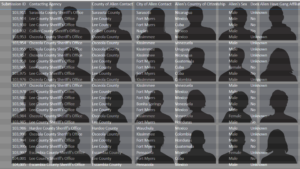
Tens of thousands of people that local police suspect of being undocumented have been logged in a database held by the Florida Department of Law Enforcement | Suncoast Searchlight illustration
Across Florida, law enforcement officers have been asked to gather names, photographs, addresses and other personal information about people they suspect may be in the country without authorization and then upload that information to a centralized surveillance database during the course of their routine job duties.
The database debuted in August 2025 as Florida created the State Board of Immigration Enforcement and expanded the role of state and local police in immigration enforcement. FDLE developed the reporting system for local agencies to log their “suspected unauthorized alien encounters” into the database, which has since grown to more than 30,000 entries.
A review of the surveillance database shows officers routinely submitted the names of individuals for whom they could not confirm even basic citizenship details—as well as the names of hundreds of minors.
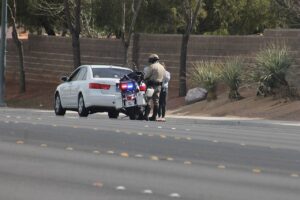
Since Florida ramped up its immigration enforcement efforts, routine traffic stops may now lead to ICE detention and deportation | Photo by Noah Wulf, CC BY-SA 3.0, via Wikimedia Commons by way of Suncoast Searchlight
Paul Chavez: The idea that a law enforcement officer could inquire into somebody’s immigration status and then land on some sort of probable cause or reasonable suspicion that the person’s removable from the country is really outlandish.
AH: That’s Paul Chavez, a civil rights attorney and director of litigation for Americans for Immigrant Justice.
Florida doesn’t require agencies to vet the data before officers submit it. And agencies have obtained millions of dollars in immigration enforcement grants for broader surveillance technologies like Flock cameras as part of an initiative tied to the reporting effort.
Only officers trained by the federal government are supposed to conduct immigration enforcement. Those police are called 287(g) officers, a title that’s derived from a section of federal law allowing local law enforcement officials who have been specially trained to take on some immigration enforcement responsibilities. But records show police agencies have allowed untrained officers to hold people on the side of the road for ICE, a practice attorneys said is illegal. Here’s Paul Chavez again:
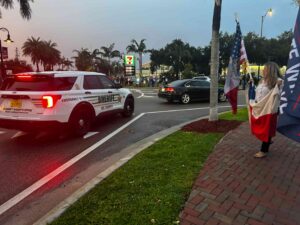
The Lee County Sheriff’s Office has recorded more “encounters” in the FDLE database than any other county sheriff | Photo by Alice Herman, Suncoast Searchlight
PC: In order to enforce federal immigration law, you have to be a 287(g) officer or a federal officer if it’s ICE or CBP or whoever. So an officer who isn’t a 287(g) officer holding somebody for immigration purposes is wholly unlawful. You can’t pull somebody over and then hold them there past the time they would have otherwise been released.
AH: Because officers are encouraged to report people they merely suspect may be undocumented, attorneys and immigration experts said the system risks sweeping in people with legal status.
Remember Jean Gustave, the TPS holder who was entered into the database? We tried to get in touch with him—give him a call and visit the mobile home park where official records said he lived—but when we got there and asked a neighbor for his whereabouts, the neighbor told us he was gone. He’d already been deported.
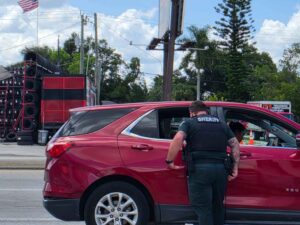
Since Florida ramped up its immigration enforcement efforts, routine traffic stops may now lead to ICE detention and deportation. The above stop took place on Palm Beach Boulevard by a Lee County Sheriff’s Office deputy | Photo by Youn-Joo Park, WGCU via Suncoast Searchlight
Like Gustave, the vast majority of people in the database—more than 80%—also had no known criminal background.
A 36-year-old man from Guatemala who worked for a lawn care service.
A 35-year-old construction worker from Mexico.
And a 52-year-old grandmother from Nicaragua who worked for a painting company.
Deputies noted no prior convictions associated with these individuals, who represent just a few examples of the entries in the database.
Florida officials have revealed only fragments of the database publicly and did not return reporters’ questions about how the information is used, how long it is retained and with whom it is shared.
I’m Alice Herman with Suncoast Searchlight. To read the whole investigation, please visit suncoastsearchlight.org/florida-immigration-surveillance-database.
WSLR News aims to keep the local community informed with our 1/2 hour local news show, quarterly newspaper and social media feeds. The local news broadcast airs on Wednesdays and Fridays at 6pm.
 It's drive week!
Your gift keeps 96.5 on the air. Be one of the people who make it happen.
Donate Now
It's drive week!
Your gift keeps 96.5 on the air. Be one of the people who make it happen.
Donate Now