Sarasota mosquito manager explains county spraying, and what you can do for prevention.
By Gretchen Cochran
Original Air Date: October 20, 2026
Host: Mosquito-borne disease is spreading in Florida. The deadly crash of a Manatee County mosquito control helicopter last week put the focus both on a Dengue fever outbreak and routine aerial spraying. Gretchen Cochran has a close look at both.
Gretchen Cochran: Florida’s Dengue fever case numbers are the highest they’ve been in decades. Hillsborough County, home of Tampa, had 96% of the Florida cases, topping 310 locally acquired cases last week. That’s when the county health department extended an already declared state of emergency to October 22.
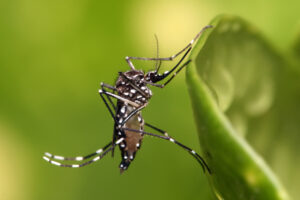
Photo: Muhammad Mahdi Karim via Wikipedia
Dengue is carried by mosquitos—not passed human to human—so spraying insecticide is one way of managing it.
Dengue has spilled over from Hillsborough into neighboring Pinellas and Polk counties, but Manatee County has yet to report a case. Even so, in a reminder of the sense of urgency after a recent malaria outbreak, aerial pesticide spraying has become routine. Last week, a Manatee County Mosquito Control pilot died in a helicopter crash near Myakka City.
While not as deadly as malaria, Dengue is a painful disease. Michelle Stears has had it and reminds us it is called “break bone fever.” She is now the director of Residential Services at the Sarasota Housing Authority, and as such she oversees the formerly named Orange Blossom Community Garden, recently returned to its former name, The Garden. It is on the edge of Newtown. Years ago, Michelle was studying in Mexico where she contracted Dengue.
 Michelle Stears: My experience of Dengue wasn’t so much a fever—it’s called hemorrhagic fever as well. It’s called “bone break fever,” and it’s because all of your bones—your skeleton aches. It’s like this shooting pain back and forth through your skeleton, and it goes on for weeks.
GC: So far, the Florida Department of Health, which keeps track of Arbovirus diseases, has not reported any cases in Sarasota County. Kim Savage, Sarasota Memorial Hospital’s public information officer, says SMH has seen no locally acquired cases of Dengue. Still, it’s little wonder folks here are a bit antsy about mosquito control.
There are at least 40 mosquito strains here in Southwest Florida. Four of them carry the Dengue virus, said Wade Brennan, who runs the Sarasota County Mosquito Management Department. It employs 31 who work ‘round the clock searching for mosquitos, identifying them and applying insecticides tailored to their individual characteristics.
When a mosquito trap showed up in Newtown’s “The Garden,” some of its city farmers were disturbed. It was one of many tracking devices moved around the county. The size of a microwave oven, it had been loaded with CO2 to attract the type of mosquito that carries Dengue.
The captured mosquitos would be flash-frozen and transported to the county’s office to determine their type. In addition to Dengue, they are also looking for West Nile virus and malaria, among others.
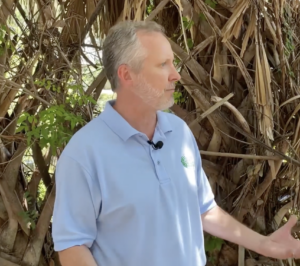
Wade Brennan
Wade Brennan: We actually take those adults, bring them back to the lab, identify the species and test them for actual virus within that same week. We’re one of the quickest around for that kind of data analysis and getting results.
GC: Ours is the only district in Florida routinely testing for malaria due to an outbreak in 2023 when seven people were infected, Brennan said.
Why Dengue in Hillsborough County? Here’s Brennan:
WB: It takes just a person that’s infected to be here for a short time or a long time—you never know. We’re a tourist attraction. We have a population that likes to travel. There’s all these factors that go into it. If the Arbovirus is brought here, we have the actual vector species. It just takes that bite.

A grounded pesticide drone | Photo courtesy of Sarasota County
GC: The traps are gathered each morning and brought to the office where the captured mosquitos are examined and classified. Then routing maps for the various treatments are circulated. You can log into the county website and go to Mosquito Management Services to determine areas to be sprayed or treated in other ways.
The department uses an integrated pest management program, referred to as IPM, using the least toxic and non-toxic approaches and products. It maintains a lengthy Approved Pesticide List at its website divided by specific uses and pests.
They use a specially designed nozzle that emits a soft spray with a low volume, sprayed from fixed wing planes, drones and trucks. They cover 575 square miles, serving 480,000 people with a $5 million annual budget.
Safety is paramount, Brennan said, for the residents’ health as well as for the environment. Their concern is for the bees and butterflies as well as the people.
WB: That’s why we only spray at night. We’re not spraying in the morning; we’re not spraying in the day; we’re spraying at night when any kind of other pollinators that are not out are going to be seeking that harborage, and they’re not going to be exposed to what we use when we’re spraying at night.
GC: Brennan is a biologist having been with the department 35 years. He described his teams’ service as “scientifically driven.”
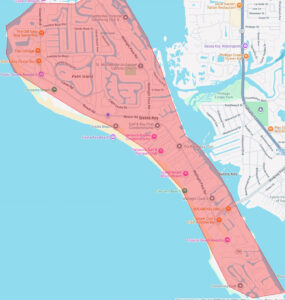
Sarasota County aerial spraying map
Now that the temperature is beginning to cool here in Sarasota County, can his team relax? Atmospheric temperature is not so much a predictor, he said. Rather, it’s the moisture in the air. “We are still in peak season,” he said.
Brennan offered a list of precautions like avoiding sunrise and sunset and wearing long-sleeved shirts and long pants. For our gardens he suggested one of the products his department uses: BTI, or Bacillus Thurengiensis Israelensis, a product that is safe for humans, our pets, birds and other wildlife but deadly for mosquitos. It comes in many forms including liquid and granules. We found a 30-ounce bag of the granules at Home Depot for $30.
You can float BTI in your birdbath and not harm the birds, Wade said.
Stears liked that. She’s concerned about the bromeliad plants spread throughout The Garden. But she is relieved to know the granules can be sprinkled in their centers to kill any mosquito larvae but not harm the organic garden.
Meanwhile, the mosquito-detecting device has been removed from The Garden, having had no Dengue-carrying mosquitos there.
For WSLR, this is Gretchen Cochran.
WSLR News aims to keep the local community informed with our 1/2 hour local news show, quarterly newspaper and social media feeds. The local news broadcast airs on Tuesdays and Thursdays at 6pm.
 It's drive week!
Your gift keeps 96.5 on the air. Be one of the people who make it happen.
Donate Now