Part 1 of a three-part WSLR News series on inflation and its ripples.
By Nic Steinig
Host: Over this last year, Americans have seen gas prices soar. Pull up to any Sarasota pump for a refill today and you’ll see regular hovering above four dollars a gallon. That picture gets worse for diesel drivers, who are staring down six dollars a gallon.
Nic Steinig: The gas price hike comes on the heels of the U.S. and Israeli airstrikes in Iran that brought tanker traffic through the Strait of Hormuz to a near halt. A gallon of regular at a Sarasota pump costs 40% more than it did a year ago, and diesel a staggering 70%, according to AAA.
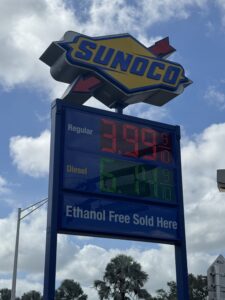
Diesel prices in Sarasota are hovering around $6 a gallon. | Photo: Werner
For American workers that are already struggling with rising costs of essential bills, that upward shift is forcing them to make tough decisions to get by. WSLR spoke with coast guard veteran Casey New, who told us how rising gas prices are boxing him in financially. New drives a diesel vehicle, and uses it to haul tools for his landscaping and general-contract business.
Casey New: With the gas prices going up, I think it’s at like what, 6.39 now a gallon? It’s insane. I just—I’m paying $130 every time I fill the truck up. It’s getting to the point where I’m filling it up almost three times a month. So I’m looking at over $400 a month, roughly . It’s just, it’s absurd.
Nic Steinig: When WSLR asked New if he had considered swapping to another kind of vehicle, he told us he wanted to, but still owed money on his mid-sized truck, and his strained finances means he doesn’t have the credit profile to make it happen.
With the $400 dollars in damage at the pump he pays for diesel every month, he said he has been biking to stores and visiting food shelters to make ends meet.
Casey New: Yeah. So now I’m going to the local food pantries here in town. I’m biking to the grocery store and I’m biking to work and it’s, and it’s getting cold. It’s not fun, man. It’s making life very difficult and I just… things have got to change. If you serve your country, you’d think you’d be, some more help, I guess benefits from the government. But I don’t see that.
Nic Steinig: As gas prices eat into Americans weekly take home, one of the first spending cuts families are forced to make seems to be the food they put on the table.
Despite grocery inflation around Tampa at one percent over the past year compared to the national rate of about two and a half percent, Senior Friendship Centers Communication manager Jodel Velarde told WSLR that food costs are still a big problem for struggling seniors, a challenge that gas prices have made worse.
According to Velarde, their crisis intervention team had just compiled a report looking into what seniors are requesting assistance with. The report concluded that “higher fuel costs leave less money for other essentials.”
One senior they assist, Richard Suckow, told us about how he has adapted to rising prices.
Richard Suckow: If there’s a red light up ahead, I keep my food on the accelerator, you know, ease up on it. I’m being a lot more careful when shopping. Getting less beef than we used to get, beef has really gotten quite expensive.
Nic Steinig: Velarde told us that home repairs are one of the most expensive things seniors on a fixed income face. With the cost of diesel rising, those repairs may become more expensive than they already are. As of now, the cost of construction materials has risen about 10% percent.
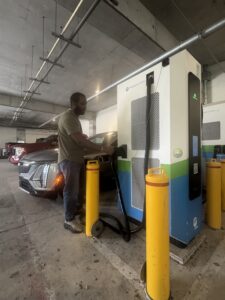
FPL recently upped its EV charging prices by 50%. | Photo: Werner
There’s also the gig delivery drivers to consider—those contracted to deliver goods through Uber, Doordash, Amazon Flex, and other platforms are feeling that price hike eating into their actual daily earnings.
Delivery drivers who have switched to electric are feeling the pain too. Tesla increased their charging station rate for non-members by about 15% this year, and FPL’s public fast chargers went up 50%. Actions from the Florida Legislature caused that FPL climb.
In 2024, they passed a law that restricted FPL’s charging stations from leaning on ordinary customers’ power bills to stay solvent. Last year, FPL chargers generated revenue that was only half what they cost to maintain.
The unintended consequence of that change is that two of the most affordable electric charging stations providers, Tesla and FPL, both saw remarkably large price increases in the same year. They are also the two largest fast–charging networks in Florida. Every local Florida House and Senate lawmaker voted yes.
WSLR spoke to Amazon Flex delivery driver Emily Herrera, whose husband also works as a gig delivery worker to make ends meet. She told us the difficulty in paying her bills has been unprecedented, even compared to the gas spike of 2022.
Emily Herrera: This has been a very difficult year, like the most difficult year. It has impacted me in particular because I make deliveries. So they give me my routes in increments of three hours. And for those three hours, I make $63. Now I am spending $15 in gas, leaving me with a net of $43 for three hours. I feel that everything has gone up, including food. I used to go buy for the week $120 in groceries, and I will come home with about four bags of food. And now I’m noticing that I buy the same amount and I come home with two bags of food.
Nic Steinig: Translation to English was facilitated by Ruth Beltran.
Photo: Mike Mozart via Wikimedia Commons
Herrera told us that finding alternative work is difficult for English learners, but her family is trying.
Herrera then shared how their family had to surrender one of their vehicles back to their dealer despite two adults working full-time, as they just couldn’t meet the rising costs.
Emily Herrera: It impacted us so much that we were not able for some time to make our car payment and also car insurance, because you have to have full coverage to have a new car. Things got so bad that we were forced to return one of the cars to the dealership because we just did not make enough to pay the car payment plus the insurance.
Nic Steinig: Both Herrera and New expressed dissatisfaction with the U.S. pursuing war with Iran, feeling it was largely responsible for their hardship and an unnecessary tragedy besides.
Emily Herrera: Among my circle, that is the common opinion. That it is because of the war. I believe that there will never be a need for war, because it ends up killing a lot of people. I feel that we have to exhaust every way before going into war.
Casey New: I just, it’s mind boggling to me. I don’t agree with it. Of course not. Why are we at war? Why have we always been at war? It’s to benefit the ones at the top.
Nic Steinig: WSLR spoke with Gene Jones, the President of Florida Veterans for Common Sense, a Sarasota veterans advocacy group that assists with VA benefits and educates the public on the cost of war. He told us what he thinks of the latest conflict, and its impact on the economy.
Gene Jones: It’s very clear that there’s many veterans and veterans families that are living on the edge. And any increase in prices makes it more difficult for them.

A Veterans for Common Sense group at a No Kings protest in Sarasota. | Photo: Mason Chambless
We have higher gas prices as a direct result of that war, and things are going to get worse. That’s our prediction. It’s because of the cost of diesel. Everything in our economy moves by diesel. Our ships, our trains, our trucks. And so inflation is going to continue to go up. And so it makes it very difficult for them if they’re living on a disability check from VA. They’re really in a bind.
Don’t get the idea, Nickolas, that we’re a pacifist group, because we’re definitely not. We’re opposed to unnecessary wars of choice. Trump lied to us. He said, ‘Oh, the nuclear program was obliterated!’ Well, if it’s been obliterated, why are we going back?
Nic Steinig: We are now eight months into a new Middle East war the White House described as a four-to-six week operation.
The election on Nov. 3 will show whether the instability at the pump converts to a swing in domestic politics. Regardless of the election results, a war is a lot easier to start than it is to put back in the can.
Reporting for WSLR News, this is Nic Steinig
WSLR News aims to keep the local community informed with our 1/2 hour local news show, quarterly newspaper and social media feeds. The local news broadcast airs on Tuesdays and Thursdays at 6pm.
 It's drive week!
Your gift keeps 96.5 on the air. Be one of the people who make it happen.
Donate Now