But laws and infrastructure have not caught up with the growing numbers of scooters and e-bikes – and their speed.
By Ed James III
Original Air Date: March 11, 2026
Host: It used to be that if you were on two wheels in Sarasota, you were either a serious athlete in spandex, somebody who lost their driver’s license, or a tourist on a cruiser. Not anymore. Now, the bike racks outside any downtown office or restaurant are filled with e-bikes and electric scooters. This is “micromobility”—the use of small, lightweight vehicles to bypass road gridlock. In Sarasota, it’s exploding. But as they get faster and more common, the e-bikes and scooters face opposition from motorists, pedestrians and regular bikers. Now, a proposed state law, Senate Bill 382, would cap speeds near pedestrians at 10 miles per hour. Ed James III breaks it down.
Ed James III: For Devon Ellis, a 36-year-old chef, his e-bike isn’t for weekend trails. It’s his primary engine as well as his coworkers’.
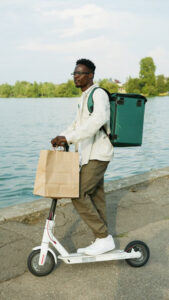
Photo by Artem Podrez via Pexels
Devon Ellis: Some of them ride e-bikes; some of them ride the bus; some of them have their own vehicles.
EJ: But Devon says the proposed 10-mph limit creates a paradox. If he goes 15 mph on the sidewalk, he’s a “danger” to pedestrians. If he goes 15 mph in the street, he’s a target for cars. He thinks there should be more education to avoid these issues and potential crashes.
DE: I definitely think there should be some type of education—and not just the e-bikes. The scooters as well. Around the downtown area, I see people driving around wherever, wrong directions, and bikes as well. I feel like that place could use some type of education for that.
EJ: To be sure, the proposed speed limit would only apply to sidewalks and shared paths.
While high-end e-bikes grab the headlines, Cary Smith sees the “low end” of micromobility. He runs a bike shop at Bayside Community Church, serving Sarasota’s unhoused and working poor. Over the past 11 years, his operation has distributed over 2,500 bikes.
Cary Smith: I’ve been all over the place. When I first started, obviously it was just a small little thing. I was doing it on my lanai at my house. Then it grew into—I rented a self-storage unit with electricity that I could work out of. Finally, I ended up getting some space at the church after many years of doing it pretty much on my own. The church became a lot more involved about three, three and a half years ago. It’s basically grown from a small one-man operation to 5 or 6 of us that are working on bikes and distributing bikes and picking up bikes and anything else you can figure to do with bikes.
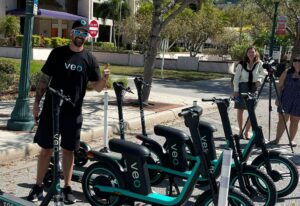
Veo’s scooter- and bike-sharing program rolled out in Sarasota in 2022. Photo via veoride.com
EJ: Cary is concerned that the crackdown on “powerful e-bikes” used by teens is going to catch his clients in the crossfire. SB 382 just cleared the Florida House and Senate unanimously, but it still needs a signature from Governor DeSantis to become law.
Cary Smith believes the streets are not safe for bicyclists. And that gives him pause about restricting e-bike traffic on sidewalks and shared paths.
CS: At 10 miles an hour—and I understand the safety issue of it on the sidewalks, but from a bicyclist’s perspective, that’s the only safe place to be. On the streets of these cities is totally dangerous, so I have mixed feelings about that.
EJ: Statistics, so far, prove him right. Florida leads the nation in bicyclist fatalities, at more than twice the rate than the national average.
Erik Westerberg is a daily transit user who sees the friction from the pedestrian side. He supports micromobility but says the etiquette hasn’t caught up to the technology.
Erik Westerberg: They go very fast, and they’re quiet, so you don’t see them coming up behind you and whatnot, especially if you’re wearing headphones. They just buzz right by you walking down the sidewalk when there’s plenty of bike lanes in Sarasota where they have a dedicated lane to go by.
EJ: Erik argues that the solution isn’t just a speed limit, but a redesign of how we move.
EW: I think they need to teach e-bike etiquette, uh, in Sarasota. It’s probably half the drivers’ fault, half the e-bikers’ fault too.They think they own the rules and the sidewalks.
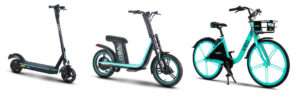 EJ: Sarasota City Commissioner Jen Ahearn-Koch is the one trying to bridge this gap. In 2022, the city signed an exclusive agreement with Veo, a shared micromobility provider in more than 50 U.S. cities. Since its 2022 launch, Veo has grown its fleet to 550 rental vehicles, logging over 150,000 rides. That would translate roughly to three rides per city resident. For many, these aren’t joyrides—they are primary transportation. Recent surveys show 40% of riders don’t own a car, and nearly 30% don’t even have a driver’s license.
Jennifer Ahearn-Koch: We need to figure this out because micromobility is something that is, I think, being embraced by a lot of the future and not just the younger generation. I think a lot of folks in the middle and older generations are also saying, “You know, why not? I can do this, too.”
EJ: Ahearn-Koch admits that the 10-mph proposal is a reaction to a city that wasn’t built for this. If signed, the law would take effect July 1.
Geofencing—using technology to restrict speed and range of scooters and e-bikes—could help reduce accidents.
JA: The Veos that we have, because they’re geofenced, they can narrow it down to certain areas and slow the speed. No matter how fast you want to go, they have it programmed so that you can’t go above a certain speed limit in certain areas where the speed limit is limited. It’s where you ride it, too. Not only speed but where. Where is it appropriate?
EJ: Micromobility in Sarasota is currently a series of collisions. Tech is colliding with old laws. E-bikes are colliding with narrow sidewalks. And advocates like Cary Smith are making sure the human element doesn’t get lost in the debate over miles-per-hour as we wait to see if the governor puts pen to paper.
Whether it’s a chef on a $2,000 e-bike or a worker on a donated cruiser, the message is clear: Sarasota is moving. The question is whether the city’s roads can keep up.
For WSLR, I’m Ed James III.
WSLR News aims to keep the local community informed with our 1/2 hour local news show, quarterly newspaper and social media feeds. The local news broadcast airs on Wednesdays and Fridays at 6pm.
 It's drive week!
Your gift keeps 96.5 on the air. Be one of the people who make it happen.
Donate Now
It's drive week!
Your gift keeps 96.5 on the air. Be one of the people who make it happen.
Donate Now