Sarasota has committed to keep the Purple Cow, but the task is complex.
By Gretchen Cochran
Original Air Date: March 25, 2026
Host: So the City of Sarasota has committed to keeping the Purple Cow. But flood and storm proofing the Van Wezel Performing Arts Hall before the next hurricane is quite the complex task, and it’s not happening overnight. It’s also going on simultaneously with the next stage of the Bay Park expansion. Gretchen Cochran reports.

Nikesh Patel
Nikesh Patel: I’ve been given the marching orders to get this done as quickly as we can.
Gretchen Cochran: That’s Nikesh Patel. He’s the public works director for the city of Sarasota, and he is talking about the shoring up of the 67-year-old Van Wezel Performing Arts Hall, following normal building aging and substantial hurricane damage in 2024.
Patel has had the public works job less than a year. Before that as the city engineer, he assisted the Purple Ribbon Committee in its two-year study crafting the hall’s future.
But when he’s talking about “as quickly as we can,” keep in mind that’s all relative. Seven months ago, the city commission gave marching orders to Dave Bullock, the interim city manager at the time. Patel has taken the mantle and is plowing through the steps to secure the building. But he is facing a mountain of project drawings and schematics, grant writing, bids and permits.
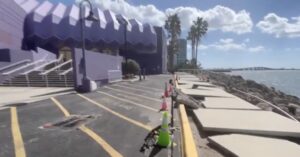
The Van Wezel Performing Arts Center sustained significant damage during the 2024 storm season | Photos: City of Sarasota
Patel is not just dealing with the Van Wezel. The expansion of the Bay Park, planned to sprawl on 53 acres from the Van Wezel north past the boat canal, is also moving ahead. Monday, the city commission granted The Bay $10 million to begin work next month on its coastline.
Patel and his people are scrambling to catch up.
NP: We have, essentially, three different components going on right now. There’s the immediate resiliency and the early mitigation project. That’s Part 1. Part 2 is the shoreline, structural and advanced systems. Part 3 is the theatrical and life safety infrastructure. Those are three components of it. Ultimately, all three are concurrently going on.
GC: Keep in mind, everything happening at the Van Wezel has to work around scheduled shows such as the Neil Diamond or Mrs. Doubtfire musicals, or Jerry Seinfeld. Still, the building must be secured before the next hurricane.
Seven barriers have already been installed to block water from seeping under the doors. Next to be installed this summer will be a pump system to get rid of any water that does get in. Also scheduled: A backflow enclosure.
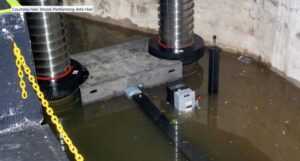
The Van Wezel has a basement 6 feet below sea level at its lowest point. During Milton, it flooded, and the transformer there was submerged in water
NP: The reason why we consider this the first piece is that, if we have a hurricane, a surge of water or whatever the situation, the flood barrier or those doors will protect them from water coming in. The backflow enclosure is essentially—when the water gets high and the sewer system starts acting up or whatever, the backflow preventer will stop sewage from going into the building. Those two things will protect the building. The pump systems are installed just in case, for some reason, the water gets in there…
GC: If the water gets in, you can get it out.
NP: … you can get it out. That’s all going to be happening by the summer. That’s the first part. On top of that is Phase 2, the shoreline structure and advanced system. We’re working on shoreline revetment design.
GP: The revetment will be a structure in the bay made of rocks or other materials to hold back and/or divert water. We’ll get a preview when The Bay installs what it calls “robust revetment” along the shore, possibly this summer.
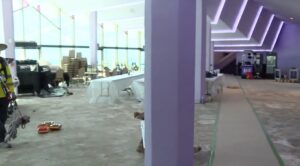 Meanwhile, the city is scrambling.
While the Bay moves along improving the shoreline, the Van Wezel will get some work done on its roof, structurally reinforcing it so a Category Five hurricane won’t blow it away.
NP: We’re trying to coordinate to make sure everything merges. We’re doing it closer to the building. Our intent is to protect the building. Their intent is to protect the park.
GC: The city has already secured a $1.5 million matching grant from the Florida Department of Environmental Protection. It is also pursuing a hazard mitigation grant for $3.75 million from FEMA, through the state and other financial leads.
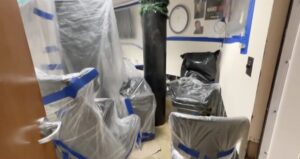 Concurrent with the exterior work will be the theatrical and life-safety infrastructure designed by Sarasota’s Karins Engineering and to be undertaken this summer.
NP: It’s the LED lighting design, including installation, emergency paging system and the dimmer system.
GP: The Bay’s $10 million, 1,000-page contract is with the Jon Swift Company of Sarasota, working with Architect Agency Landscape and Planning of Cambridge, Massachusetts and Sasakki Civil Engineers of Boston. Its plans include creating a rain garden, a vegetated stepped wall to slow runoff, clusters of palms as windbreaks and a floodable edge of six feet. That project is funded in part by the tax increment financing arrangement (or TIF) supported by Sarasota County.
In other park news Monday, Sarasota appointed County Commissioner Tom Knight to the Bay’s advisory board.
For WSLR, this is Gretchen Cochran.
WSLR News aims to keep the local community informed with our 1/2 hour local news show, quarterly newspaper and social media feeds. The local news broadcast airs on Wednesdays and Fridays at 6pm.