In Mitch Maley’s satirical whodunit, the lines between Mullet County and Manatee County blur.
By Ed James III
Original Air Date: July 10, 2026
Host: Journalists sometimes venture into fiction. Scratch that—faction. That’s the literary genre where facts and fiction overlap. The editor of the Bradenton Times just published a novel titled Fish Kill, and our reporter Ed James III is probing how Mitch Maley walks that line at a time when satire and reality seem to blend.
Ed James III: Fish Kill is the debut novel of Dennis “Mitch” Maley. For those familiar with local media, Maley has been the editor and featured columnist for The Bradenton Times since 2010. With this book, he shifts from editorial commentary to long-form fiction. I asked him where the inspiration for this story came from:
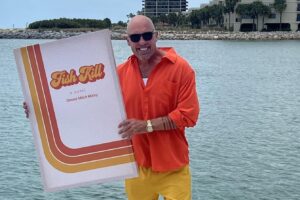
Dennis “Mitch” Maley
Mitch Maley: The book is a direct parallel to a community going through the same kind of developer-led infiltration of local government and getting rid of wetland protection policies like happened in Manatee County. By 2023, 2024, the politics in Manatee County had just become so absurd and cartoonish that I wanted to lampoon it, but even when it got done, it was like, “Is this—?” It’s only probably moderately more cartoonish than the real thing. It’s almost hard to do satire in today’s politics.
EJ: Fish Kill is a satirical crime novel set in a fictionalized coastal Florida municipality called Mullet County. The plot is centered on the mysterious death of Micky “Fish” Pesch, a local activist and community radio entrepreneur. Pesch’s career in investigative journalism and environmental advocacy frequently put him at odds with the county’s political and development interests, making his death a focal point for the narrative.
The investigation is carried out by Shelton Hamner, a journalist who works alongside a photographer named Ringo Khan. As the pair looks into the circumstances of Pesch’s death, the story expands to examine several key themes. Maley uses the narrative to explore the intersection of local government, land development and environmental regulation.
He uses the novel as a satire of local politics. Maley borrows motifs from the Florida landscape—specifically the swamp—as both a literal setting and a metaphor for the murky nature of municipal politics. In our conversation, I asked Mitch about the popular political rhetoric of “draining the swamp” and how that applies to his work.
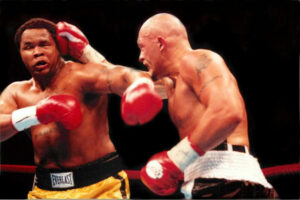
Not holding any punches — Mitch Maley defeating Willie Herring in 2002 | Photo courtesy Showtime Boxing
MM: The great irony is that he might have drained the swamp, but he threw a bunch of swamp monsters in it. You are kind-of using the same language as he used, and my politics are very different than his, but it’s time to reclaim that because there was no swamp-draining done, I don’t think, in any of the Trump administrations. Certainly, the swamp has gotten a lot swampier here in Florida, in my opinion.
EJ: Through the perspective of Hamner, the author examines the tension between independent local reporting and the influence of established political and corporate interests. Character development plays a significant role in the story. Hamner is presented as a protagonist who gradually moves from a detached observer to an active investigator. The interaction between him, Khan and other associates provides a framework for discussing the lack of accountability in local politics.
Maley’s background in journalism is evident in the book’s focus on the role of the local press. The novel depicts the Gazette—the newspaper owned by the victim—as a central institution that attempts to provide oversight in an environment where many feel that established channels of accountability are compromised.
As for what’s next, Maley shared his plans to continue this narrative:
MM: I’m going to keep this in a series. I’m planning on doing a three-book series with these same characters, and I’ve already got the stories outlined. I’m really enjoying it. I don’t think I’ve had as much fun writing a book as this one. This is my fifth go—I have three other novels and a short story collection—but this was by far the most fun, and it’s been fun to engage people with and talk about, so I think I’m going to shoot for a three-book series with these characters in this same story universe.
EJ: Fish Kill is a satirical crime novel that uses the framework of a murder investigation to provide a critique of Florida’s development landscape and local political dynamics. It reflects the author’s professional experience in investigating and reporting on these issues in the real world.
Mitch Maley will be interviewed by local journalist and author Cooper Levy Baker at a book signing event next week at Fogartyville Community Center. That’s Saturday July 18, 12:00 p.m. at 525 Kumquat Court.
Reporting for WSLR, I’m Ed James III.
WSLR News aims to keep the local community informed with our 1/2 hour local news show, quarterly newspaper and social media feeds. The local news broadcast airs on Wednesdays and Fridays at 6pm.