Construction is now underway at the 12th Street facility.
By Noah Bookstein
Host: We reported last week that the Sarasota City Commission approved a $51 million expansion and update of the city’s wastewater treatment plant. Now, WSLR News reporter Noah Bookstein is taking a deeper dive into the project, funded through a low-interest loan from the State of Florida.
Noah Bookstein: After the commission approved the work on July 20, construction is now underway at the 12th Street facility.
WSLR News sat down with Verne Hall, Sarasota’s utility director, who presides over a department of 135 employees.
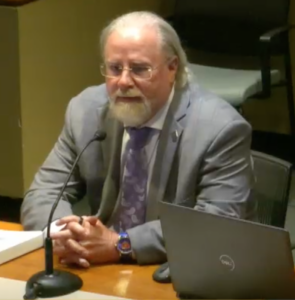
Verne Hall
Verne Hall: I do a little bit of everything. I was out hosing down on one of the clarifiers at the wastewater plant this morning because I was just doing a little walk through. I have meetings with administration, with other directors, with my staff. I go through the treatment plants. I go through the lift stations. I’m kind-of a jack of all trades.
NB: The water treatment process starts in a wellfield, a cluster of groundwater wells the city pulls raw water from before it is treated. Sarasota draws from two of them.
VH: With the city of Sarasota, we have two wellfields. We have what we call the Downtown Wellfield—which is here in town—and that’s a little bit more brackish. That comes in, and that water is treated by the RO process at the water plant. Then, about 20 miles east of town, we have the Verna Wellfield. That’s a little bit more organic sulfur TOC content. That water comes in and is treated by the IX process—the ion exchange. After those treatment processes, those two products are blended, treated with chlorine and pumped out into our distribution system.
NB: As Sarasota grows, the city expects to lean more heavily on the Verna Wellfield, so the city is planning to change technologies in order to best treat that water.
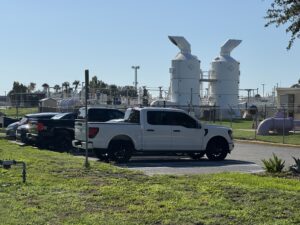
Sarasota Wastewater Treatment Plant
VH: As our growth increases, our dependency on the Verna Wellfield will also increase, so we’ll be pulling more water in from the Verna Wellfield, and we need a process that can handle that and still meet standards. As a part of our initial master planning, we did pilot studies and determined the best method for treating the Verna water to the standards that we’ll need, and nanofiltration was the winning technology. As a part of our new master plan, the design of that nanofiltration facility is already taking place.
NB: After treatment, the water goes to homes and businesses. Once it’s used, it goes back through the sewer system to the wastewater plant, where it’s cleaned and either discharged or reused for irrigation at places such as Bobby Jones Golf Course and Lakewood Ranch.
One key step in that cleaning process is something called a clarifier.
VH: It’s a big circular tank, and it has a bull ring in the center. The flow comes into that bullring, and that bullring kind of diffuses that—lets it settle down. Then the clarifier is very calm, and the sludge settles to the bottom of the clarifier, and the clear liquid goes to the top.
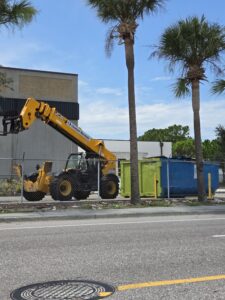
Photo: Noah Bookstein
NB: That sludge is kind-of alive.
VH: That sludge has our microorganisms, and that’s how a wastewater treatment plant operates. It’s basically a living organism. It has microorganisms that consume the waste that comes in. The operators are responsible for managing that population. They have to make sure that it has enough oxygen, that it has enough food. You balance all that with the food—the raw wastewater—coming in to be sure that that sludge is happy.
NB: The plant’s upgrades include adding a fourth clarifier to the plant’s current three, along with new piping, upgraded flow-control gates, increased capacity for wastewater processing and a single new electrical building to replace three aging ones. The upgrades are not necessarily meant to prevent damage to the plant during a historic storm such as Hurricane Debby.
VH: That facility’s rated at 10.2 million gallons. In one 24-hour period, we had 40 million gallons come through that treatment plant. Nothing’s going to stand up to that. When that happened, it loosened some material—some algae and whatnot—and caused a blockage in the effluent lines coming from the clarifiers, and that’s what caused us to spill.
NB: Hall says the city made a deliberate choice during the storm to keep pumping everything toward the plant rather than let sewage back up into neighborhoods.
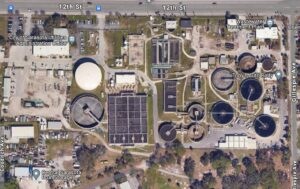
The city’s advanced wastewater treatment plant on 12th St.
VH: If we’re going to have a spill, we want it to happen here where we know how much we spilled, and we can at least do as much as we can to contain it.
NB: This project is just one piece of a longer-range plan. The city’s last utility master plan, from 2019, runs through 2040. A new one, now in progress, stretches to 2055. It is built around three pressures: population growth, emerging treatment technology and coming regulation.
VH: As a part of that master planning process, there’s calculations that you do for anticipated growth. We’re also looking at different treatment technologies, the coming regulatory changes on the horizon that we need to accommodate in our planning so that, if we need to make changes at treatment process, we have some options on what we need to do.
NB: One of those regulatory pressures is PFAS, so-called “forever chemicals” linked to cancer and pollution. Hall says PFAS doesn’t totally disappear in wastewater treatment; it either passes through, or gets trapped in the leftover sludge.
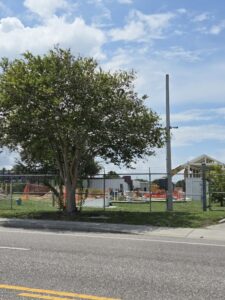
Photo: Noah Bookstein
That sludge is hauled to Charlotte County, where a contractor composts it. Hall says the city’s been working with the University of Central Florida to pin down exactly where in the process PFAS concentrates most. On the drinking water side, Hall says PFAS is not a problem after treatment.
VH: On the drinking water side, we don’t have any PFAS issues. We’ve been doing PFAS testing since before the UCMR 5 came out, and we didn’t have it then. We sample it a couple of times a year just to make sure that we don’t have it, and it is not present in our drinking water.
NB: He credits reverse osmosis—the treatment process used at the drinking water plant—as an effective method to treat the forever chemical.
VH: Reverse osmosis is an effective method.
NB: Hall says he wants listeners to know that the new upgrades, master plan and PFAS research are all part of the city’s constant planning.
VH: The utility is constantly planning. We’re constantly looking at things—figuring out what needs to be done, what improvements need to be made. If developers are coming in, they have to go through a whole permit review process. They have to go through the development review committee. Their projects are modeled in the system so that we know what those impacts are. In some instances, the developer has to pay if there’s improvements that have to be made to the system. They’re expected to pay for that. So rest assured that there’s an awful lot of planning that goes on. It’s a continuous state with the utility. We’re always looking at, “What are we doing today, and what do we need to be doing tomorrow?”
NB: Reporting for WSLR News, Noah Bookstein.
WSLR News aims to keep the local community informed with our 1/2 hour local news show, quarterly newspaper and social media feeds. The local news broadcast airs on Wednesdays and Fridays at 6pm.