The reversal of a lower court decision marks a major win for transparency advocates.
By Noah Bookstein
Original Air Date: September 3 2026
Host: In a big win for transparency advocates, a court ruled that the digital records produced by a Sarasota Police investigation involving Christian and Bridget Ziegler are public. Noah Bookstein reports.
Noah Bookstein: A Florida appeals court has ordered that digital records seized from Christian Ziegler during a 2023 criminal investigation can be released to the public. The unanimous ruling from Florida’s Second District Court of Appeal reverses a lower court decision and marks a major win for open-government advocates who have spent nearly three years fighting to make the records public.
Michael Barfield, a journalist and open government advocate who’s been part of that fight, spoke with WSLR News after the ruling came down.

Michael Barfield
Michael Barfield: This has been close to a three-year battle to get these records. We haven’t received the records yet; there will be some post-appeal processes that occur. I’ve been doing this about 40 years, and this is certainly one of the more significant appellate rulings that I’ve been involved with.
NB: The case dates back to late 2023, when the Sarasota Police Department investigated Christian Ziegler, then chair of the Republican Party of Florida, on allegations of sexual battery and video voyeurism. His wife, Bridget Ziegler, is a Sarasota County School Board member.
The police obtained warrants to pull data from his phone, Google Drive, and Instagram—more than a terabyte of material, including videos and photos. In March 2024, prosecutors dropped the case, citing insufficient evidence.
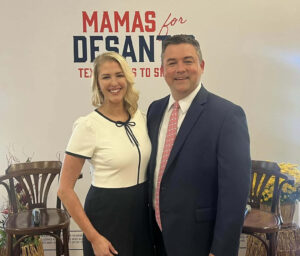
Bridget and Christian Ziegler
Under Florida law, once police copy, review and flag material as part of an investigation, it becomes a public record—regardless of whether charges are ever filed, and regardless of how personal the material is. That’s the principle the Florida Center for Government Accountability and several media organizations were fighting to enforce when they filed public records requests for the files investigators had reviewed. The Zieglers sued to block release and to have the data destroyed, arguing privacy and spousal privilege protected it.
A Sarasota circuit court judge sided with the Zieglers last July, calling the search warrants unconstitutionally broad and ordering police to destroy the files. The city held off on releasing or destroying anything while the media organizations’ lawsuit stayed alive.
On Tuesday, the appeals court threw that ruling out. Chief Judge Matthew Lucas wrote that the trial court had effectively invented exemptions to Florida’s public records law that do not exist in the statute. The panel reaffirmed that investigative files are public records and that an unconstitutional search does not create a records exemption. That does not mean the files go out the door tomorrow. The city still has to review the material against Florida’s list of statutory exemptions—some records may be redacted or withheld to protect third parties named in them—so the release itself will take time, even with the ruling in place.
The Zieglers could still ask the Florida Supreme Court to take up the case. Barfield says that’s a long shot.
MB: They could seek review in the Supreme Court. It’s not an automatic review, and in fact, less than 0.1% of all cases that someone seeks review are actually granted in the Supreme Court.
NB: The City of Sarasota has been caught in the middle of this because they are the custodians of the records in question. A representative for the City of Sarasota’s police department told WSLR News the city attorney is reviewing the ruling to determine whether or not the files are eligible to be released. Barfield says the fight, which has cost roughly $0.25 million, was worth it.
MB: You can’t really put a price tag on transparency, because if you do, you won’t have transparency. To us, it was vitally important that the public be allowed to see what some of the top elected officials and political figures in the state are up to. It’s a constitutional right in Florida. We were the first state to adopt the right of access to public records as a constitutional right, and that should mean something, so we fought to enforce that right.
NB: Reporting for WSLR News, Noah Bookstein.
WSLR News aims to keep the local community informed with our 1/2 hour local news show, quarterly newspaper and social media feeds. The local news broadcast airs on Tuesdays and Thursdays at 6pm.
 It's drive week!
Your gift keeps 96.5 on the air. Be one of the people who make it happen.
Donate Now
It's drive week!
Your gift keeps 96.5 on the air. Be one of the people who make it happen.
Donate Now