Two upcoming events in Sarasota spotlight the hostages taken by Hamas.
By Noah Bookstein
Original Air Date: October 15, 2026
Host: The Gaza hostage crisis continues to make ripples all the way to southwest Florida. Two events in Sarasota over the next weeks focus on the people taken in the Hamas attack on southern Israel October 7. One is a the screening of a documentary film that features a Sarasota family. The other is a sold-out event featuring another family on a big stage here. Noah Bookstein has the story.
Noah Bookstein: On October 7, about 1,200 people were killed in the attack and 251 were taken into Gaza as hostages. Israel’s military campaign in Gaza that followed killed tens of thousands of Palestinians, according to Gaza health officials, and drew widespread international criticism.
Many hostage families spent the next two years pressing Prime Minister Benjamin Netanyahu’s government for a deal, and many accused it of putting the war ahead of the hostages. A ceasefire last October brought the last living hostages home.
Now, with Israel’s first elections since the war began approaching, local organizers are highlighting the hostages and those who fought for them to be remembered as people.
 The first event is a screening of The Response, a documentary about ordinary Americans who held walks, runs and vigils so the hostages would not be forgotten.
Uzi Baram, an anthropologist and archaeologist who teaches at New College, joined one of those efforts, Run for Their Lives. Sarasotans walked once a week for 18 minutes, a number that stands for “life” in the Jewish tradition.
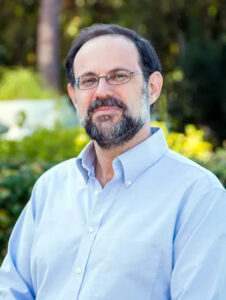
Uzi Baram
Uzi Baram: Here in Sarasota, the person who started the Run for Their Lives chapter isn’t Jewish. She just had heard about what happened and thought this is something she could do. A person who just thought, “No, no, this isn’t right”—that people are being held in captivity.
NB: Baram said the idea goes back to something he learned from Amnesty International as a teenager.
UB: If someone’s imprisoned, make sure the people imprisoning them know that people on the outside care.
NB: Baram shared photos of the walks with the filmmakers. Later, the director told him something surprising.
UB: He said that basically no one was interested in it—could I contact an independent theater in my area? And so I simply sent a message to Burns Court Cinema. They did the rest.
NB: Baram said that kind of quiet effort is rarely highlighted.
UB: When a woman in Boulder, Colorado was part of Run for Their Lives and someone threw fire at her and killed her and injured others, that got media attention. But the quiet work also deserves attention. I think this film gives us that quiet work and reminds all of us we can help make this a better world.
NB: He pointed to one of his heroes, the anthropologist Margaret Mead.
UB: “Never doubt that a small group of thoughtful, committed citizens can change the world. Indeed, it is the only thing that ever has.” I realize that’s really idealistic, but I also believe in that idealism.
NB: Asked about criticism of Israel’s war in Gaza, Baram said the event keeps its focus on the hostages.
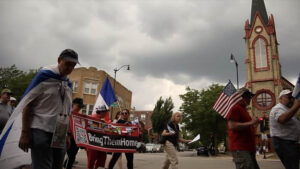
Screenshot from The Response
UB: The focus is very firmly on people who were kidnapped from their homes, and taken into captivity. I think everyone—every decent person—knows that’s wrong. Those who are seeking peace seriously know it’s really difficult and that we’re not the first moment to think about how to arrange peace in that land. But there’s very thoughtful people who are trying their best to make a difference, and that gets back to the Run for Their Lives. Focus on people. Focus on making people’s lives better.
NB: His field, he said, taught him to look past the categories people use to talk about the conflict.
UB: As an anthropologist, I use labels for people, but labels are fictions. We can easily talk about Israelis and Palestinians—it’s easy to say it—but there’s great diversity in both groups.
NB: Baram has also participated in efforts to support the Islamic Center of Sarasota-Manatee and the Black Lives Matter movement. He said this is about rejuvenating civic life.
UB: It isn’t just because of my own connection to Israel. It is much more my commitment to democracy that I think comes out of this—that we need to strengthen the civic society by getting together, by looking at the positive things people are doing.
NB: That is why he wants people to watch the film together.
UB: By going to a movie theater, by hearing people’s reactions and thinking about your reaction in relationship, I think something bigger comes about. Yelling at your screen won’t make anything happen, but getting together with others does it.
NB: The Response screens this Monday, October 19, at Burns Court Cinema. Baram will lead a discussion after the 6:30 showing.
The second event centers on the parents of hostage Hersh Goldberg-Polin. One of its organizers is Gisele Pintchuck, a former Jewish Federation professional who now helps run TheSIXsrq, a small volunteer-led Jewish community organization. On a trip to Israel after the attack, she heard from the mother of hostage Omer Shem Tov.
Gisele Pintchuck: She spoke loud and clear: “We need you—when you go home, when you are with your families, when you are with your representatives, when you are with your community—say my child’s name. Say Omer’s name.”
NB: Pintchuck’s group later brought Omer himself to Sarasota after his release, drawing a sold-out crowd of 800.
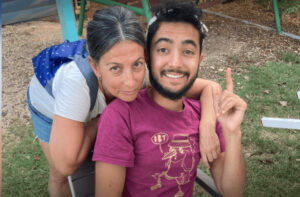
Rachel and Hersh Goldberg-Polin
Now TheSIXsrq and the Jewish Federation of Sarasota-Manatee will host Rachel and Jon Goldberg-Polin. Their son Hersh, a 23-year-old Israeli-American, was killed in captivity in 2024. His parents became leading advocates for the hostage families. Pintchuck reached out, and they accepted her invitation. Pintchuck says a phrase from Rachel’s memoir became a mantra.
GP: She says, “Hope is mandatory.” It’s not advice, it’s not a suggestion, it’s not an option. It is mandatory.
NB: The event sold out an 800-seat room in four hours, moved to the Van Wezel, and sold out again. About 1,700 people are expected.
GP: I think that is something very powerful about being together in one room, listening to a family share the story of someone they loved and they lost.
NB: She hopes the evening offers more than grief.
GP: I truly feel that the audience will carry something positive from the event—not just pain and sorrow for her loss. I hope that they take the same responsibility that I carry with me to continue telling these stories.
NB: The Goldberg-Polin event is November 17 at the Van Wezel.
Reporting for WSLR News, Noah Bookstein.
WSLR News aims to keep the local community informed with our 1/2 hour local news show, quarterly newspaper and social media feeds. The local news broadcast airs on Tuesdays and Thursdays at 6pm.
 It's drive week!
Your gift keeps 96.5 on the air. Be one of the people who make it happen.
Donate Now
It's drive week!
Your gift keeps 96.5 on the air. Be one of the people who make it happen.
Donate Now