Want to save Florida black bears? Buy a hunting license, conservationists urge.
By Noah Bookstein
Original Air Date: September 15 2026
Host: The sale of bear hunting permits went live on Friday, and preservationists are practicing activist jiu-jitsu to prevent bear deaths during the upcoming bear hunting season scheduled for most of December. Noah Bookstein reports.
NB: Conservationists across Florida have found a nonviolent way to oppose a hunt they cannot stop through official channels: by entering it themselves.
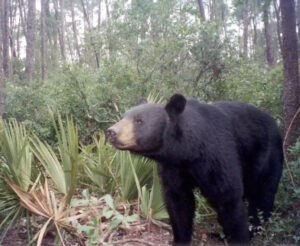
Photo: FFWC
Bear protectors are getting licensed as hunters and buying state lottery tickets for a shot at one of this year’s bear hunting permits. If they win, they hold the permit and save a bear’s life.
The campaign started last year out of frustration. 200 people showed up in person to a Florida Fish and Wildlife Conservation Commission meeting opposing the hunt. While FWC’s own scientists were in the process of compiling new data on bear populations, the commission, stacked with governor-appointed developers, pushed the hunt through anyway under the pretense that bear populations are too high. This year, there was not even a public comment period.
Susannah Randolph is chapter director for the Florida branch of the Sierra Club.
Susannah Randolph
Susannah Randolph: Last year, when they authorized it, they authorized a yearly hunt to occur. When we were stymied last year from having our voices heard and from having the Florida Wildlife Commission respond to us, we decided, “Let’s get everybody together and enter the lottery to see if we can get some permits in the hands of conservationists and people who know that this is not a good, well done hunt.” It’s not based on science—it’s not based on any evidence—so our only play was to have people buy up tickets to try to hold down the permits for conservationists and wildlife supporters.
NB: Environmental organizations including Sierra Club and Bear Warriors United are helping to organize the effort to buy up tickets for the hunt. Randolph bought a ticket herself.
SR: I remember when I bought my lottery ticket last year. I sat for a minute and felt incredible because I thought, “This could be the ticket that saves a bear’s life.”
NB: Last year, conservationists and non-hunters bought up a significant amount of tickets, and while it is hard to pin down how many bears were saved by the effort, only 52 of the 172 permits issued were used during the 2025 hunt. This year, FWC raised the number of permits to 215.
SR: That’s why we have to get that many more people this year to enter this lottery so that we can protect these 215 bears with targets on their backs.
NB: Here’s how it works: a hunting license costs $17—free if you’re 64 or older. Lottery tickets are $5 each. Sierra Club suggested its members try to get one ticket for each of the state’s four bear hunting zones. Win a permit, and it costs $100. Sierra Club has set up a fund to help cover that fee for individuals who cannot. The lottery closes September 21.
Florida black bears are found nowhere else in the world. By the 1970s, hunting and habitat loss had driven their population down to just a few hundred bears, and the state banned bear hunting altogether in 1994. Decades of conservation work brought them back, with estimates putting the population around 4,000 bears.
Randolph and wildlife biologists say the hunt was never based on sound science, and that FWC ignored their own data.
SR: When we look at this population, it’s not sustainable because of the encroaching threats on their territory and on their habitat. The FWC last year actually revised the permit number down from 187 down to 172 because they ended up going back and looking at the Osceola forest population and found that there had been a two-thirds loss to that population. That was after they’d already authorized the hunts.
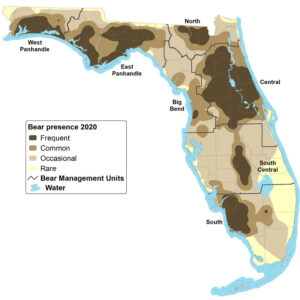
Florida black bear presence as of 2020; darker shades represent greater presence
NB: Florida’s black bears are not spread evenly across the state. They’re clustered into several distinct subpopulations, concentrated in the Panhandle, in Big Cypress and the Everglades region and across pockets of North and Central Florida. Near Sarasota County, for instance, the bear population is low, but Big Cypress, 140 miles to the south, holds one of the state’s largest black bear subpopulations.
The four zones in this year’s hunt are limited to where there are larger bear populations, but wildlife biologists point out the FWC tends to manage hunting as if each subpopulation were its own island. Wildlife biologists say these subpopulations are connected. Bears disperse between them, and that movement between groups is essential for the whole species to survive.
If hunting occurs in larger bear populations, it is possible that less bears will try to move across the state and get to smaller populations, leaving them vulnerable.
SR: If you have a small group of bears and they’re essentially inbreeding, you’re opening them up to being much more vulnerable to disease.
NB: Traveling for bears is already very dangerous. Vehicle collisions are the leading cause of bear deaths in Florida as they try to cross land fragmented by roads and developments without well-connected wildlife corridors. A Florida black bear, in fact, was the inspiration behind the Florida wildlife corridor. Florida black bears largely try to avoid humans but can be drawn into neighborhoods by improperly secured trash cans.
Randolph says the Sierra Club hears from a lot of residents who know black bears are not a threat.
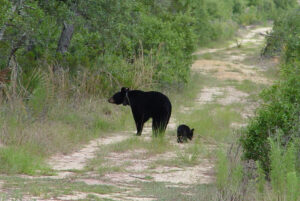
Photo: FFWC
SR: We hear from a lot of people up in the Panhandle and all around where they have bear populations. They see regular bears. They know them. They know they’re not a threat. They know they’re not a nuisance. But they would be horrified to know that that was one of the bears that got killed.
NB: Sierra Club wants the hunt scrapped entirely and the lottery money redirected towards Bearwise trash cans, which keep bears out of neighborhoods in the first place.
SR: We know that the science and the work of these staff members is being pushed aside by the political appointees on the board. We would really urge that they stop it and go back to the drawing board and look again. They need to go out and do a real count, and they need to go out and and make sure that what they’re extrapolating—what they’re estimating—is actually matching with the reality on the ground with these populations.
NB: For more information, visit the Sierra Club’s websites or social media channels. Reporting for WSLR News, Noah Bookstein.
WSLR News aims to keep the local community informed with our 1/2 hour local news show, quarterly newspaper and social media feeds. The local news broadcast airs on Tuesdays and Thursdays at 6pm.
 It's drive week!
Your gift keeps 96.5 on the air. Be one of the people who make it happen.
Donate Now
It's drive week!
Your gift keeps 96.5 on the air. Be one of the people who make it happen.
Donate Now