But the rule’s wording leaves unclear which students would be ‘lawful’.
By Rhatia Murphy
Original Air Date: July 17, 2026
Host: The Florida Board of Education voted 4-1 to approve a new rule that tells the state’s 28 two-year and community colleges to develop policies that effectively ban undocumented students from enrolling. Rhatia Murphy reports.
Rhatia Murphy: Florida’s State Board of Education approved a new rule that will require students enrolling in Florida’s public colleges to prove they’re U.S. citizens or “lawfully present.”
The rule effectively bars undocumented students from enrolling in Florida’s 28 state colleges. But nearly a month after it passed, one major question remains: Who exactly qualifies as “lawfully present?”
The answer isn’t entirely clear.
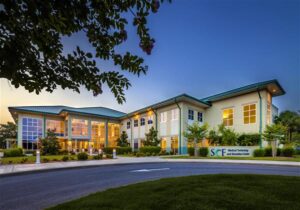
The Medical Technology and Simulation Center at State College of Florida’s Lakewood Ranch campus. At schools like SCF, students will be required to prove they’re U.S. citizens or “lawfully present” | Photo: gulfshoresrealty.com via Wikimedia Commons
Alexis Tsoukalas: This rule, even though it was moderately revised, would require students to demonstrate that they’re U.S. citizens or “lawfully present” to enroll in any of Florida’s 28 colleges, and there’s an attestation that they have to give to apply and documentation before they enroll. Essentially, this is banning undocumented students from enrolling in our state colleges.
RM: This is Alexis Tsoukalas, education analyst for the Florida Policy Institute. The progressive think tank criticizes the rule, arguing that limiting access to higher education could have long-term consequences—not only for students but for Florida’s workforce and economy.
AT: When you block people from enrolling in colleges and universities, not only does it harm their prospects individually, but it harms our broader economy. The goal is to get 60% or more people to have higher education access—to either have a degree or a certificate. You can’t do that if you’re blocking entire groups of people from enrolling and being admitted to colleges.

The Stephen J. Korcheck Student Services Center at State College of Florida’s Bradenton campus. The new rule does not define “lawfully present,” raising questions about which applicants and enrollees will be impacted | Photo: gulfshoresrealty.com via Wikimedia Commons
RM: The rule’s wording has also created uncertainty. It requires students to prove they’re “lawfully present,” but it does not clearly define which immigration categories qualify. That has raised questions about current students, future applicants, DACA recipients—also known as “Dreamers”—and others whose legal status may not fit neatly into existing categories.
AT: We’re still not getting clarity on it. The phrase “lawfully present” can be very broad. It could definitely include DACA recipients. There’s no stipulation about which type of enrollees or those who are applying that this would impact.
RM: CJ Czaia is a co-founder of Unidos Now, a Sarasota-based non-profit that helps immigrants get a college education. He says that uncertainty may ultimately have to be resolved in court.
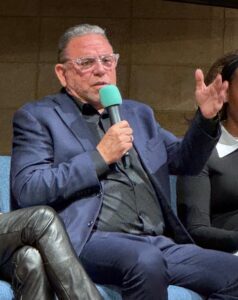
CJ Czaia | Photo: Johannes Werner
CJ Czaia: What exactly is legal status? This is going to have to be litigated. I don’t know what this means.
RM: Supporters of the rule argue public colleges should prioritize students who are legally present in the United States. But policy analyst Tsoukalas says undocumented students already pay tuition and are not displacing other applicants at Florida’s state colleges.
AT: People pay money to attend these schools. They’re still paying for this education. It’s just not true that immigrants are taking up spots that non-immigrants in Florida would be occupying.
RM: Others worry the rule could make it harder for Florida to build the workforce it says it needs. Kelly Kirschner, board chair of Unidos Now, says restricting access to higher education could have ripple effects well beyond the classroom.
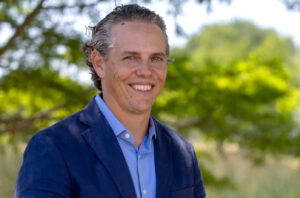
Kelly Kirschner
Kelly Kirschner: These students were paying tuition. It’s hurting workforce development. On all levels of this, beyond mean, it’s just stupid—beyond stupid.
RM: Kirschner is also running for U.S. Congress in Manatee County-centered District 16.
For students and families trying to understand what comes next, advocates say answers remain limited. The Florida Immigrant Coalition has established a hotline for people with questions about changing immigration policies, while legal organizations continue reviewing the rule.
Whether the policy ultimately faces a court challenge remains to be seen.
AT: Rulemaking—that’s what this is—is supposed to provide guidance on implementing laws that have already been passed. There is definitely an argument to be made that this is not something that the Florida Department of Education should be doing at all.
RM: The Florida Policy Institute says the broader concern extends beyond one group of students.
AT: Florida can’t meet its education and employment goals if entire groups of students are sidelined from the process. People are just going to go elsewhere and take their money and their brains elsewhere, and we’re all going to suffer as a result.
RM: The new rule applies to Florida’s 28 two-year and community colleges. A separate proposal affecting Florida’s 12 public universities is still under consideration.
For WSLR News, I’m Rhatia Murphy.
WSLR News aims to keep the local community informed with our 1/2 hour local news show, quarterly newspaper and social media feeds. The local news broadcast airs on Wednesdays and Fridays at 6pm.
 It's drive week!
Your gift keeps 96.5 on the air. Be one of the people who make it happen.
Donate Now
It's drive week!
Your gift keeps 96.5 on the air. Be one of the people who make it happen.
Donate Now