Care and hospitality employers are expected to feel the impact.
By Ifhmalee Caceuis
Original Air Date: July 17, 2026
Host: Temporary Protected Status, or TPS, ends for Haitian immigrants on Friday next week, and that could have a big impact on the care industry and patients in Florida. A combined 5,500 Haitian immigrants live and work in Sarasota and Manatee counties, according to census data. And an estimated 45% of them are here under TPS. Ifhmalee Caceuis is trying to understand the impact on this area.
Ifhmalee Caceuis: The end of TPS for Haitians has raised concerns about the future of thousands of workers—and their employers—across Florida. Following a U.S. Supreme Court ruling in late June, the Trump administration moved forward with ending TPS protections for Haitian and Syrian nationals. While federal officials initially said work authorization would expire on July 10, U.S. Citizenship and Immigration Services later extended work authorization through July 24 as legal challenges continue.

Haitian worshiper in Sarasota | Courtesy New Jerusalem Haitian Baptist Church
The uncertainty has sparked concern among employers and industry leaders across multiple sectors of Florida’s economy. According to the Florida Health Care Association, roughly 145,000 Haitians live in Florida, and an estimated one in four works in healthcare. The organization warns that losing those workers could disrupt care for hundreds of thousands of older Floridians who rely on nursing homes and long-term care facilities.
Haitian workers also play a significant role in Florida’s hospitality industry. More than 90,000 Haitian immigrants are legally employed in jobs ranging from hotel and resort operations to restaurants and food service, contributing billions of dollars to the state’s tourism economy.
Together, these industries rely on a workforce that could face significant disruption if large numbers of Haitian TPS holders lose authorization to work.
Temporary Protected Status is a federal humanitarian program that allows people from countries facing extraordinary conditions such as armed conflict, natural disasters or political instability, to temporarily live and work in the United States. Haiti has remained eligible for TPS because of years of political instability, gang violence and humanitarian crises.
For many Haitian immigrants in Florida, the end of TPS means uncertainty whether they will be able to continue working, support their families and remain in the communities they have helped build.
Pastor Jean Tannulis of New Jerusalem Haitian Baptist Church in Sarasota says members of his congregation are already feeling the effects.

Pastor Jean Tannulis
Jean Tannulis: Lost their job—it stopped them from working. Nowhere to go. They don’t know what to do. They just wait to see what’s going to happen.
Dr. Rich Templin, director of politics and public policy for the Florida AFL-CIO, says TPS holders are not just immigrants. They are workers who have been legally employed and are filling critical roles across the state.
Rich Templin: The people that are impacted are doing everything right. They are here with legal protections. They have a clear immigration status. They are working. They are doing everything that they are supposed to be doing.
IC: Templin says removing protections from workers who are already contributing to Florida’s economy could have effects far beyond the individuals directly impacted.
RT: Nobody works in a vacuum. For every person that has a job, there’s someone that relies on that person, or there’s another job that relies on that person, or there’s a company that relies on that individual so that they can keep their doors open and keep other people employed.
IC: Haitian workers on TPS are part of a larger workforce that supports some of Florida’s most essential industries—healthcare, nursing homes, restaurants and hospitality.
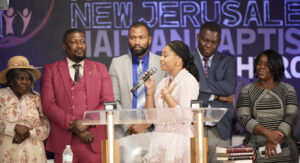
Haitian worshipers in Sarasota. | Courtesy New Jerusalem Haitian Baptist Church
From caring for older Floridians to working in hotels, resorts and food service, immigrant workers help keep critical services operating across the state.
Pastor Tannulis says many Haitian immigrants came to the United States seeking safety, opportunity and a better future for their families.
JT: They heard that the United States is a free country—a home of opportunity. They try to flee a dictatorship—a gang government—to look for freedom, and instead of finding something better, they end up coming to a country where they push them back, tie their feet, tie their hands, and then back to the same country they left, even when they apply for political asylum.
IC: To the Sarasota pastor, the end of TPS is more than a technicality.
JT: This is not the United States that I know.
IC: Labor advocates say the future of TPS holders will depend on ongoing legal challenges and decisions made by policymakers.
Templin says members of the public have a role in shaping what happens next.
RT: Let their elected officials know how strongly they feel about this because, at the end of the day, yeah, we’re taking some hits, and sometimes it seems like really dark days, but we’re still a democracy. Our elected leaders at all levels need to know how disastrous and unwise this decision is.
IC: For WSLR News, this is Ifhmalee Caceuis.
WSLR News aims to keep the local community informed with our 1/2 hour local news show, quarterly newspaper and social media feeds. The local news broadcast airs on Wednesdays and Fridays at 6pm.
 It's drive week!
Your gift keeps 96.5 on the air. Be one of the people who make it happen.
Donate Now
It's drive week!
Your gift keeps 96.5 on the air. Be one of the people who make it happen.
Donate Now