The company that employs the husband of Fiona McFarland is poised to reap a $6m windfall from a state contract
By Michelle DeMarco/Florida Trident
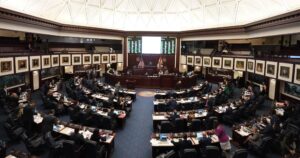
Florida House chamber | Photo: WMNF
A California-based data integration company that employs the husband of Florida State Rep. Fiona McFarland (R-Sarasota) is poised to reap a multi-million dollar windfall as lawmakers continue to finalize a state budget.
Documents released by the Florida House on May 15 show a $6 million entry suddenly added by the House Justice Budget Conference Committee as part of the negotiations between House and Senate budget conferees.
The language lacks details but mirrors a $6 million legislative budget request submitted as a budget amendment in early January by the Florida Department of Law Enforcement (FDLE). The purpose of FDLE’s request was to expand the operations of Peregrine Technologies data integration operation.
McFarland’s husband, Matthew Melton, is a top executive with the company. A former naval intelligence officer, Melton was hired by Peregrine in 2024 and heads the company’s business development and partnerships.
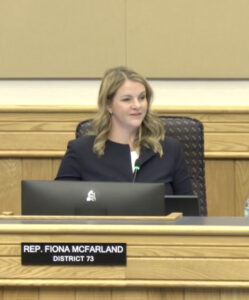
Fiona McFarland | Photo: WSLR
When reached last week by the Florida Trident, McFarland, a budget conference member of the House Justice Budget Subcommittee and co-chair for the IT Budget, at first denied any knowledge of FDLE’s request. “That one I’m not familiar with,” she said.
In a follow-up interview, however, McFarland said she was aware that the money for Peregrine was being sought but insisted she had nothing to do with securing the funding, or it appearing as a new item in the May 15 House proviso offer.
“I knew that it was in the Governor’s recommended budget in the first place,” she said, adding she thought the money had not made it into the original spending proposals passed by the House and Senate earlier this year. “I had chalked it up as a loss already,” she said.
FDLE’s January legislative budget request (LBR) sought $6 million to expand a data platform collecting intelligence information from state and local law enforcement and state and justice agencies “for data sharing and collaboration,” according to the budget documents. The project enabled law enforcement’s ability to “integrate, deduplicate, and connect data from across over 20 different data sources.”
The January LBR, added by FDLE as an addendum to its budget, identified the resources the agency was seeking: “The department requests $6,000,000…to continue the use of Peregrine for the state of Florida law enforcement partners.”
McFarland said she only became aware of her conference committee’s sudden addition of the $6 million in the proviso offer after reading about it in a news post.
She said that’s when she asked her husband about it.
“Did you somehow get that back in the budget? I didn’t think that was possible,” McFarland said she asked her husband. His reply: “I don’t know how we got it, but we got it.”
The Legislature’s sole constitutional obligation is to annually pass a balanced state budget, a process which typically occurs during the regular 60-day annual session. But for the second year in a row, budget talks stalled during the regular session and no agreement was reached before the session ended March 13th.
Lawmakers returned to Tallahassee on May 12th for a special session focused on passing a balanced spending plan by May 29. The state constitution requires a 72-hour cooling off period once the chambers’ presiding officers have officially agreed on a spending plan and before a final vote by the full House and Senate can be taken to give the public time to weigh in.
But the process itself has been criticized by Democrats and others for its secrecy, including decisions made behind closed doors and money appearing in the budget or in negotiation offers that’s often hard to trace or identify its beneficiary.
Additional funds earmarked for Peregrine which appeared in HB5001E, the proposed House budget as originally written, is one such example. Described as $2 million for “Data Analytics Software for Hurricane Preparedness, Response and Recovery,” the budget entry has no additional descriptive information other than a number alongside the entry marking it as a local House Appropriations Request. But documents on file with the House show that the request was actually for $4 million, and was made by the Sarasota County Sheriff’s Office by Rep. James Buchanan (R-Sarasota). An identical $4 million local funding request was filed in the Senate by Sen. Jonathan Martin (R-Ft. Myers) records show, while the Senate-passed spending proposal, SB2500E, shows $500,000 allotted for the project.
The only clue as to where the money was headed comes from that separate local funding request, which notes it “will be used to expand the successful use of the Peregrine platform” in Sarasota County in tandem with the Florida Division of Emergency Management. The documents also note a $3 million appropriation approved the year before for a similar Peregrine project in Manatee County.
In response to questions included on the House local appropriations request form of whether the need for the funds had been “documented by a study, completed by an independent 3rd party for the area to be served?” the answer was “No.”
On the question of whether the Peregrine funding was “related to relief or recovery from a natural disaster?” the House funding request checks “No.” The Senate checks “Yes,” identifying mitigation efforts and identifying natural disasters of “Hurricanes Helene, Milton and Debby.”
The local appropriation requests also identify lobbyists connected with the projects. In this case, Nick Iarossi, an influential Tallahassee lobbyist is listed as the contact lobbyist on the $4 million Peregrine appropriation request.
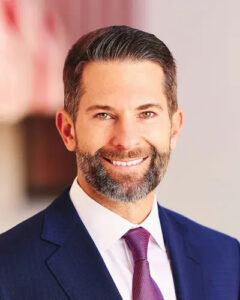
Nick Iarossi | Capital City Consulting
Peregrine became a client of Iarossi’s Capital City Consulting (CCC) firm in 2025, according to state lobbying registration records. That was the same year Peregrine’s political contributions to the high-powered lobbying firm’s political action committee began as well, according to state campaign finance records.
Beginning on Nov. 21, 2025, Peregrine Technologies made three contributions to CCC PAC, the most recent on January 7 of this year, for a grand total of $225,000 thus far.
CCC PAC has donated hundreds of thousands of dollars to several of Florida’s political committees and candidates over the years, including House and Senate leadership.
Contacted on Thursday regarding Peregrine and the new $6 million House proviso language, Iarossi, through his assistant, declined comment after being informed of the nature of the question. “Nick is going to have to pass on that one,” the assistant said.
According to McFarland, while Iarossi lobbied her on other issues, no lobbying was done on any project connected to her husband’s business. Both husband and wife traveled together to Tallahassee on at least one occasion, she said, and found themselves at the CCC lobbying firm at the same time. Melton, she said, was there to meet about Peregrine, which she said she tried to avoid hearing anything about while she met with the firm on a separate issue.
Whether the $6 million for the data integration expansion project makes it into the final budget is as yet uncertain, though the Senate appeared to accept the House proviso language over the Memorial Day weekend. The final budget is expected to be released for review on Tuesday.
While the language in the proviso provides for “the department” to “competitively procure an independent third party provider,” McFarland conceded that the language is pro forma because specifying a specific vendor in budget language is not permitted under rules of operation. “I’m guessing that’s what happened,” she said, adding that her husband confirmed his interest in bidding on the project.
McFarland said that she was aware that her husband’s company had both state and local contracts. But she said she had notified the House leadership early on of her husband’s employer and asked that they help her “do the right thing” by keeping separate any Peregrine-related matters.
“They were completely accommodating,” she said.
Asked if the knowledge of her husband’s relationship with Peregrine might have influenced the reinsertion of the $6 million in the new proviso language, McFarland said she didn’t “want to opine” as to what the thoughts of the House leadership might have been.
Rep. Patt Maney (R-Fort Walton Beach) who chairs the House Justice Budget Subcommittee had also been given a heads up to maintain separation, McFarland said, later saying she thought he may have been aware of her husband’s employment. Their families have known each other for six years, she noted.
According to Maney, the money originated as a recommendation from the governor’s office. “I didn’t get it until well into session,” he said. “I think it was knocking around before then.”
Maney said he could not recall if the recommendation was sent directly from the governor’s office or FDLE, but that his understanding was that it “was for FDLE.”
Whether it originated directly from the governor’s office or FDLE, Maney said the $6 million was sent to his committee’s staff director, who then passed it to Maney. He also noted that “there are multiple vendors that might be interested. It would have to be competitively bid.”
Asked about the similarities in descriptions between the original FDLE request specifying Peregrine, and the House proviso offer, and whether those similarities might raise questions about the competitiveness of any bidding process, Maney replied, “As I understand the rules, we’re going to follow the rules.”
WSLR News aims to keep the local community informed with our 1/2 hour local news show, quarterly newspaper and social media feeds. The local news broadcast airs on Wednesdays and Fridays at 6pm.
 It's drive week!
Your gift keeps 96.5 on the air. Be one of the people who make it happen.
Donate Now
It's drive week!
Your gift keeps 96.5 on the air. Be one of the people who make it happen.
Donate Now