These crews brave turbulence (and tedium) to keep you out of harm’s way.
By Ramon Lopez
Original Air Date: May 8, 2026
Host: NOAA’s hurricane hunters made a stop at Sarasota-Bradenton International Airport, and Ramon Lopez was there.
Ramon Lopez: We are being urged by weather forecasters to begin preparing now for the 2026 Atlantic hurricane season. It officially begins on June 1 and runs through the end of November.
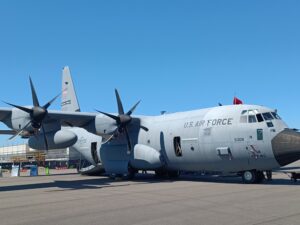
Hercules hurricane hunter at Sarasota-Bradenton International Airport. | Photo: Lopez
Accuweather warns that as many as five storms could directly impact the United States. This despite a developing El Niño climate pattern, which is expected to keep the overall number of storms near or below historical averages.
AccuWeather meteorologists expect between 11 and 16 named storms to form during the upcoming Atlantic hurricane season. Of those, four to seven are expected to become hurricanes. Two to four could reach major hurricane status, meaning Category 3 or stronger, with sustained winds of at least 111 mph.
The weather forecasters say every coastal resident should not “throw caution to the wind” because it takes only one hurricane making landfall in their area to ruin one’s day. So thorough preparation should be made every season, regardless of the predicted activity.
Raising awareness of the threat were NOAA and U.S. Air Force hurricane hunter crew members who were in town on Monday. Locals got a closeup look at the specially equipped aircraft that help federal forecasters. On display at SRQ were a NOAA-operated WP-3D Orion and King Air and a U.S. Air Force Reserve WC-130J Hercules.
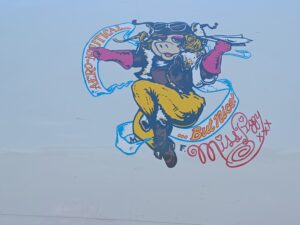
The Orion hurricane hunter is named in honor of Miss Piggy, the Muppets character. | Photo: Lopez
The Orion and Hercules fly directly into the core of a hurricane to gather data that are critical for forecasting a cane’s intensity and landfall. The data is sent from the flying laboratories—in real time via satellite—to the National Hurricane Center in Miami for analysis and forecasting.
While satellites provide a significant amount of information, the data the “Hercs” gather within the storm is unique and cannot be captured from space. That information helps the NHC refine forecasts and gives people more time to prepare.
A typical mission lasts eight to 13 hours. The hurricane hunter flight crew fight severe wind turbulence and buffeting in the eye wall before finding beauty, peace and calm in the hurricane’s eye. And it’s not uncommon to see flocks of birds flying alongside the hunter aircraft.
For all its daredevil thrills, hurricane hunting is tedious work. One pilot called it “hours of boredom interspersed with moments of sheer terror.”
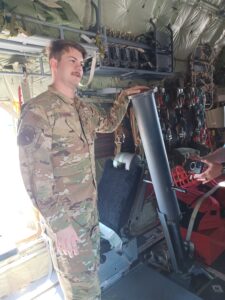
TSgt Robbins | Photo: Lopez
We asked Tech Sergeant Robbins why he’s a hurricane hunter.
Sgt. Robbins: I enjoy the job. You go and fly a mission. You’re tired, you’ve flown for 13 hours, you’re exhausted, but then you turn on the news and you see, “Oh. 53rd Weather Reconnaissance Squadron flew another storm, and it’s reduced the uncertainty by this much.” It’s kind-of nice to see the fruits of your labor.
RL: Asked him if he’s had any close calls.
Sgt. Robbins: Overall, it’s a very safe airplane. There’s times where it gets super turbulent where you start to question, but overall, everything’s pretty safe.
RL: I also asked him what it feels like flying in the eye wall.
Sgt. Robbins: It gets pretty bumpy. It gets very turbulent in the plane. The first hurricane I flew was a Cat 5, and that was my first experience—getting tossed around in the back of the airplane, all because of the turbulence. I’m actually terrified of heights!
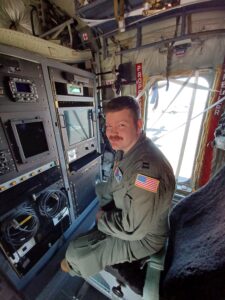
Weather Officer McKoy | Photo: Lopez
RL: And in the ’eye’ of the hurricane?
Sgt. Robbins: The eye is super calm and—clean air. As soon as you hit the eye, it’s just crisp, clean air, and it’s super smooth in there.
RL: I also spoke to Weather Officer Cpt. Mark McCoy. Same question. What’s it like flying in the middle of a storm?
Mark McCoy: They’re all so very different. Some of them are pretty bumpy for a long time. Some, not much—you don’t feel anything. The best way I can describe it is basically like going through a car wash on a roller coaster for several hours.
RL: Mark says being a weather-watcher is “the Real McCoy.”
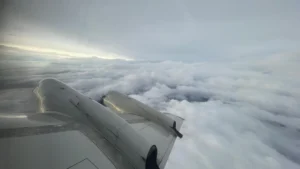
Photo via NOAA
MM: Every day I do this, I know that what I’m doing is helpful—it’s critical—and every time I get into the plane to fly a storm mission, I know that what I’m doing is actually going to benefit and help save people’s lives.
RL: But is the work dangerous?
MM: It can be dangerous, but our squadron trains absolutely the best as we can to be as safe as we can going through these storms. We don’t do anything that unnecessarily puts us into danger.
RL: Captain McCoy said he never thought he’d be an airborne hurricane hunting weatherman.
MM: Not in a million years. This was not on my bingo card, so to speak. I knew they existed, but I just never thought I would actually be working with the hurricane hunters. Like I said, my goal was to go to the Weather Service, but this opportunity came up in my last year, and I jumped on it, and I somehow got in it.
There’s only one of us—this is the only squadron that does what we do. It’s pretty exciting and also humbling knowing that I’m a part of this mission set and knowing what I’m doing is extremely important.
RL: This is Ramon Lopez for WSLR News.
WSLR News aims to keep the local community informed with our 1/2 hour local news show, quarterly newspaper and social media feeds. The local news broadcast airs on Wednesdays and Fridays at 6pm.
 It's drive week!
Your gift keeps 96.5 on the air. Be one of the people who make it happen.
Donate Now
It's drive week!
Your gift keeps 96.5 on the air. Be one of the people who make it happen.
Donate Now