Amendment 3 passed, leaving Florida municipalities with big questions.
By Johannes Werner
Original Air Date: Nov. 5, 2026
Host: Florida voters passed Amendment 3 by a good margin, it will take effect January 1, and now the scramble is on in city halls and county administrations to adapt their budgets to the new reality of substantial property tax cuts. We have a look at what’s next for the City of Sarasota.
Johannes Werner: In his first post-election press conference Wednesday in Tallahassee, outgoing Gov. Ron DeSantis called his Amendment 3 initiative the “beginning of the property tax elimination program,” credited it for Republican wins, and he pledged to call legislators into a special session before January 1 to implement what he calls a “taxpayer bill of rights.”
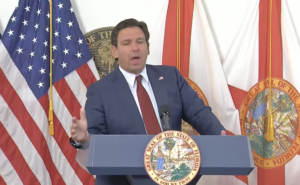
Gov. Ron DeSantis during the Nov. 4 press conference. | Screenshot Governor’s Office video
Ron DeSantis: We also saw the passage of Amendment 3, which is the beginning of our property tax elimination efforts in the state of Florida. I got a resounding “yes” vote. I’m very proud of everyone that had been a part of that, and I know that’s something that’s very meaningful for a lot of Floridians. The truth is—and this is something that I pushed for over many months and even over the last year—had Amendment 3 not been on the ballot, I don’t know that we’d turn out the voters that we ended up turning out. People wanted to vote “yes” on that, and then many of them ended up voting Republican later on down the ballot.
JW: He said the implementation should block local governments from raising fees or raising other taxes, and how the state should set aside funds cities and counties could ask for to make up local shortfalls. He called these funds “budget dust.”
RDS: I think what it will do is set the schedule for further homestead expansion, obviously, because we want people to be able to get that, but also limiting local governments from doing an end run around the amendment and taxing them in other ways. It’s budget dust to help them with their sheriff’s departments. We’re talking about tens of millions of dollars in grants would be able to handle the “shortfall.” We’ll be able to do that. There will be a transition period. We’ll work with them on that. I think people are going to be very excited to get some much needed relief.
JW: The same day, the City of Sarasota put out a press release.

Karie Friling
It quoted City Manager Karie Friling saying: “Florida voters have spoken, and we respect their decision.”
“Local government must now address the financial realities associated with these changes, while continuing to provide the essential services our community expects and deserves.”
Friling said it would be premature to speculate about specific service cuts. The city expects an immediate hit of $5.6 million in revenue in the first year and that this amount will grow each year. The press release pointed out that Amendment 3 explicitly mandates the complete sunset of homestead property taxes without having to go back to voters.
Friling also said the city will work closely with local state legislators “to ensure its position is represented.”
Jen Ahearn-Koch was just re-elected to a third term as city commissioner. She told WSLR News she is most concerned about the uncertainty—first and foremost, the timeline towards elimination of property taxes.

Jen Ahearn-Koch
Jen Ahearn-Koch: There are so many question marks and vague and gray areas. We have to wait and see what is meant by a lot of the terms.
JW: Another problem: The city depends on services provided by the county, such as transit or emergency services. But the city does not know yet what the county is planning in regards to these services.
Ahearn-Koch is also worried about vague language in the amendment about what municipalities are allowed to spend taxpayer money on. She says public safety is not mentioned in the list of permitted activities, nor are historic preservation or economic development.
JAK: The way we read it right now, it doesn’t include a whole lot of things that we do. We are looking for clarity on that. Public safety is not at all called out as protected. A big piece of what we do is health, safety and welfare. Would we be allowed to spend our dollars on public safety?
JW: Another worry: The well-being of existing staffers and the city’s ability to attract quality employees.
JAK: We rely on—our community relies on—the quality of life we so value here—that’s provided by the humans. We have to compete with the market, and our staff are our magic tool.
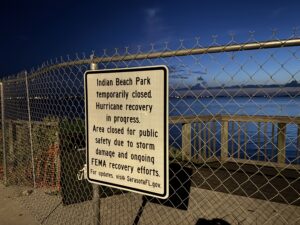
The city is trying to replenish its hurricane-depleted reserves using property taxes. It’s unclear how the city will now rebuild its financial cushion for the next storm. | Photo: Werner
JW: And then there are hurricanes. The city used to have close to 30% reserves. But that emergency fund has been depleted to fix the damage from the epic 2024 hurricane season.
JAK: If we are unable to build up those reserves—which I don’t know how we will be able to—I don’t know how that works.
JW: The city recently increased its property tax rate.
JAK: All of that increase goes to replenishing our reserves, and if we don’t have the ability—well, we won’t have the ability—to collect property taxes, I don’t know how we will replenish our reserves.
JW: Jeff Brandes is a Republican, a former state senator, founder of the Florida Policy Project think tank and a critic of Amendment 3. In a post on X Wednesday, he urged legislators to wrap their minds around the cuts cities and counties will face. Brandes listed cuts, from the Pinellas County Sheriff’s Office to the possible shutdown of the seven-member police force in rural Bowling Green, Hardee County.
“The governor and Legislature own what comes next. They have the responsibility to manage the fallout.”
Brandes points to the fact that counties might see themselves forced to pick up the slack for cities. Dissolving cities and mergers with counties are not just a distinct possibility.
“Some cities will struggle to stay on their own. The worst outcome is letting a city spend years draining reserves and raising fees, only to leave the county scrambling to keep basic services running.”
Stay tuned. Reporting for WSLR News, Johannes Werner.
WSLR News aims to keep the local community informed with our 1/2 hour local news show, quarterly newspaper and social media feeds. The local news broadcast airs on Tuesdays and Thursdays at 6pm.
 It's drive week!
Your gift keeps 96.5 on the air. Be one of the people who make it happen.
Donate Now