Our neighbors to the south could be at risk of extended blackouts.
By Johannes Werner
Original Air Date: January 30, 2026
Home: Reminder: Havana is as close to Sarasota as Tallahassee. And there is a long history of migration to Florida when things are not going well in Cuba. Now, the Trump Administration has announced unprecedented moves aimed at strangling Cuba’s energy supplies. That, in turn, could lead to extended blackouts. We have the details.
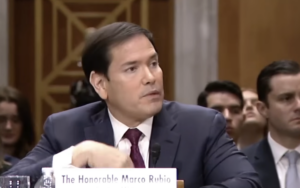
Rubio during the House Foreign Relations Committee hearing Jan. 28.
Brian Schatz: Just going to move on to a couple of other issues. Your comments that Havana should be concerned about the Maduro operation is fueling speculation that this administration will turn its sights to Cuba next. Will you make a public commitment today to rule out U.S. regime change in Cuba?
Marco Rubio: Regime change?
BS: Yes.
MR: Oh, no. I think we would like to see that regime there change. We would like to. That doesn’t mean that we’re going to make it change, but we would love to see it change. There’s no doubt about the fact that it would be of great benefit to the United States if Cuba was no longer governed by an autocratic regime.

Oil storage tanks at an aging refinery on the south shore of Havana Bay.
BS: But you know what we mean by regime change. We don’t mean, “I wish someone else were in charge.” When we talk about regime change, we’re talking about using the power of the United States—usually kinetic power, but often other kinds of, coercion. And I’m not even saying that that’s always not in our interests. I’m just saying—I’m not asking you whether we would prefer a different kind of government. I’m asking whether you are trying to precipitate the fall of the current regime.
MR: Yeah, but that’s statutory. The Helms-Burton Act—the U.S. embargo on Cuba is codified. It was codified in law, and it requires regime change in order for us to lift the embargo.
Johannes Werner: That was Secretary of State Marco Rubio, on Wednesday before the House Foreign Relations Committee. Rubio responded to questions by Representative Brian Schatz, and he refused to rule out active regime change efforts by the United States.

Lines at Havana gas stations are long, in anticipation of Trump’s oil blockade.
Then, on Thursday, Donald Trump made a move that amounts to an energy blockade of the island. He signed an executive order declaring a national emergency and imposing tariffs on any country that supplies oil to Cuba, on top of existing tariffs. The executive order goes on to cite the “depredations of the communist Cuban regime”, with a laundry list of accusations.
Mike Hammer is the U.S. chargé d’affaires in Havana. According to a CNN report, citing an unnamed source, Hammer said during a meeting with diplomats and staff this week, “The Cubans have complained for years about ‘the blockade.’ But now there is going to be a real blockade. Nothing is getting in. No more oil is coming.”

Rubik’s Cube sculpture featuring the flags of Cuba and Venezuela on display at the Gran Teatro de La Habana.
Cuba’s main supplier of oil has been Venezuela. But after the Trump Administration’s removal of Nicolás Maduro and the seizure of oil tankers en route to the island, that does not seem to be the case anymore. No Venezuelan oil shipments have made it to Cuba this month. The only other supplier in the region has been Mexico. State oil company Pemex shipped 90,000 barrels to Cuba on January 9. But a Mexican shipment scheduled mid-month was canceled, according to Bloomberg News. That came after Donald Trump threatened repercussions.
Asked by a reporter, Mexican President Claudia Sheinbaum only said it was her government’s prerogative whether or not to send oil.
The island, according to a report yesterday by energy consultancy Kpler, is down to about 15 to 20 days of oil supplies. Cuba’s electricity production relies almost exclusively on oil, and while there is limited on-shore oil production on the island, much of that oil comes from abroad.
Amid a worsening economic situation, Cubans have already been emigrating at one of the highest rates in years recently.
Stay tuned.
Reporting for WSLR News, Johannes Werner.
WSLR News aims to keep the local community informed with our 1/2 hour local news show, quarterly newspaper and social media feeds. The local news broadcast airs on Wednesdays and Fridays at 6pm.