The new group covers the complete food cycle, from seed to compost.
By Gretchen Cochran
Original Air Date: April 22, 2026
Host: Composting, once only the domain of tree huggers, is being increasingly embraced as a serious way to reduce the need for costly, methane-emitting landfills. Here in Sarasota, the drive to composting was pioneered by Sunshine Community Compost. That non-profit is no more, but it merged into something bigger—a new non-profit with new approaches to food, from seed to compost. Gretchen Cochran gives us the details.
Gretchen Cochran: Earth Day was a big day at The Bay on Saturday.
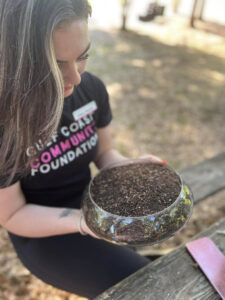
 It was also the coming-out event of Sunshine Community Harvest, the newly merged food management group marrying Sunshine Community Compost and Community Harvest SRQ.
Sunshine Community Compost—started by activist Tracie Troxler—has been facilitating composting for a decade, providing for drop-off and pickup of food scraps and doing large-scale composting. Meanwhile, Community Harvest SRQ—started 15 years ago as a local chapter of Transition, the global peak-oil network—has morphed into a major player of the Eat Local movement.
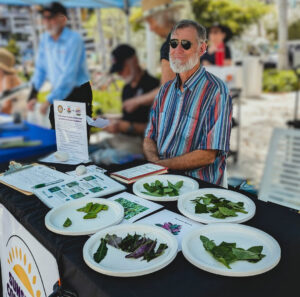
Andrew Hudson
Ahead of the big day, we had caught up with Anne Miller on the phone in her car, while delivering duck eggs from her small farm in Arcadia. She’s acting director of the new organization and gave us some background.
Annie Miller
Anne Miller: Sunshine Community Compost has been serving the community for ten years with community composting education and programs. They had stations set up at a lot of the city parks where people could come and bring their food scraps and be part of the composting process. Of course, Community Harvest SRQ has been doing food recovery and education programs for the last 15 years, and often the two have worked together to close the loop. Now we’ve just done it officially. Instead of collaborating, to do a merger that enables us to combine resources, not duplicate systems and effort and run a more streamlined, combined organization.
GC: One of those resources will be ramped up mechanisms for converting food scraps literally into food for the soil. Composting is a big deal.
Alia Garrett was at the Bay, wearing two hats—one as the Sustainability and Resilience Manager for the City of Sarasota’s planning department and one as a board member of the new food group.
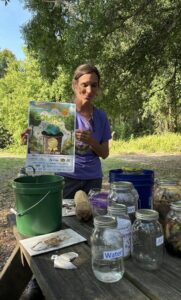
Tracie Troxler | Photos: Courtesy Sunshine Community Compost
Just weeks ago, the Sarasota commission gave Garrett the go-ahead to pursue code changes to allow ramped-up composting in the city. Without those changes, restaurants cannot dispose of the large quantities of food leftovers in any organized way. At that commission meeting, Commissioner Jen Ahearn-Koch gave a resounding positive vote, basically saying it was about time.
It’s an environmental issue as well as an economic one. Here’s Ahearn-Koch talking about her “aha” moment. It was five years ago, and she was on a guided tour of the city’s newly upgraded solid waste facility. As usual, there were birds everywhere, attracted by the food waste.
 Jen Ahearn-Koch: All these birds were there, and I said to him, “Why are all these birds here?” Like, all the birds. He said, “They’re here to eat the compostable materials and the food waste.” And I said, “Wow. There are a lot of birds. How much do you think it is?” And he said, “It could be about 20% of all of that pile is food waste.”
GC: The city has no intention of developing its own compost business, Garrett said. Rather, it hopes groups such as Sunshine Community Harvest will pick up the ball.
While Sunshine Community Compost has created a network of compost sites throughout the city, Community Harvest SRQ focuses on food before it’s scraps, with programs such as gleaning and events like Eat Local Week. It focuses attention on locally grown food instead of long-distance-grown food.
SRQ Community Harvest has focused on keeping food from becoming wasted scraps. Its brochure says between 30 to 40% of the food supply is wasted. Anne Miller captured the logic of the merger:
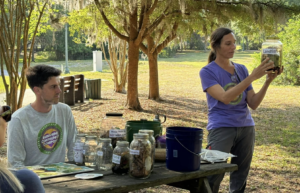 AM: It closes the loop. It makes sure that all aspects of the beautiful food grown in our area are taken care of, whether it’s putting food on the plates or, the food that doesn’t make it to plates, makes sure it gets turned back into rich compost that then enhances the soil that the food is grown in.
GC: The group’s hope in the long run is to reduce food waste’s greenhouse gas emissions and thus climate change.
With their combined resources they will be able to hire a new executive director. Andrew Hudson will be the program manager and Miller will be the vice chair, assisting president Sam Valentine. All that helps with the preservation of the environment and thus our economy, Ahearn-Koch said on Earth Day.
For WSLR, this is Gretchen Cochran.
WSLR News aims to keep the local community informed with our 1/2 hour local news show, quarterly newspaper and social media feeds. The local news broadcast airs on Wednesdays and Fridays at 6pm.
 It's drive week!
Your gift keeps 96.5 on the air. Be one of the people who make it happen.
Donate Now
It's drive week!
Your gift keeps 96.5 on the air. Be one of the people who make it happen.
Donate Now