The owner dissolved US Recycling following allegations it violated the Clean Water Act.
By Noah Bookstein
Original Air Date: April 22, 2026
Host: A controversial concrete crushing plant near downtown Sarasota apparently keeps operating, without permits. Noah Bookstein visited the plant to find out what’s going on.
Noah Bookstein: A concrete crushing plant in an industrial corridor in the Central-Cocoanut neighborhood near downtown has been operating for months without a permit.
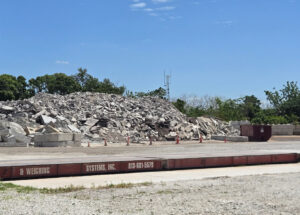
Photo by Noah Bookstein
According to a representative for the company, they are also—at least for the next two weeks—operating without an owner.
During a recent site visit, a front desk worker told me that nothing is currently happening on site—a claim that was difficult to square with the workers and equipment that were clearly present.
Workers are at least continuing to dump concrete at the site, but the representative declined to identify who employs the workers and said other operations are halted until the new owner takes over.
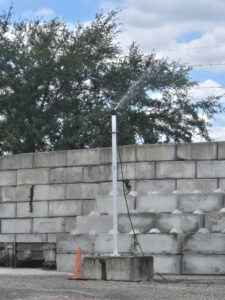
Photo by Noah Bookstein
The representative declined to identify who that new owner would be.
The previous operator, US Recycling, was owned by Christopher Williams. He dissolved the corporate entity bearing that name following a lawsuit filed by Suncoast Waterkeeper alleging violations of the Clean Water Act.
Suncoast Waterkeeper documented significant water pollution originating from the site.
This is all happening in an industrial zone that allows heavy operations like concrete crushing and mixing, directly next to the Rosemary District, one of Sarasota’s fastest-growing residential areas.
Concrete crushing generates respirable silica dust, a known carcinogen linked to silicosis—an irreversible scarring of the lung tissue.
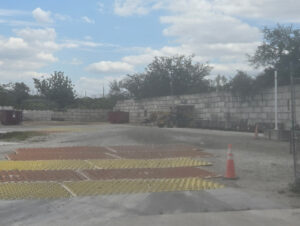
Photo by Noah Bookstein
The Occupational Safety and Health Administration sets a specific, enforceable exposure limit for workers—50 micrograms of respirable silica per cubic meter of air over an eight-hour shift.
For residents living adjacent to a concrete processing operation, the protection is far more diffuse. The EPA’s Clean Air Act establishes national ambient air quality standards for fine particulate matter—the category silica dust falls under—but those are regional standards, not facility-specific limits.
Enforcement depends on air quality monitoring, complaints and state agency follow-through. In practice, the people working inside facilities have stronger federal protections than the people living nearby.
FDEP has not responded to a request for an update, but any new operator is required to obtain a permit.
Reporting for WSLR News, Noah Bookstein.
WSLR News aims to keep the local community informed with our 1/2 hour local news show, quarterly newspaper and social media feeds. The local news broadcast airs on Wednesdays and Fridays at 6pm.
 It's drive week!
Your gift keeps 96.5 on the air. Be one of the people who make it happen.
Donate Now
It's drive week!
Your gift keeps 96.5 on the air. Be one of the people who make it happen.
Donate Now