What looks like a decrease in power may end up being a strategic expansion of it.
By Noah Bookstein
Original Air Date: May 29, 2026
Host: The City of Bradenton is trying to change the role of its mayor, limiting re-election and stripping them of a vote on the city council. But will it result in a weakened mayor? Noah Bookstein is having a close look.
Noah Bookstein: The City of Bradenton may ask its voters to weigh in on two changes to the way their city is governed. On the surface, both seem straightforward. But one of them is more complicated than it appears.
First, the simpler proposal. Ordinance 4078 would add term limits to the city charter for the first time—capping the mayor and council members at three consecutive four-year terms in the same office, beginning in January 2028. After hitting that limit, a former mayor or council member would have to sit out a minimum of two years before running for the same seat again.
NB: During a May 13 City Council meeting, Mayor Gene Brown said the conversation has been a long time coming.

Bradenton Mayor Gene Brown
GB: We’ve talked about this for years, back even before I was on the council—before 2013—is some sort of term limits, and we let the citizens decide.
NB: Brown also acknowledged that elections alone don’t always produce the change voters want.
GB: But sometimes you want to make a change, and elections don’t always do that.
NB: If approved by voters in November, the term limit amendment would take effect with terms beginning in 2028. Both the first and second readings of the ordinance are scheduled before the end of June, with a public hearing on June 10.
The second proposal—Ordinance 4077—is where things get more nuanced.
That ordinance would amend Section 8 of the Bradenton city charter to remove the mayor’s role as president of the city council and strip the mayor of his tie-breaking vote. It would also formally codify that the mayor is not a member of the city council at all.
During a meeting of the city council on Wednesday, May 27, Brown framed the change as something that doesn’t touch the mayor’s day-to-day authority.
GB: It doesn’t change the mayor’s day-to-day role. It doesn’t give any more authority or less authority. It just gives opportunity to talk and figure outside of this so there’s no Sunshine violation. Still doesn’t give the mayor the authority to go count votes.
NB: That phrase, “so there’s no Sunshine violation,” is the key to understanding what this ordinance actually does.
Florida’s Sunshine Law requires that any meeting between two or more members of the same public board where official business is discussed must be publicly available. Right now, because the mayor holds a tie-breaking vote, there’s a reasonable legal argument that he functions as a de facto member of the council, which means if he were to have substantive private conversations with council members about city business, it would be a violation of the Sunshine Law.
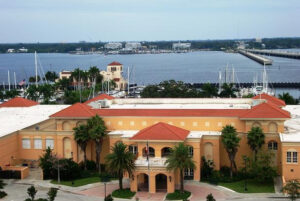
Bradenton city hall. The city is in the process of selling the land to a luxury developer.
Under Sunshine, a vote comes with a constraint. Removing the vote removes the constraint. By removing the vote and formally declaring the mayor is not a council member, the ordinance puts the mayor outside the Sunshine Law’s reach.
In other words, what looks like a retreat from power may actually be a strategic expansion of it. The mayor would trade a vote he can only cast in rare tie situations for something potentially far more valuable: the freedom to talk privately, lobby council members, share information and build political consensus behind closed doors—all things he cannot safely do today. Mayor Brown referenced this dynamic during the May 13 meeting.

Lisa Gonzalez Moore
GB: Everybody’s looking at that angle every day, so nobody’s trying to hide anything. I did bring up—and since we’re on TV now—I did bring up at the workshop about removing the mayor’s tie breaking vote so that the mayor may be able to share a little information with the council so that we don’t break any Sunshine Law.
NB: The tie-breaking vote is a power that rarely comes into play. If the ordinance passes, the mayor would lose a rarely used power and gain one he could use every day.
During the May 27 meeting, at least one council member, Lisa Gonzalez Moore, said she hadn’t yet formed an opinion on either measure—and that a decision on both would ultimately rest with voters.
LGM: Regarding both of these, I just wanted to throw out there that I haven’t really formulated an opinion on either one of them, and we’re really putting it to voters, which I always am in agreement with.
NB: Brown pointed to the city of Palmetto as a precedent, noting it made a similar change a decade ago.
GB: What we’re going to in the mayor’s part of it, Palmetto already has. They’ve had it for years now. They changed it about 10 or 12 years ago because the mayor was the tie-breaking vote and is the person in the office all day long, basically. So I just think it’s the right time, and the citizens will tell us if they want it or not.
NB: Both ordinances go to a second reading and public hearing on June 10. If passed by the council, both questions will appear on the general election ballot on November 3, 2026—leaving the final word to Bradenton residents.
Reporting for WSLR News, Noah Bookstein.
WSLR News aims to keep the local community informed with our 1/2 hour local news show, quarterly newspaper and social media feeds. The local news broadcast airs on Wednesdays and Fridays at 6pm.
 It's drive week!
Your gift keeps 96.5 on the air. Be one of the people who make it happen.
Donate Now
It's drive week!
Your gift keeps 96.5 on the air. Be one of the people who make it happen.
Donate Now