Mitigation research is blooming in Sarasota.
By John Dunbar/Suncoast Searchlight
Host: Scientists say a new wave of mitigation research could make a difference in the next Red Tide outbreak. Will it? John Dunbar of Suncoast Searchlight has a close look.

John Dunbar: Nearly a decade ago, the worst red tide outbreak in a generation choked Sarasota Bay and much of Florida’s Gulf Coast, killing marine life by the thousands and sickening residents.
From October 2017 through January 2019, crews removed more than 2,400 tons of dead animals from beaches and waterways as the toxic bloom killed hundreds of manatees, dolphins, whales and sea turtles.
It also sent people with respiratory issues to the hospital and dealt a $2.7 billion blow to the local economy. The event was “unprecedented in duration, intensity and impact,” according to one report.
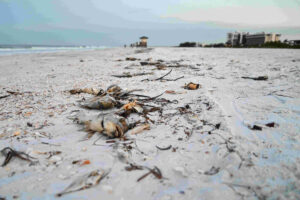
A red tide outbreak nearly a decade ago killed hundreds of manatees, dolphins, whales and sea turtles, along with countless fish, crabs and other creatures that washed ashore. Photo courtesy of Sarasota County via Suncoast Searchlight
Now, scientists say a wave of new research happening in Sarasota could help stop future outbreaks before they spiral into that kind of disaster.
Researchers at Mote Marine Laboratory are testing a new generation of treatments designed to kill red tide organisms quickly without harming the surrounding environment. In lab and field trials, some have reduced red tide blooms by more than 70%, raising hopes that blooms could one day be knocked down before they spread.
At the same time, federal officials have recently changed how water is released from Lake Okeechobee during the rainy season, a shift experts say could reduce the conditions that fuel and intensify red tide once it reaches coastal waters. That change, adopted in 2024, is designed to send more water south through the Everglades while reducing harmful discharges to estuaries along Florida’s west coast.
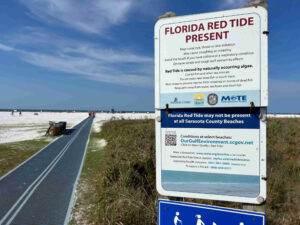
A sign warning beachgoers in Sarasota County about the presence of red tide and its harmful effects. Photo courtesy of Sarasota County via Suncoast Searchlight
For decades, red tide has been a recurring threat along Florida’s Gulf Coast. The blooms are caused by Karenia brevis, a microscopic marine algae. Scientists say pollution and runoff, including large discharges from Lake Okeechobee, help fuel those blooms once they reach the coast.
In recent decades, outbreaks have persisted for months at a time and appeared outside their typical seasonal patterns, raising concerns that the problem is getting worse.
While the mitigation research sounds promising some area environmentalists fear the treatments could replace one disaster with another.
“We do believe that mitigation is probably rife with unintended consequences,” Suncoast Waterkeeper Executive Director Abbey Tyrna said.
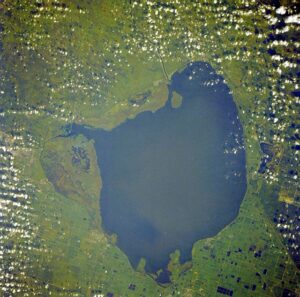
Lake Okeechobee, the Southeast’s largest lake, spans 730 square miles and is polluted by nutrients from sugar farming—including nitrogen, phosphorus and ammonia—that fuel algae blooms. Photo courtesy of NASA via Wikimedia Commons by way of Suncoast Searchlight
Glenn Compton, chairman of the local environmental nonprofit ManaSota-88 Inc., also would rather see more effort aimed at eliminating wastewater “at its source,” which would erase the need for mitigation.
Cynthia Heil leads the Red Tide Institute at Mote, where researchers have tested more than a hundred compounds designed to reduce the intensity of red tide blooms.
Heil, a biologist with a master’s degree in red tide from the University of South Florida College of Marine Science, said researchers are using only compounds that are safe for the marine environment.
Lake Okeechobee is the largest lake in the southeastern United States, covering 730 square miles. It’s so big, in fact, you cannot see all the way across it in most areas.
Situated in the middle of the state, the lake has faced rising levels of nutrient contamination, including high concentrations of nitrogen, phosphorus and ammonia — elements commonly found in fertilizers and human waste—all of which feed the algae blooms.
For years, the U.S. Army Corps of Engineers has managed water levels in the lake through controlled releases. When levels get too high, the Corps dumps lake water into the Caloosahatchee River, which flows into the Gulf and exacerbates red tide.
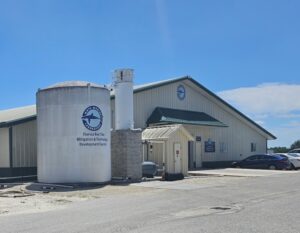
About 15 miles inland off Fruitville Road, Mote’s Aquaculture Research Park houses a 28,800-square-foot lab and a 150,000-gallon aquarium where scientists simulate Sarasota Bay ecosystems to test red tide solutions. Photo by John Dunbar via Suncoast Searchlight
But after environmental groups sued the Corps in 2019, arguing the toxic discharges from the lake were endangering protected species, including manatees, a federal judge ordered the agency to consult with stakeholders to minimize environmental impacts.
Mote researchers have evaluated more than 300 chemicals and compounds, and over 40 projects have been completed or are currently underway.
A handful of products have even been tested at canals in Venice, waters adjacent to Sapphire Shores Park in Sarasota and near Fort Myers.
Researchers are, so far, optimistic. “I’m really encouraged,” Heil said. “We’re producing results. We’ve gotten to the field. And now, we’re really waiting for the next bloom.”
This is John Dunbar, reporting for Suncoast Searchlight. You can go to suncoastsearchlight.org/red-tide-outbreak-shrink-lake-okeechobee-mote if you’d like to read the full article.
WSLR News aims to keep the local community informed with our 1/2 hour local news show, quarterly newspaper and social media feeds. The local news broadcast airs on Wednesdays and Fridays at 6pm.
 It's drive week!
Your gift keeps 96.5 on the air. Be one of the people who make it happen.
Donate Now
It's drive week!
Your gift keeps 96.5 on the air. Be one of the people who make it happen.
Donate Now