The scan puts affordable housing at the top — and detects a lack of belonging.
By Johannes Werner
Original Air Date: April 24, 2026
Host: Every two or three years, one of the biggest funders of non-profits in the region is looking for guidance—from people on the ground. The Gulf Coast Community Foundation just completed its eighth “regional scan” of people’s biggest concerns and needs. The results are loud and clear. We talked to Erin Minor, the vice president in charge of this listening exercise.
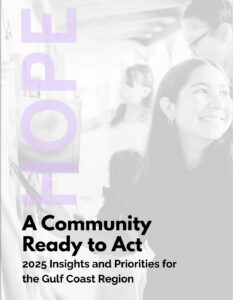 Johannes Werner: Sarasota County conducts an annual citizen opinion survey. But that one focuses on government services and residents’ satisfaction or dissatisfaction with those services. The foundation’s Regional Scan is different. Erin Minor:
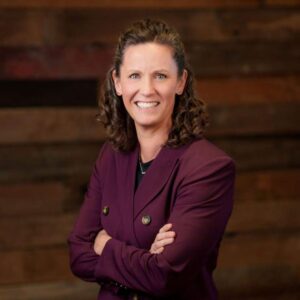
Erin Minor. Photo via Gulf Coast Community Foundation
Erin Minor: It’s not about satisfaction, like “How do you see Gulf Coast?” This is more about, “How do you see your community?”
JW: This time around, the exercise began with focus groups to come up with the best way to reach hard-to-reach residents and what to ask them. It also ended with focus groups, elaborating on the results. In between, the pollsters mobilized 1,500 respondents in Sarasota, Charlotte and DeSoto counties, up seven times from the last survey. That’s a representative sample, although—the foundation concedes—there’s overrepresentation of respondents in Sarasota and underrepresentation of Hispanics.
Most importantly, though, according to Minor, this is not just an exercise in deep listening.
EM: When they do respond, we’re going to act on it. The biggest thing is for the community to know that they take their precious time telling us, what do they see? What impacts their family? What impacts their business? I think that’s what separates us, maybe, from other surveys or scans, is we’re asking them what is impacting them daily, what is impacting their business daily, and then we take that seriously, and we’ll act on it, and our board will act on it.
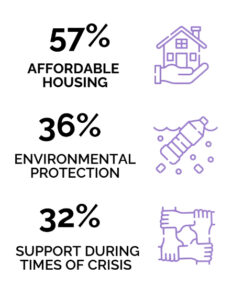 JW: But on to the results of the survey. Takeaway No. 1: The biggest concern is the lack of affordable housing. 57% of respondents had that on top of their mind, putting it in a class of its own. Curiously, only one out of four who listed housing as their top concern said that this directly affects their household.
For the Gulf Coast Foundation, according to Minor, that means a bigger, concerted effort by the foundation, local government and business.
EM: That gives us a good roadmap of how we can begin to build more affordable housing. We need about 15,000 units in the current state of housing, so that’s not adding any new units. Of course, new units are going up everywhere, so you can add that to what we need even more. For every new, market rate home, we need a certain amount of affordable homes.
JW: Minor cites identifying a permanent and recurring local funding source for affordable housing as the most important goal for the foundation.
EM: We continue to talk about that, advocate for that, because these one-time tranches are great, but we don’t want to rely on a disaster for the federal government to give us money to build affordable housing.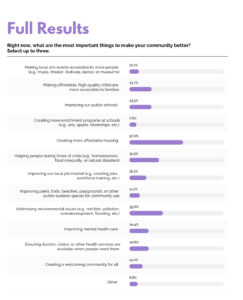
JW: Next on the list of Suncoast residents’ concerns is the environment. 36% said they’re worried by overdevelopment, loss of natural habitat, flooding, pollution and red tide. This concern hits close to home—different from the affordable housing challenge, three out of four said they’re personally affected.
The third-biggest concern is providing help to people in need. 32% of respondents picked help for people struggling with hunger, mental health or homelessness as their top concern. As with affordable housing, it’s mostly concern for others.
EM: The fact that that popped up in the top three, I think, shows a strong sense of responsibility for neighbors facing homelessness, food insecurity and disaster recovery.
JW: One final takeaway: We seem to be isolated—from each other, community—or government, for that matter. Erin Minor:
EM: We asked a question to all respondents around belonging and how often they feel they belong in their community. One of the data points that came out which was interesting is 40%-plus of respondents said they sometimes or never feel like they belong. 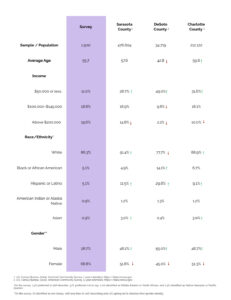
JW: Most of those said they feel local government is not listening, or that they cannot find people they have things in common with.
EM: We have big issues in front of us, these top three that we talked about. We believe that, if folks feel like they belong and they feel connected, they will do something about these issues, but if they feel alone, they don’t know their neighbors, they have no one to link arms with, very unlikely they’re going to come together and try to solve problems. So we have to start with people feeling like they belong, like they’re connected, like their voice matters, and then we can tackle these big things together.
JW: Johannes Werner, reporting for WSLR News.
WSLR News aims to keep the local community informed with our 1/2 hour local news show, quarterly newspaper and social media feeds. The local news broadcast airs on Wednesdays and Fridays at 6pm.
 It's drive week!
Your gift keeps 96.5 on the air. Be one of the people who make it happen.
Donate Now
It's drive week!
Your gift keeps 96.5 on the air. Be one of the people who make it happen.
Donate Now