20 Sarasota and Manatee high schoolers went to Alabama for a lived experience of history.
By Rhatia Murphy
Original Air Date: April 24, 2026
Host: This spring, 20 high school students from Sarasota and Manatee counties headed to Alabama as part of the Boxser Diversity Initiative’s Bending the Arc program. Rhatia Murphy reports.
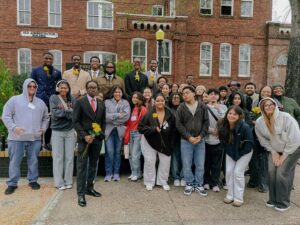
Photo via Boxser Diversity Initiative
Rhatia Murphy: At a time when conversations about how history is taught in classrooms continue to evolve, programs like this are offering students another way to experience it—by stepping directly into the places where it happened.
The week-long trip wrapped up a six-month deep dive into civil rights history—pairing classroom learning with time spent on the very ground where that history unfolded.
Students traveled through Selma, Montgomery and Birmingham—cities that didn’t just witness the fight for voting rights and racial equality but helped define it.
For Booker High junior Jodany del Rosario, the experience brought history into sharp focus.
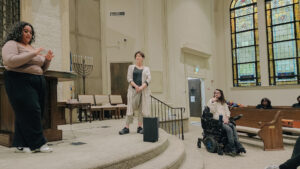
Jodany del Rosario (left). Photo via Boxser Diversity Initiative
Jodany del Rosario: It sounded very interesting, so I did some investigating, and then once I realized that Ms. Sherrell—she’s a teacher at my school—was in charge of it, it was like a cherry on top. It sounded like a really cool opportunity.
RM: The Boxser Diversity Initiative, started 15 years ago by husband-and-wife team Dan and Litten Boxser, describes itself as “a leading voice for inclusion, education and dialogue in Southwest Florida” Quote: “We believe that by fostering understanding among diverse communities—across race, religion, gender and background—we can build a more inclusive and vibrant region.”
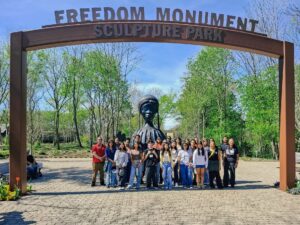
Photo via Boxser Diversity Initiative
The “Bending the Arc” program brings together students from across the region to connect with civil rights history.
The phrase “bending the arc of history” reflects the belief that justice doesn’t happen on its own, it’s shaped by people who push for change. Over several months, students dive into key events and figures, take part in conversations with teachers and scholars—and then travel to the places where that history actually happened. Anicie Joseph from Venice High School:
Anice Joseph: Learn about the past. Inform yourself. Stay current on events. There is always a way for you to absorb knowledge and know information, even if it’s not from your school. Because I’m not going to lie: Schools aren’t great at teaching you everything. They hide so much, and it’s so sad because the information they are hiding is important to you. It is how we avoid repeating history over and over again. We already made those mistakes. We don’t need to make them again. And remember: You’re the future.
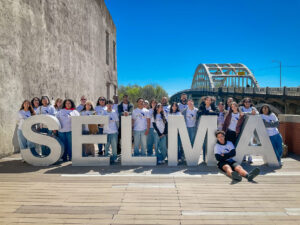
Photo via Boxser Diversity Initiative
RM: During the trip, students crossed the Edmund Pettus Bridge in Selma—a place etched into the history of the 1965 voting rights marches.
JDR: Back in the day, society made it really hard for African-Americans to go vote, but I didn’t know how severe it was—the questions they would ask them, like “How many bubbles are in a bar of soap?” or “How many jelly beans are in this jar?” It was, like, impossible answers that no one would know. I think that’s something that shocked me.
RM: They also visited museums and memorials that bring forward the stories of those who fought for justice, often at great personal risk.
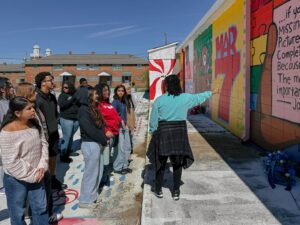
Photo via Boxser Diversity Initiative
JDR: I really enjoyed when we went to the national lynching museum and the hanging memorial. I just really enjoyed the beauty of it all—the symbolic meaning behind everything and how it wasn’t just like any other museum; it has backstories and pictures of the victims. I really liked how symbolic it was.
RM: For many, the experience didn’t just deepen their understanding of the past—it made its connection to right now impossible to ignore. Jodany picked up on that right away.
JDR: I think it helped me see and connect some of the stuff that happened during that time—that it’s kind-of feeling like we’re starting to repeat history. I don’t think that the civil rights movement is over. I think we’re still living in it today.
RM: This isn’t just about looking back—it’s about making the connection to what’s happening today.
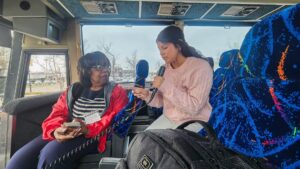
Dr. Martha Bouyer and a student. Photo via Boxser Diversity Initiative
Organizers wanted the students to think critically about their place in shaping what comes next.
JDR: Go on the trip to sign up to learn more about our history because I think it can really help us with everything that’s going on in today’s time.
RM: While every student experienced the trip in their own way, many returned with a broader understanding of how history is learned—and who gets access to it.
And for a small group of students each year, programs like this offer something more than a lesson—they offer a lived experience of history that extends beyond the classroom.
As Dr. Martin Luther King Jr. once said, “The arc of the moral universe is long, but it bends toward justice.”
For WSLR News, I’m Rhatia Murphy.
WSLR News aims to keep the local community informed with our 1/2 hour local news show, quarterly newspaper and social media feeds. The local news broadcast airs on Wednesdays and Fridays at 6pm.