Bradenton workshop draws a county commissioner who says 90% of his job has nothing to do with partisanship.
By Noah Bookstein
Original Air Date: May 22, 2026
Noah Bookstein: In Manatee County, citizens who are concerned about polarization in our discussion of politics came together to learn a better way to communicate. On Monday afternoon in downtown Bradenton, at the Central Library, about 40 people filed into an event space to learn and practice a skill that sounds simple but is actually quite difficult: how to talk with and listen to someone you disagree with.
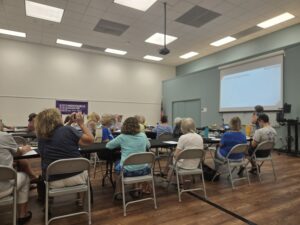
The Braver Angels meeting at the downtown Bradenton library. | Photo: Bookstein
They were there for a workshop run by Braver Angels, a national nonpartisan organization, at the invitation of Indivisible Manatee, a local progressive advocacy group. The Manatee League of Women Voters co-sponsored the event. There was an initial event on May 11 and another that followed on May 18, where WSLR News spoke with organizers and participants.
Braver Angels started after the divisive 2016 election, when Donald Trump won over Hillary Clinton. Pat Mayer, a retired University of South Florida educator, is the co-chair of the Braver Angels Tampa chapter.
Pat Mayer: Braver Angels is all about uniting Americans together and bringing civil conversations back into politics. We like to bring people from all political perspectives together and help provide opportunities to have discussions, conversations and ultimately begin problem solving as opposed to the kind of divisiveness that we have now.
NB: The workshops have since spread nationwide. They call the whole approach “courageous citizenship.” The methodology draws from the work of Bill Doherty, Braver Angels’ co-founder and professor at the University of Minnesota. His specialty is marriage and family counseling. The idea is that the skills for repairing a strained marriage aren’t so different from the ones needed to repair a strained society.
Linda Chamberlin is the co-chair of Braver Angels in Tampa.
Linda Chamberlin: I kind-of came to it from being a psychotherapist when people were coming into my practice who were struggling—especially with relationships, which is a lot of what I worked with. What I was finding was that people were ending relationships that, in every other respect, were viable, good relationships, but marriages were ending, friendships were ending, people were becoming polarized, and it was really impacting their lives in very significant ways. What I got interested in was trying to understand on that level as well as on the larger level because it distresses me that people don’t talk to each other. I don’t think we get to keep a democratic republic if we can’t do that.
NB: A Braver Angels workshop often starts with developing an understanding of polarization and some self-examination.
 PM: Well, it begins with looking at, “What is polarization?” and then we do a little survey—a little questionnaire—where people examine their own inner polarizers, because we all have them. So there’s a little lesson in humility; we very much accept that everyone polarizes. Then we move into, “What are some strategies that you can start to practice that will help you to begin to reduce that polarization?”
This particular workshop today will then move onto a conversation model that we teach to help people have conversations across differences. Any differences, really. It doesn’t have to be political.
NB: The single most important skill they hope workshop participants come away with, Mayer says, is listening with curiosity.
PM: Learning to listen to one another, learning to listen with an open mind—with what we call a curious mind—so, learning to listen with curiosity to learn and understand, “Why does the other person believe or support the kind of policies that they do?” So listening is critical.
NB: That may sound obvious, but for Liv Coleman, a political science professor who works on Indivisible Manatee’s leadership team, this spirit is exactly what’s been missing.
Liv Coleman: I think if people are just interested in having conversations—actually willing to engage—that’s a big part of it. If they’re willing to strike up a conversation with a neighbor that they might otherwise shy away from; if they’re actually willing to bring up topics—people are always saying, “Don’t talk about politics,” “Don’t talk about religion” and things like that. But it’s because we aren’t talking about those things—because we don’t have a framework to discuss our differences—that it’s harder to come into community with people.
We needed people across the aisle, and we knew that if they put their names forward and advocated for these programs or advertised them to their own constituents that we might be more likely to get a broad basis of participation of people who are red-leaning or blue-leaning, liberal or conservative.
NB: George Kruse, a Republican Manatee County commissioner, said almost everything that comes before his commission has become partisan, even when the issues are primarily technical.
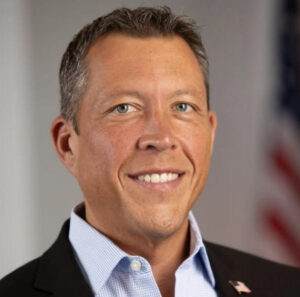
George Kruse
George Kruse: Well, everything we discuss in Manatee County is becoming polarized. It doesn’t matter if we’re talking about nonprofit funding, we’re talking about growth and development, we’re talking about infrastructure, talking about property taxes and whether or not to eliminate them. Everyone trends it to some party. Everyone wants to paint everything with the brush of “conservative,” “liberal.”
Most of what we do—90-plus percent of what we do—has nothing to do with politics and partisanship whatsoever.
NB: Kruse said being involved in Braver Angels helped him to apply listening skills professionally.
GK: I went to speak to a Democrat club out on Anna Maria. I do things with the League of Women Voters. I attended a session on immigration reform with Indivisible Manatee. Those are not classic conservative, registered Republican-type organizations, but I attend them because I like hearing both sides of things, and I don’t fully agree with either side.
NB: For a community where civic conversations have grown louder and less productive, participants, including Roger Lindgren, were relieved to be learning how to support a healthier dynamic.
Roger Lindgren: My wife and I are attending today because we’re looking for a way to talk to people about what’s going on in our country without having animosity or name-calling, et cetera. I think society has become less civil in their discussion of politics. I’m hoping that maybe this will be a small turn to bring civility back into politics and the issues that we sometimes disagree on.
NB: For WSLR News, Noah Bookstein.
WSLR News aims to keep the local community informed with our 1/2 hour local news show, quarterly newspaper and social media feeds. The local news broadcast airs on Wednesdays and Fridays at 6pm.