In the wake of the ‘Trump slump,’ Sarasota is trying to lure back big-spending international visitors.
By Rhatia Murphy
Original Air Date: May 29, 2026
Host: Tourism in Florida has gone through what the industry calls the “Trump slump”—bigger-spending international visitors staying away from the United States. The Sarasota-Bradenton area is seeing the same decline—and a big rise in domestic visitors flown in on no-frills airlines. But local tourism boosters do not seem to appreciate the latter. Our reporter Rhatia Murphy has a close look at the changing face of tourism in this area.
Rhatia Murphy: Sarasota beaches are still crowded. Its restaurants are still busy. And downtown still hums during tourist season. But local tourism leaders say bigger crowds may no longer be the goal.
The agency in charge of promoting tourism in Sarasota County says the focus now is “quality over quantity.” Not necessarily more tourists but different tourists—people who stay longer, spend more and move beyond the beach towel economy.
Hunter Carpenter is the director of community relations for Visit Sarasota County.

Hunter Carpenter
Hunter Carpenter: Those staying in higher-end, larger daily-rate hotels are going outside those four walls and spending at restaurants. They’re going to the art exhibits They’re going to the gift shop and buying a piece of art. They’re contributing back to that local economy.
RM: The Sarasota-Bradenton International Airport continues expanding service. New airlines and routes have increased access to the region.
The airport recently opened a new terminal for budget carriers, the main driver of a major rise in passenger numbers at SRQ.

Budget carrier Allegiant Air has brought 5 million passengers to Sarasota in just eight years. But tourism development officials prioritize ‘quality over quantity’. | Photo: Courtesy SRQ
No-frills carriers like Allegiant Air have brought more travelers into Sarasota at lower prices. Allegiant last week welcomed its 5 millionth Sarasota passenger, after just eight years since picking SRQ as a destination.
But tourism officials say growth alone is not the goal. The focus, they say, is economic impact—visitors who move through the local economy, not just through the airport.
March tourism numbers—the most recent ones available—tell an interesting story. Visitor counts rose slightly compared to last year. About 158,000 people visited Sarasota County in March. But hotel occupancy dipped slightly. Room nights sold also declined. At the same time, hotel prices climbed sharply. The average nightly room rate rose to more than $400 a night.
Visit Sarasota County says that may reflect a broader shift in strategy. Carpenter said the county is focusing less on sheer visitor volume. They’re more focused on attracting tourists who support local restaurants, attractions and small businesses.
In other words: Less volume. More spending.
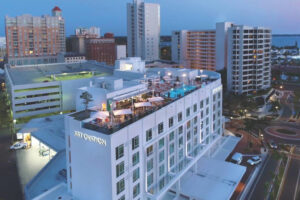
Using culture to lure big spenders: Art Ovation hotel. | Photos courtesy Visit Sarasota
That strategy can already be felt downtown. Higher-end restaurants continue to open. Boutique hotels are expanding. Luxury condos dominate parts of the skyline.
Sarasota has long marketed itself as a beach destination. Now it’s fully leaning in to wanting to be seen as a cultural destination. A city of art galleries, theater, fine dining, film festivals and curated experiences.
Tourism boards across Florida are adjusting to a changing travel economy. Economic uncertainty remains high, travel costs have climbed and politics now shape travel decisions more than many destinations expected. Canadian tourism to parts of Florida has softened in some markets amid political tensions and shifting public sentiment. Sarasota is seeing some of those same trends.
Hunter Carpenter with Visit Sarasota County says international sentiment toward the United States has changed in some markets, though interest in Sarasota remains strong.
HC: What we’re hearing from our agency is there’s definitely a change in sentiment to the U.S. market but not necessarily a change in wanting to come. What we’ve heard from our representation is, “We don’t necessarily like your politics, but we like your beaches.”
RM: That’s pushing some destinations to rethink how they market themselves. Instead of chasing maximum crowds, Sarasota is leaning into luxury travel, arts tourism, culinary experiences and high-end visitors.
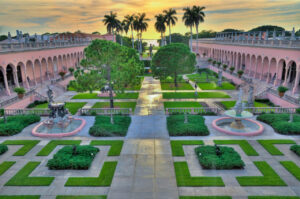
Ringling Museum of Art
HC: When we say that we’re going after quality of visitors over quantity of visitor, it’s those visitors that want to go outside the hotel—to the restaurants, to the experiences, to the gift shop.
RM: Carpenter says many European travelers book vacations 18 months to two years in advance, meaning shifts in travel sentiment may take time to appear in local tourism numbers.
Tourism officials pay close attention to international visitors because they typically stay longer and spend more money locally.
Greg Galford has been helping run Florida Underwater Sports for nearly twenty years. He says that he’s noticed Sarasota tourism shifting over the years.
Greg Galford: When I first started here, we had generational tourists, meaning tourists whose parents had come and vacationed here, or maybe even their grandparents, and then they were coming back down. Over the last couple years, I’ve seen more and more people who are just coming to come to Sarasota.
RM: He says visitors are increasingly looking for experiences, especially outdoor activities like fossil diving and snorkeling.
Greg Galford: Right now, it’s really about getting out to the beach, going snorkeling and stuff like that.
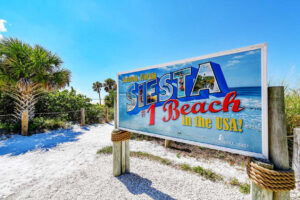 RM: As Sarasota grows more expensive and more exclusive, can the city continue balancing the needs of visitors, businesses and the people who call it home?
Sarasota may still be selling sunshine. But increasingly, it’s also selling an experience. The question is who gets to enjoy it.
Carpenter says tourism officials are increasingly thinking about residents as much as visitors. He says attracting tourists only works if locals continue to feel invested in the economy they’re helping promote.
HC: If residents are not on board with tourism—if they equate it to, “Oh, there’s more traffic during peak season or I can’t get into my favorite restaurant”—they’re not going to be welcoming to a visitor.
The audience of tourism certainly is a visitor. However, we have now seen in recent decades that the primary audience, actually, for a tourism bureau is kind-of residents when you think about it.
We can’t just rest on our laurels, and we can’t just assume people will choose us. We have to be very intentional about that.
RM: For WSLR News, I’m Rhatia Murphy.
WSLR News aims to keep the local community informed with our 1/2 hour local news show, quarterly newspaper and social media feeds. The local news broadcast airs on Wednesdays and Fridays at 6pm.