Among the biggest losses: an accelerated nursing program.
By Nic Steinig
Original Air Date: June 12, 2026
Host: It’s a fact now: After 50 years, the Florida Legislature shut down the USF Sarasota-Manatee campus. One of the biggest losses for the area: a nursing program. WSLR News reporter Nic Steinig has a close look at this and other ripples.
Nic Steinig: A few weeks ago, local higher education and business stakeholders were hopeful that the Florida Senate would block the Florida House’s effort to transfer ownership of the USF Sarasota-Manatee campus to New College of Florida, with organizers placing pressure on local legislators to voice opposition to the transfer.
Ultimately, they were unsuccessful—the final version of the statewide budget and its conforming bill, signed May 29, mandate that the USF Sarasota-Manatee campus be transferred to New College of Florida on July 1.
The Florida Senate negotiators, however, successfully removed a provision from the House that would have diverted $22.5 million from USF to New College every year.
With that $22.5 million secured, USF Sarasota-Manatee plans to conduct a teach-out of the current students while maintaining its faculty. USF Sarasota-Manatee students admitted before July 1, 2026, will be granted priority use of the campus until they graduate, while incoming students will no longer be able to designate USF Sarasota-Manatee as their primary campus.
As for student housing, the bill obligates New College to honor leases held by USF Sarasota-Manatee students residing in the on-campus Attila Hall until August 17, 2027—about a year out. After that date, it’s up to New College to decide whether to renew existing leases or reserve that space for its own students.
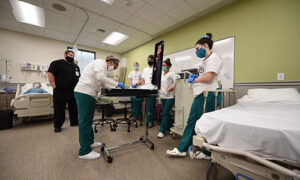
USF Sarasota-Manatee nursing students participate in a simulation lab. | Photo courtesy USF S-M
Critically, the transfer to New College is only for the physical property. There is no readily available replacement for the workforce-centered academic programs USF Sarasota-Manatee hosts, such as nursing, accounting, hospitality, criminology and more. That’s what led several regional Chambers of Commerce and a coalition of local leaders to oppose the transfer over the last year. Chair of the Manatee Chamber of Commerce Justin Phillips told WSLR that the concern really came down to a lack of “continuity” for the local community.
Once the teach-out concludes, it’s possible an agreement could be forged between the two colleges to permit USF faculty to use the campus, but signals from lawmakers and USF officials make that scenario unlikely.
Governor Ron DeSantis stated in January that he thinks USF should redirect its resources to Tampa, and USF Board of Trustees Chair Will Weatherford seconded that view, saying the transfer would allow them to “invest in other growth initiatives.”
More recently, USF President Moez Limayem released a communication on May 26 stating, “USF’s strength is not a collection of buildings and land; our real strength has been, and always will be, our people.”
At the same time that USF officials are using phrases like “strategic reinvestment,” they also claim that support for the Sarasota-Manatee region will continue.
“My commitment is that USF will still be a strong partner for the Sarasota-Manatee community,” Limayem wrote. “We will reach out to our stakeholders to work together to determine how our university can continue to help the region’s growth, and I will soon be visiting the campus in coordination with Interim Regional Chancellor Brett Kemker.”
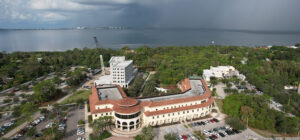
USF’s Sarasota-Manatee campus
WSLR spoke with Kemker by phone. He claimed that continued regional support could be arranged, given the commuter and hybrid nature of the USF Sarasota-Manatee campus.
According to Kemker, around 2,000 students have USF Sarasota-Manatee set as their home campus—but over 17,000 students take classes there in total, with about two out of three classes taught at USF Sarasota-Manatee being online or hybrid.
Some of the expected loss of workforce programs could therefore be mitigated by offering classes online. But there is no guarantee that the same course offerings will be provided in Tampa or St. Pete by current USF Sarasota-Manatee faculty, or that classes would be as small as they currently are. Some students may not be able to commute for in-person instruction.
USF Sarasota-Manatee alum Angela Perez Cruz is one such example. Cruz was a pre-med double major that graduated with a 4.0 GPA. As a first generation immigrant, she said staying local allowed her to save housing costs that otherwise would have forced her to work full-time and harmed her academic performance.
Angela Perez Cruz: Throughout college, I didn’t have to work. I didn’t have to pursue financial means. I could focus solely on academics and pre-clinical experiences. I shadowed for physicians. I volunteered every week at a local hospital. There was a level of care given to my education at USF Sarasota-Manatee that I don’t think I could have found at either of the other two campuses.
NS: When asked what she thought of the USF Sarasota-Manatee transfer, this was her response.
APC: Oh, it’s absolutely heartbreaking. I know a student personally at SMH, the hospital where I volunteer, who was part of my team. She is now a freshman at USF Sarasota, but she fears that because of the transfer, she won’t be able to graduate on the USF Honors College or otherwise just because she really can’t do the commute. She also wants to live at home. She wants to save up money. And the drive all the way to Tampa or St. Pete would just be awful.
NS: Once the physical footprint dissolves, USF has stated that all current faculty and staff will be given a new role, a space will be provided for them, and their compensation will stay at its current rate—but their core responsibilities and job may change.
Former USF Regional Chancellor Karen Holbrook expressed concern that faculty reshuffling could lead to their departure and the loss of their students.
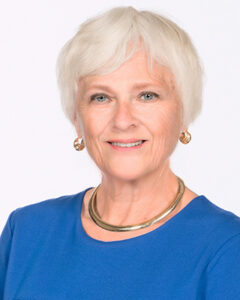
Karen Holbrook
Karen Holbrook: You may remember Lakeland was a USF campus, and Lakeland became Florida Poly. At the time, it was promised that the faculty will retain their jobs, but they may not have the same job. Well, you can’t just go from job to job. So a lot of them were not continued, and a lot of the students were not continued. It’s very uncertain what will actually happen next.
NS: When WSLR reached out to USF Sarasota-Manatee history professor Scott Perry, he said he had already arranged an immediate transfer to another campus. He didn’t want to wait on a teach-out entangled in the Governor’s higher education politics. After New College faced a conservative “hostile takeover” three years ago, about a third of the faculty departed. If other USF Sarasota-Manatee faculty follow the same path, the teach-out could face major strain on its logistics.
Notably, the USF Sarasota-Manatee campus also provided local services for which there are no easy replacements, such as running unique programs in the surrounding community.
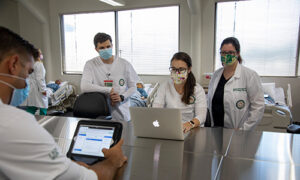
USF Sarasota-Manatee nursing students. | Photo courtesy USF S-M
KH: Our nursing program? It’s different. It is an accelerated nursing program. The students who go into the nursing program already have a bachelor’s degree, so instead of putting in four whole years into a nursing program, they have 16 months. The accelerated nursing program gets them out into the field much faster because, as you know, the nursing shortage is very great. Our teaching programs were really important because we prepared students to become teachers for the community. And our teachers graduated with signing bonuses with a school. Criminology was a really neat program because we had a lot of the students go into the prisons and work with the prisoners. We had one that even taught an entrepreneurship program to the inmates. Things that were really relevant and made a difference to this community. Our school was preparing students for those jobs.
NS: Kemker agreed that transferring these programs would be logistically challenging—especially the nursing program, since it requires a physical classroom—but that it remains a high priority.
Local nursing students will still be able to get on-site “contact hours” at local hospitals, but Kemker indicated that resolving the classroom requirement is an ongoing discussion. About 60 nurses graduate from the USF Sarasota-Manatee program every year and enter the local workforce.
Kemker said an overlooked loss of the physical campus is the free advertisement it gave Sarasota-Manatee as a region. Kemker claimed that many of the 17,000 students enrolled at USF Sarasota-Manatee were commuters who willingly drove from Tampa or St. Pete to attend those classes because of the high faculty reputation and intimate classroom sizes.
“You’d rather be taking intense courses like biochemistry in a class with 20 other students than a class with over 200,” Kemker said. That ratio was unique to USF Sarasota-Manatee, Kemker claimed, and USF students often received their first introduction to the Sarasota-Manatee area through this pipeline.
Ultimately, Kemker said that USF “doesn’t want to let down its community” and is working to find solutions.
Some of the damage could be mitigated through online teaching, but the unique characteristics of USF Sarasota-Manatee that made it a driving force for the region—community programs, intimate classrooms, exceptional instructors—are facing troubled waters and an uncertain leap.
Reporting for WSLR News, Nic Steinig.
WSLR News aims to keep the local community informed with our 1/2 hour local news show, quarterly newspaper and social media feeds. The local news broadcast airs on Wednesdays and Fridays at 6pm.
 It's drive week!
Your gift keeps 96.5 on the air. Be one of the people who make it happen.
Donate Now
It's drive week!
Your gift keeps 96.5 on the air. Be one of the people who make it happen.
Donate Now