Rural residents pay ‘impervious surface’ fees, even though little or no rainwater ends up in the county system.
By Noah Bookstein
Original Air Date: July 8, 2026
Host: One rural resident in Sarasota County has an issue with being charged for rainwater that does not end up in the county’s ditches, channels or canals. She may have a case. Noah Bookstein reports.
Noah Bookstein: Becky Ayech has lived on a farm in Old Miakka for 46 years. In the early years, she says, water was just part of life out there.
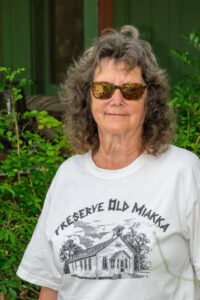
Becky Ayech | Photo: Todd Sherman via Suncoast Searchlight
Becky Ayech: The first 20, 21 years that we lived here, the rainfall was as it normally would be, with 52 inches of rain falling mostly in the three months of the summer. The water on my property stood two inches six months out of the year. During the rainy season, we would park our vehicle at our gate and put our muckers—our boots—on, and we’d wade up to our house, or if we had a bunch of stuff, we had a canoe, and we’d load the canoe.
NB: Standing in the water was hard on her sheep.
BA: There were often problems with my sheeps’ hooves because there wasn’t any dry place on the property where they could go for a long period of time. Just like if you took your foot and put it in water for 20 hours, your feet would be all wrinkled, and they’d be sore. Same kind of concept. The next 20-plus years, the rainfall has been less and less and less and less to the point that we are desert-esque.
NB: When Hurricane Milton knocked down decades-old trees on her property, she discovered their taproots had withered. The water table had been so low for so long that the old trees had basically been running on empty.
BA: I tell people trees aren’t like dogs. They don’t fall over right away when they’re dead; they hang on.
NB: Against the backdrop of this changing environment, Ayech has spent decades as a community activist fighting to prevent suburban development in this stretch of rural Sarasota County. Now she is fighting what, on paper, seems like a line item on her utility bill.
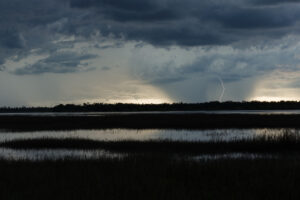
Most rainwater in rural areas gets absorbed the natural way. But that is changing as suburban construction keeps sprawling. | Photo: Brice Claypoole
Sarasota County charges a stormwater fee with a base charge that funds professional staff and planning as well as another charge tied to how much impervious surface sits on a parcel, which funds stormwater operations. Impervious surfaces are driveways, roofs, patios and some soil types. The idea is that, the more surface that can’t absorb rain, the more it burdens the county’s drainage system.
Ayech’s issue isn’t with the base charge but the impervious one.
BA: 97% of my property is pervious surface. I should be getting credit for that.
NB: Ayech says the water on her property flows east toward the Myakka River. Another nearby property, the Miakka Community Club’s schoolhouse, is on a sand ridge, and that water sinks into the Earth. Ayech says whatever rain does fall in the area doesn’t go into a county system; it just goes down into the ground or to the river.
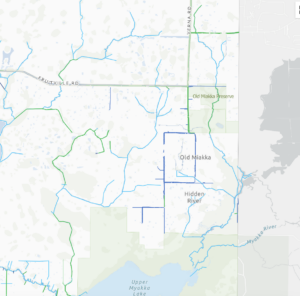
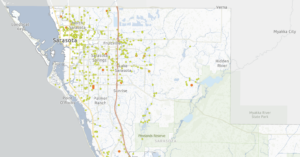
A county map shows the Old Miakka area has few public stormwater conveyances.
BA: It could rain enough to float Noah’s Ark, and there would never be any water that left that property. It goes straight down. It drains right away. None of the properties out here are running off into a county stormwater conveyance system. That’s my issue.
NB: She asked the county to show her how runoff from her property reaches county systems.
BA: Identify the system that I’m causing impact to from runoff of my impervious surfaces. Identify the system first before we go any further. If there’s no system, we don’t have to go any further. That just solves the problem.
NB: The county’s stormwater director, Ben Quartermaine, told her the impervious charge funds work on old easements and drainage rights-of-way that, in his words, have “mostly been ignored” in Miakka.
Stormwater conveyance systems are not always massive canal and retention pond projects; they can just be ditches and channels. The county’s own stormwater maps confirm there are a few county-maintained systems around Old Miakka, including an excavation project along Verna Road, and it maintains ditches and channels nearby that occasionally need to be cleared of debris.
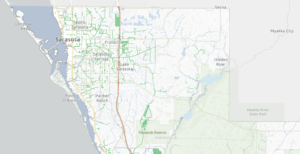
A map of recently completed stormwater projects in Sarasota County shows that nearly all the work is done in urban areas.
Most other stormwater conveyance in the area is privately maintained. There are ditches and swales on individual properties, and the Myakka River itself, which does the job naturally. Going forward, most of the county’s planned work is not concentrated in Old Miakka, but well to the west, on aging stormwater infrastructure in the county’s urban areas.
Ayech says she has seen this play out before. Years ago, Old Miakka residents were paying the same rate as neighborhoods in town for a less equipped volunteer fire department.
BA: We were being charged the same amount of money as the people in town who had manned stations with ambulances. The exact same amount of money for nothing. So we sat down with the county, went over all of the money that was generated, what we got for it, what the service was. And the county said, “Oh, we need to man your station. You are paying the same as everyone else. You have to have the same service.” It’s the same.
NB: That time, the county sat down, went through the numbers, and made a change. That is the outcome Ayech is hoping for again.
Planned stormwater projects in Sarasota County
While legacy farmers in Old Miakka may not be straining the county’s roadside stormwater systems, Ayech says new construction is. Developments pushing boundaries in the county such as Lakewood Ranch Southeast are built higher than the surrounding pasture, changing the way water moves through the area, particularly on Singletary Road.
BA: In reality, what happens is they build a dam, so that sheet flow that was going through that pasture, there is now—it’s easy to see if you drive out to Old Miakka. You’ll see that new subdivision—how much higher those houses are. What it has done is put a dam in place and diverted that sheet flow onto the road.
NB: Ayech sees new development pushing water into the county’s stormwater systems while she and her neighbors get billed as if they’re the ones causing the strain.
BA: They should be charging the people that built the dams that caused the problem in the first place.
NB: The kind of growth she and her neighbors have spent decades trying to hold back may be exactly what’s straining the system she’s being asked to help fund. Ultimately, Ayech says the county is reasonable, and she is hopeful they will work with her to find a solution.
BA: I think this commission is fair. Teresa Mast is our county commissioner. I hope that she steps up and leads the charge. I will continue to bring it up, and I will continue to pursue it.
NB: Reporting for WSLR News, Noah Bookstein.
WSLR News aims to keep the local community informed with our 1/2 hour local news show, quarterly newspaper and social media feeds. The local news broadcast airs on Wednesdays and Fridays at 6pm.