25 years later, we hear from those who were next to George W. Bush when he received the news.
By Ed James III
Original Air Date: September 8 2026
Host: This Friday marks 25 years since 9-11—a day that changed American history. While national commemorations focus on New York, Washington and Shanksville, Pennsylvania, that morning in 2001 is uniquely tied to Sarasota’s Newtown community. On September 11, President George W. Bush was visiting Emma E. Booker Elementary School when he received news of the attack and delivered his first address to the nation. WSLR reporter Ed James III brings us this reflection on how that morning reverberates a quarter century later.
Ed James III: On the morning of September 11, 2001, the atmosphere at Emma E. Booker Elementary School was electric. The Title 1 school in Sarasota’s historically Black Newtown neighborhood had been chosen for a presidential visit.
President George W. Bush was on campus to champion his administration’s education reform agenda, including the No Child Left Behind Act. Booker had been selected as a national model for its dramatic reading score gains using direct instruction—an achievement made all the more notable given its student population: at the time, 79% were African American and 87% qualified for free or reduced-price lunch. For the students, the policy details mattered far less than the sheer excitement of a president walking through their doors.
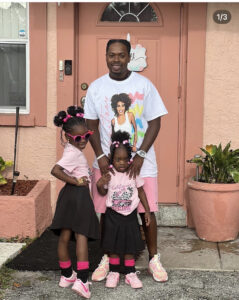
Andre Hobbs Jr. and daughters
Andre Hobbs Jr: For one, we were extremely excited just because, out of all the schools in the world he could have picked, he came down a little old Emma E. Booker. We were super excited about that.
EJ: Andre Hobbs Jr, who was a fifth-grader and was one of a select group of students chosen to assemble in the media center:
AH: I was one of the kids who were selected to stand behind the president. We were supposed to shake his hand after he had left Mrs. Daniels’ class. He was coming down to the media center to shake hands with about 15 to 20 of us who got selected. He was supposed to give a speech about—I can’t remember what we were doing at the time. Something about a reading program. But he was supposed to say his speech and then go down to each and every one of us—go down the row and give everybody a handshake. You can see in one of the clips—well, quite a few of the clips—when he addressed the nation about the terrorist attack, you can see me in the back—me and a couple of my classmates.
EJ: Before stepping into the media center, President Bush was in a second-grade classroom listening to students read. Longtime WWSB ABC 7 anchor Linda Carson was one of only three media members permitted inside that classroom. She recalls the exact moment the tone of the morning changed.
Linda Carson: Andrew Card, the chief of staff, came in, and he stooped down and covered his mouth and spoke to the president—whispered. I thought he probably said, “We need to move on.” And the president sat there. His face, to me, just looked calm—like he was thinking. And then he listened to the child finish.
He stood up, and Ann Compton, who did not follow orders—she had a second cell phone—said, “Mr. President, did you know a second plane just hit the World Trade Center?”
And he said, “We’re going to deal with that right now.” And he headed out toward the media center.
EJ: As the President walked down the breezeway, Carson watched as the reality of the situation began washing over the crowd gathered outside.
LC: As he went down that breezeway, a lot of the people were standing there. They had been chosen to meet the president. They stuck out their hands. Then they saw his face, and their hands dropped.
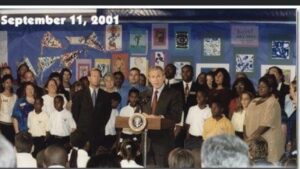
George W. Bush addresses students, faculty and media at Emma E. Booker Elementary on September 11, 2001
He walked into the media center. The rest of the media from all over the world had been in the cafeteria while he listened to the children read. By then, they knew what was going on. They were already coming into the media center. The president walked in. We still were right behind him and had no idea what was happening. A lot of the people also in the media center who didn’t know what was happening started to applaud. And then they saw his face, and—you know how applause sounds when it dies.
He stood beside the television set in front of the room. There were people behind him, people all around him in a circle, and he addressed the world—not just the nation, but the world—in a very calm voice. He said, “We are under attack.”
EJ: That moment became one of the most recognized images in modern history. As Chief of Staff Andrew Card whispered into the President’s ear that a second plane had struck the World Trade Center, President Bush maintained his composure before stepping up to the podium in the school media center to address a stunned nation.
For the children standing behind him on stage, the weight of the moment took time to process.
AH: At first, I had no idea what was going on. When he addressed the nation in the media center that day, he said that a plane had hit a building. I’m a 10 year old kid at the time; I’m thinking, “Maybe it was an accident. Why is everybody so upset? I understand something tragic happened, but it was an accident. Everyone should have understanding.” But as he broke it down—and, later on that day, when I went home and my teachers and my parents explained it to me, and I watched it on the news, like, “Oh, wait, this wasn’t an accident. This was done on purpose—an attack on America.”
EJ: While the students tried to make sense of what was happening, the adults in the building were forced to balance overwhelming national security anxiety with their immediate responsibility to protect the children in their care.
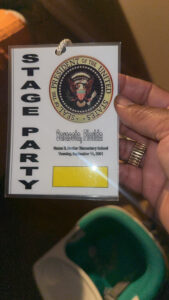
Carol Hammond’s event pass
Carol Hammond was a teacher’s assistant at Emma E. Booker that morning. Selected by the late principal, Ms. Rigel, Hammond stood on stage alongside faculty members—while simultaneously carrying the heavy burden of knowing three of her own children were students inside the building that very morning.
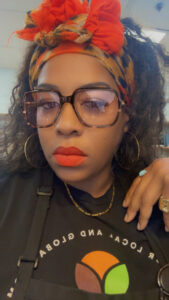
Carol Hammond
Carol Hammond: The morning of, I remember that we had to be to the school at 4:00 a.m. to go through security clearance, and I was so excited because the then principal—God rest her soul—Miss Rigel, handpicked me. I was really proud to be up there. But it was a surreal moment. Then, when that announcement was made, I was terrified.
EJ: Amid the confusion, lockdown procedures were enacted, and Secret Service personnel quickly secured the perimeter. For Hammond, standing under the bright media lights required hyper-vigilance.
CH: When President Bush said, “Bow your head,” I was probably the only person on stage that didn’t bow my head and close my eyes. I was like, “I need to just be on alert.” That was a little moment with me.
EJ: The president’s high-speed departure down MLK Way toward the airport marked a turning point. In the days and weeks that followed, the global spotlight brought a new perspective to Emma E. Booker and Newtown.
CH: We were all shocked in Emma E. Booker. It put us in the limelight for unfortunate reasons, but I think that, after that, people had a little more respect for Emma E. Booker.
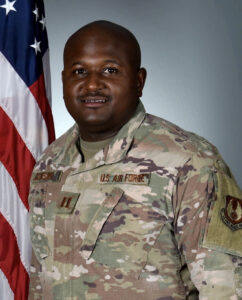
Victor Johnson
EJ: The events of September 11 left an indelible mark on the young students who witnessed history firsthand. Some of Hobbs’ classmates, including Victor Johnson and Carlton Shelley Jr, went on to enlist in the United States Armed Forces—a decision Hobbs believes was directly influenced by their presence on stage that morning.
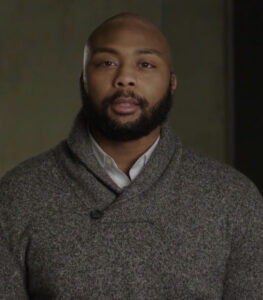
Carlton Shelley Jr.
Now, after a quarter century of wars playing out in Afghanistan, Iraq, Syria, Yemen, Gaza and Iran, Hobbs works with youth and is raising children of his own. He finds himself passing down the historical memory to a generation born long after 2001.
AH: I do my best to not brag but let them know, “Hey, when this took place, I was actually standing behind the president at the time, and I was a little bit younger than y’all. I was 10 years old—I had no idea what was going on—but as I got older, I started to understand what took place, how this is a part of American history now.”
EJ: Twenty-five years after the world watched President Bush receive the news inside an elementary school library in Newtown, Emma E. Booker remains a cornerstone of resilience and community pride. The badge worn by staff that morning and the iconic photos of students standing behind the podium serve as enduring reminders of a day when Sarasota became the unexpected epicenter of American history.
Reporting for WSLR 96.5 FM News, I’m Ed James III.
WSLR News aims to keep the local community informed with our 1/2 hour local news show, quarterly newspaper and social media feeds. The local news broadcast airs on Tuesdays and Thursdays at 6pm.