Debt investor has other ongoing deals with the college.
By Nic Steinig
Original Air Date: Nov. 17, 2026
Host: Last Friday, the State University System Board of Governors unanimously approved a debt package that New College of Florida Trustees had structured to take over a neighboring campus. It relies on a private investor and deviates from state guidelines, as WSLR News reporter Nic Steinig points out.
Nic Steinig: The assumed debt will cover the cost of transferring USF’s Sarasota-Manatee campus to New College, and will also be tapped to refinance New College’s existing debt under worse terms set with the new lenders. The debt structure deviates from Board of Governor guidelines in several ways. This approval gives them the green light to proceed regardless.
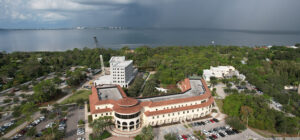
The former USF Sarasota-Manatee campus. | Photo courtesy USF
At the meeting, Board of Governors member Nick Sinatra said he thought it was a great deal.
Nick Sinatra: It’s a phenomenal real estate deal for New College—it really is—on its face. Understanding that you don’t have the bonding capacity of other institutions, the debt terms are phenomenal.
Nic Steinig: New College will borrow up to $47.5 million from two private lenders. $40 million will come from BankUnited, a Miami Lakes-based national bank with a history of lending to public projects. A private individual lender, the identity of whom was left undisclosed in all public documents, would float up to $7.5 million, with around $4 million earmarked today. At the Board of Governors meeting, Kevin Pichard, who oversees finance and facilities for the Board’s staff, verbally identified the private lender as Aldina, a company acting as a representative of a “family trust.” Aldina has firm ties to New College alum, tech entrepreneur, real estate developer and Sarasota Film Festival president Mark Famiglio.
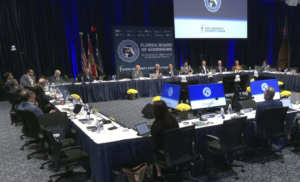
The Florida Board of Governors discussed the New College debt proposal last week. | Photo courtesy BoG
Kevin Pichard: The private investor is Aldina LLC, acting as trustee of a nearly 40-year-old family trust that’s affiliated with three New College alumni.
Nic Steinig: According to state records, Aldina is managed by an entity called MPF Family, LLLP, whose leadership is listed as “Mark P. Famiglio, Trustee.” The name MPF also happens to contain the same string of letters that resolve from the initials of Mark P. Famiglio. New College’s own records send the same message. Mark Famiglio’s name is on Aldina’s signature line in a drafted lease agreement between Aldina and the college’s foundation, and he is marked as Aldina’s primary contact for notices.
It’s worth mentioning that Aldina is also the landlord of two leases with the college’s foundation. New College trustees approved those leases so they could rent Aldina’s property. One covers two houses on 58th Street at $10,000 a month, which Aldina purchased two months before trustees approved the lease. The other covers gym space on Tallevast Road for about $25,000 a month. Sydney Gruters—the former New College foundation director, current District 16 U.S House congresswomen elect and wife of RNC chair Joe Gruters—was the foundation’s signer named in the 58th Street lease. Famiglio donated the maximum $7,000 contribution to Sydney Gruters’ campaign for Congress.
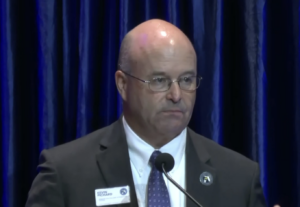
Kevin Pichard
At the Board of Governors meeting, Pichard explained that the reason the risk in the New College debt schedule was determined as tolerable to the Board of Governors was because the college’s foundation would pay for any lapses in the college’s installments.
KP: We view that any risk that’s imparted by these deviations is mitigated by financial backing of this transaction by the New College Foundation.
Nic Steinig: As previously reported by WSLR, the debt schedule includes thin income-to-debt margins that assume higher occupancy in student dorms and a large increase to student rent. BankUnited’s loan is interest-only for its first two years and adds principal later, so payments ascend over time. Aldina’s loan is interest-only until 2032. Taken together, the college will pay more than double what they do now in 2027.
The college’s interest rate on their existing $15 million debt will increase from about 3% to about 5.5% as it is refinanced from Truist to BankUnited. Aldina is set to get a better deal than the bank. In New College’s Board of Trustees materials, Aldina was projected to receive an interest rate of about 6%. Interestingly, the materials sent to the Board of Governors a day after the Board of Trustees approved the debt plan projected an even higher rate of 7% for Aldina, all tax exempt.
When asked about the discrepancy by email, New College Deputy Chief of Staff & Interim VP of Communications and Marketing Virginia Zimmerman told WSLR that “the interest rates will fluctuate with the market and will not be fixed until a few days before the closing.” 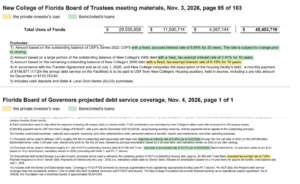
While the trustees’ materials did not firmly lock rates, it described only the BankUnited loan as “subject to change prior to closing,” and based its rate on two percentage points above a five year treasury rate. In contrast, the Aldina loan listed a “fixed, tax-exempt interest rate of 6.19%,” and nothing tied it to market fluctuation. The interest rate for BankUnited did not shift between the New College trustees’ Nov. 3 approval and the Board of Governors meeting last Friday. The assumed rate on the Aldina loan rose nearly a full percentage point, and neither set of documents explains why.
It all comes to a head in six years, when the $40 million loan comes due in full and Aldina’s maximum loan of $7.5 million kicks its principal into full effect. New College President Richard Corcoran previously indicated that the college’s plan is to refinance once federal tax law opens the possibility of tax-exempt loans in 2032. At the Board of Governors meeting last Friday, Sinatra said the loan would be refinanced as soon as possible.
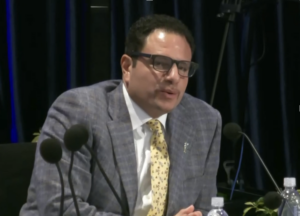
Nick Sinatra
Nick Sinatra: I feel strongly that this will be refinanced the moment that you possibly can in the future. Kevin, what’s the time frame that this debt has to stay in place?
KP: New College does not have a history of borrowing in the public market, and frankly, they don’t have a lot of history of borrowing, period. The idea here is that, by 2032, they will have established enough credit history that they will go out with a traditional revenue bond issue, fully tax exempt.
Nic Steinig: Should New College tap Aldina’s loan for the full $7.5 million, Aldina will make about $2.9 million by 2032. If they are unable to refinance, Aldina will make about $4.2 million once the loan is fully repaid. Aldina will also generate about $2 million in revenue over five years for the real estate they rent to New College.
Reporting for WSLR News, Nic Steinig.
WSLR News aims to keep the local community informed with our 1/2 hour local news show, quarterly newspaper and social media feeds. The local news broadcast airs on Tuesdays and Thursdays at 6pm.
 It's drive week!
Your gift keeps 96.5 on the air. Be one of the people who make it happen.
Donate Now