Organizers had to clear a few hurdles before getting the civil rights icon to Sarasota.
By Ed James III
Original Air Date: Nov. 17, 2026
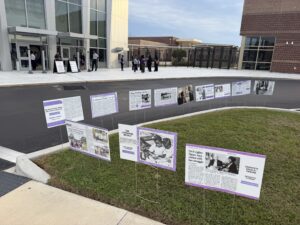 Host: Last week, civil rights icon Ruby Bridges spoke to students at Bay Haven School of Basics Plus, the first school in Sarasota County to integrate. Just a few years ago, that same school wouldn’t let a walk in her honor onto its campus. WSLR’s Ed James III reports on what it took to bring her here.
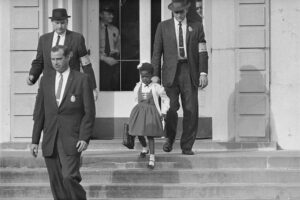
Ed James III: In 1960, six-year-old Ruby Bridges walked into an all-white New Orleans elementary school, escorted by federal marshals. Two years later, 29 Black children enrolled at Bay Haven, and integration began in Sarasota County.
Bay Haven teacher Teidra Everett has organized an annual Ruby Bridges Walk to School Day since 2021. Last year, she asked Walter Gilbert, a former president of the Sarasota NAACP, to come speak to her class.
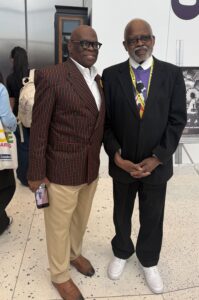
Walter Gilbert (left) and Dr. Washington Hill (right) | Photo: Ed James III
Walter Gilbert: Last year—we had done it three years—my great granddaughter was in Teidra’s class. I stood up in front of those kids and said, “Next year, Ruby’s going to be here.” As soon as I said it, I said, “Oh my God. How’s that going to happen?” But we went to work.
EJ: Gilbert reached Bridges’ agent through a Kansas state representative who had hosted her at a walk there. The bigger obstacle was here at home. In earlier years, with a conservative majority leading the school board, the walk wasn’t allowed on school grounds.
WG: The first couple years that we did this over at Bay Haven, we couldn’t do it on campus. It wasn’t a School Board-sanctioned function. We had to meet across the street with the kids and their parents and actually walk up to the school from the public sidewalks up to the entrance to the school. And the program could not go into the school. We couldn’t get them to budge off it because the leadership of the school board at that time was slanted a particular way. There was no way this could have happened.
EJ: In August, voters flipped the school board to a non-conservative majority.
Co-chair Victoria Kasdan, a nurse and public health leader, helped turn a group of neighbors into a fundraising operation, with Embracing Our Differences serving as fiscal agent. This year, she says, the district changed course.
 Victoria Kasdan: We have, surprisingly, been able to get the cooperation of the school district this year. And that event, though it will be at Bay Haven for those 500 or so students there, it will be live-streamed to 14 other elementary schools, so she will actually be doing a presentation to a total children’s audience of 6,500 kids in Sarasota County.
EJ: That cooperation went only so far. The livestream was offered to all of the county’s 20-plus elementary schools, and 14 principals accepted.
The evening town hall was held at Booker High. When the county desegregated, Black students were bused out of Booker, and in the 1967-1968 school year, the school district shut down Booker High School. Dr. Rachel Shelley, Booker’s immediate past principal, spoke with me before the doors opened.
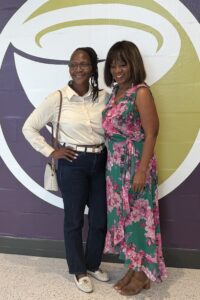
Dr. Rachel Shelley (left) and Vicki Oldham (right) | Photo: Ed James III
Rachel Shelley: I think it’s absolutely imperative that she chose this place, and the reason why is our connection. It’s so important that people understand the struggles that she went through and what we have gone through here. Being at Booker High School, on this ground here, it’s just amazing. I am excited because people need to know the struggle, understand the struggle and then be able to relate it to some things that are going on and have happened in our community.
EJ: The town hall put Bridges on stage with journalist Charlayne Hunter-Gault, who helped integrate the University of Georgia. Tickets sold out in 12 hours. The price—$50 a pop—caused some criticism. But the event did raise $130,000 through ticket sales and sponsorship. That money now benefits two non-profits: The Sarasota African American Cultural Coalition and Embracing Our Differences.
VK: They provided their support, but they scrambled for those tickets, and we are unable to accommodate all the people who want to see it because it’s such a phenomenal event.
EJ: Under the terms of Bridges’ speaking contract, the press was not allowed to record her remarks or interview her. That’s why you won’t hear her voice in this story and why the town hall was not livestreamed to the public.
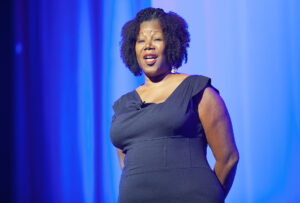
Ruby Bridges | Photo: JD Lasica via Wikimedia Commons
Gilbert says the history lesson is meant for every student.
WG: We have to look at this whole thing bigger than just Black, because a lot of those kids that walked up to that school during those walks we had were white. What we have to count on is that that message does not get lost on just—well, not lost on us—given to us. They have to learn the message also. It makes a difference. That’s the difference that has to be made. They need to know just as much as we need to know.
EJ: A few years ago, Bay Haven families had to walk up from a public sidewalk. This year, Ruby Bridges was inside the school, speaking to them. For WSLR News, I’m Ed James III.
Hear Ed’s full conversation with Walter Gilbert and Victoria Kasdan on episode 10 of Rap Sessions, from WSLR 96.5 FM.
WSLR News aims to keep the local community informed with our 1/2 hour local news show, quarterly newspaper and social media feeds. The local news broadcast airs on Tuesdays and Thursdays at 6pm.
 It's drive week!
Your gift keeps 96.5 on the air. Be one of the people who make it happen.
Donate Now