It must absorb a 40% cut in state funding – and a neighboring campus. Also, spending on salaries and administration has mushroomed.
By Nic Steinig
Original Air Date: July 1, 2026
Host: Today, July 1, the takeover of the USF Sarasota-Manatee campus by New College is official. Yesterday, the New College board of trustees met, and our reporter Nic Steinig tried to find out more about how New College’s pared-down budget for 2026-27 squares with its plans to absorb the campus expansion.
Nic Steinig: Yesterday, the New College of Florida Board of Trustees held its first meeting since Governor Ron DeSantis signed the state budget. This year’s budget slashed New College’s state funding by about 40% while mandating the transfer of USF Sarasota-Manatee campus to New College, including its associated construction debt. At the Board of Trustees meeting, the college, which must contend with this shift, has now approved its planned operating budget for the upcoming school year.
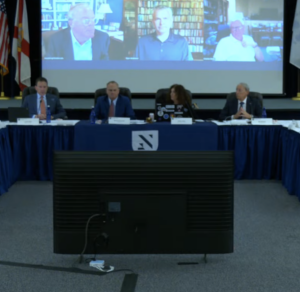
Screenshot of New College’s June 30 Board of Trustees meeting.
Many were wondering how New College would respond to the sudden financial pressure. Over the last few years, the college has received generous financial awards from the legislature in support of Governor DeSantis’s project to overhaul the college in line with a conservative vision of higher education, with one-time allocations between $15 and $25 million assigned to New College given annually in addition to a new recurring $10 million.
Drawing on the boost from the legislature, New College saw explosive growth in its annual expenses. According to the Board of Governors State University System Operating Budget, since 2022, the cost of all salaries and benefits has increased by 50%; administrative costs have more than doubled; student service costs have tripled; and scholarship costs have risen nearly sevenfold.
A striking component of New College’s approved 2026-2027 operating budget is the continued expansion of its faculty, administration, and staff expenses. All salaries and benefits are set to grow by an additional 25% this year, up from last year’s all-time high. The athletics budget is set to quadruple. Student services are also rising sharply, and the school is still slated to spend nearly $6 million on temporary student housing.
All of these expenses were previously supported in part by the legislature’s generous one-time allotments to the schools’ Education and General fund, which has now dried up. At a time when the fuel for its growth has been diverted, New College is stepping on the gas instead of making cuts.
New College alum Rodrigo Diaz stepped up to the microphone at the meeting to express concern about the budget to the trustees.
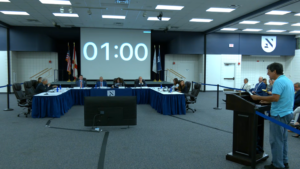
Rodrigo Diaz addresses the board. Screenshot from New College’s June 30 Board of Trustees meeting livestream on YouTube
Rodrigo Diaz: The proposed budget for the 2026-2027 reflects the loss of over $22 million in Education and General funds compared to the fiscal year 2025-2026, a cut in total revenues of 21%.
However, the budget intends to spend only 5% less than the school collected in revenues this year. The plan is to make up the difference through spending cuts and increased revenues. Is this budget realistic? Does it tell you enough of what you should know? The solvency of the college is the matter at hand.
NS: Only a few revenue increases are proposed. For one, the athletics fee will increase tenfold, growing from around $250,000 to $2.5 million. There’s also about $3 million more expected from donations to the college’s foundation. The largest source the college seems to be banking on is the combined revenue from last year’s carry-forward dollars and this year’s insurance and FEMA payouts.
WSLR interviewed Richard Corcoran after the meeting. We asked the New College president if the cut from the legislature would result in any reductions to New College’s programs or staff.
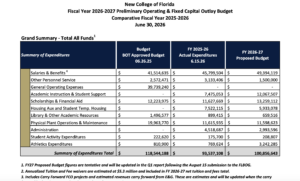
New College of Florida’s 2026-2027 budget proposal
Richard Corcoran: It’s not really as you describe it. Basically ,the legislature funds you with recurring dollars and non-recurring. If they give you non-recurring, they’re telling you, “It’s only for one year—that’s it. Don’t bank on it.” What happened at New College: for decades of scarcity, buildings were falling apart, AC units needed to be replaced, roofs needed to be replaced, floors needed to be replaced, dormitories, beds, refrigerators, golf carts, planes, trains and automobiles—everything needed to be replaced, so we were asking for non-recurring money—one-time money—so we could spend it on non-recurring expenses so it doesn’t affect us. The recurring money stayed the same. We didn’t lose a penny of recurring money. and we have that recurring money. The reason we didn’t get that non-recurring money is because we didn’t ask for it. Every year we went up there and we’d say, “We want this much—$25 million, $15 million, $30 million—in non-recurring money,” and we got it every single year. This year, we made a concerted effort because it’s absolutely game-changer transformational for the college to say, “What we’d rather have is a $200 million dollar campus that we could move into the very next day,” and we were successful.
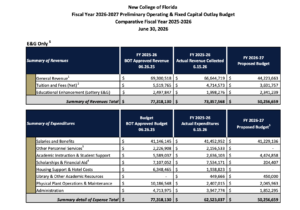
New College of Florida’s 2026-2027 preliminary operating budget
NS: Contrary to Corcoran’s claim that New College didn’t ask the legislature for additional dollars this year, WSLR previously obtained pictures of a document from a New College delegation that was sent to Tallahassee to lobby Florida lawmakers, and that document depicted an intent to ask lawmakers for $25 million in perpetuity.
The fact that the New College delegation asked the legislature for recurring dollars totaling $25 million rather than a one-time deal may suggest they are actually reliant on that funding. DeSantis’s own budget proposal to legislators this year also requested a recurring $25 million per year for New College in perpetuity, reinforcing that point.
A further complication of their financial profile: New College’s assumption of USF Sarasota-Manatee and its debt. At the Board of Trustees meeting, USF history professor Scott Perry came up to the podium to raise that question.
Scott Perry: Speaking for myself, not USF: The transfer agreement includes a provision that New College will assume full responsibility for $53 million in debt incurred by USF’s Sarasota Manatee by December 31. I find it hard to believe that an institution that is already $17 million in debt and has been frozen out of the bond market for many years can find an investor to undertake that burden. Perhaps a developer will issue a loan in the expectation that both schools will fail and all this prime estate will become available.
NS: At the Board of Trustees meeting, Corcoran said that the college would not have any trouble finding a partner to finance the debt from USF, even suggesting that financing the debt in the market could entice a bidding war favorable to the college.
Corcoran’s former Vice President, Nathan Allan, has painted a far more cynical picture, claiming that New College’s current $17 million debt was already “bad enough to freeze it out of the debt markets.” Allen predicts the college will be shuttered under the weight of the assumed $53 million in debt from USF Sarasota-Manatee.
WSLR asked Corcoran how the College plans to assume USF Sarasota-Manatee’s debt and what he thinks of Allen’s perspective.
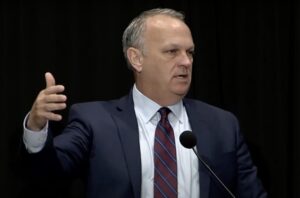
Richard Corcoran | Still shot New College video
RC: Nathan used to work here. He’s a bright guy. But, as I said in that meeting, if Nathan’s saying that we have to assume $53 million in debt and that New College still has $20 million in debt, that’s $73 million worth of debt. If Nathan knew that the numbers were $28 million, not $53 million, and $15 million, not $20 million, it changes the whole paradigm of what you get with financing. There’s no issue at all for New College, but the problem is Nathan keeps saying $53 million. He’s off by almost 100%. I think we’re going to have competitors. It’s the opposite. Our hope is that, once we put it on the street, we’re going to have multiple people. We’ll be able to say, “This is the best deal for New College and taxpayers.”
NS: WSLR sent a request to New College Communications Director James Miller asking for documentation corroborating that the assumed debt will total $28 million and not the widely circulated $53 million. Miller provided financial documents from USF Financial Corporation that show the debt payment schedule. What Corcoran claims is true; the principal on the debt is around $28 million. The $57 million is the total amount to be paid over 30 years, including interest.
However, any deal that New College structures will include a new interest rate based on whatever mechanism they use to finance the debt. USF’s current debt schedule was based on the rate it secured with its triple-A bond rating, something New College will lack when it goes to the market. In other words, the annual debt schedule is unlikely to differ from previous projections of about $2 million annually and could be even higher if New College can’t secure the same low interest rate.
As of now, the college shows no signs of slowing its planned growth. By tapping its reserve funds, raising fees and relying on donations, the college has balanced the budget this year. Governor DeSantis will be vacating his office in January of 2027. Without that political support, it’s unclear if the College will secure additional funding next year.
Reporting for WSLR News, Nic Steinig.
meeting
WSLR News aims to keep the local community informed with our 1/2 hour local news show, quarterly newspaper and social media feeds. The local news broadcast airs on Wednesdays and Fridays at 6pm.
 It's drive week!
Your gift keeps 96.5 on the air. Be one of the people who make it happen.
Donate Now
It's drive week!
Your gift keeps 96.5 on the air. Be one of the people who make it happen.
Donate Now