Oysters, among nature’s best water filters, once thrived in the region.
By Ifhmalee Caceuis
Original Air Date: July 3, 2026
Host: “Oysters, oysters everywhere” – that is how A. Smeltz of the U.S. Fish Commission described the Manatee River in 1897. WSLR News intern Ifhmalee Caceuis took a deeper dive into oyster restoration.
[Splashing sound]
Ifhmalee Caceuis: Long before it was known as the Manatee River, this waterway was called the Oyster River, named for the vast oyster reefs that once thrived here. Those reefs played a major role in shaping the region’s ecosystem. But decades of overharvesting and habitat loss caused oyster populations to collapse.
Today, restoration efforts are trying to bring that ecosystem back.
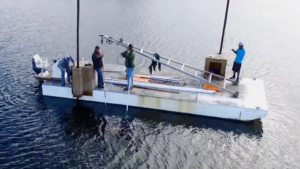
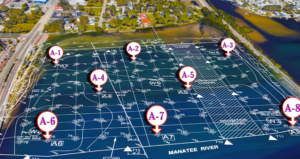
Photos: Screenshots Palmetto Bay Oyster Restoration Project
The Palmetto Community Redevelopment Agency’s Water Quality and Aquatic Habitat Enhancement Project is restoring native oyster habitat while improving the ecological health of the Manatee River. I boarded a pontoon boat on Wednesday at the Riverside Boat Ramp for a closer look at the restoration sites.
Marked by bright red buoys, the sites are scattered across the river. Researchers revisit them every month to monitor how the reefs are developing.
At the center of the project is Ernesto Lasso de la Vega, the project’s principal investigator. He explained how researchers track the health and growth of the developing reefs.
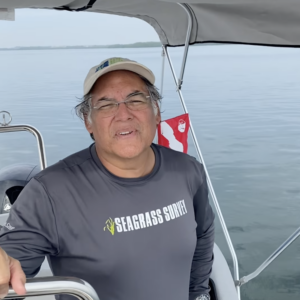
Ernesto Lasso de la Vega. | Screenshot Suncoast Aqua-Ventures
Ernesto Lasso de la Vega: We mark those red buoys to easily find them because it’s so hard to find a cluster—I have a GPS—and it is a lot easier to just anchor next to the buoy and jump in and do the project.
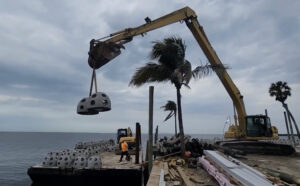
IC: At each location, researchers pull settlement tiles from the water to count baby oysters, also known as spat, and document the marine life growing alongside them. That could be barnacles, sponges or tunicates. Those observations help scientists understand not only how quickly oysters are returning but how the surrounding ecosystem is recovering as well. Currently, there are about 380 reef balls across 18 football fields worth of habitat in the river.
 ELV: I want to see if there is any effect on the river versus the land in production of baby spats, and we quantify that by putting tiles in the water—3 tiles around the cluster—and we go there, pull the tile, count the spats, scrape them off and put it back again every month.
IC: Ecologically, oysters are among nature’s most effective water filters. A single oyster can filter up to 50 gallons of water each day, removing algae and suspended particles that cloud waterways. According to the Palmetto CRA, once the restored reefs are fully established, the oysters in the project area could collectively filter enough water each day to fill the equivalent of 726 Olympic-sized swimming pools.
The restored oysters are not intended for harvesting or consumption. Because the lower Manatee River is affected by bacteria and pollutants from urban runoff, state agencies advise against eating shellfish from the area. Instead, the oysters are left in place to filter the water, improving water quality while the reef expands.
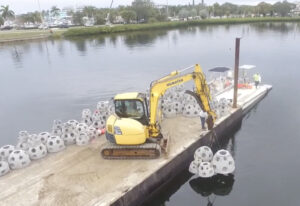 According to the National Oceanic Atmospheric Administration, oyster reefs also provide an added benefit by helping protect shorelines, reduce wave energy and buffering against storm impacts.
[Splashing sound]
Moments after diving in the Manatee River, Lasso de la Vega explained how restoring oysters is about expanding habitat.
ELV: Oysters are doing phenomenal. There’s also some sponges. You’ll see orange sponges. They’re very unique, and they’re doing their job. Again,
they’re providing food for somebody else. That’s all part of their nature. They’re not going out of control yet, but I’m monitoring how much of their invasiveness is happening here.
 IC: As oyster reefs grow, they create habitat for sponges, fish, crabs and other marine life while strengthening the overall health of the river.
The restoration is backed by both local and state funding. The Palmetto CRA says the project includes local investment along with a $625,000 state matching grant awarded in 2024. That funding supports five years of biological and water quality monitoring. This allows researchers to track and create data that could help guide oyster restoration efforts in other Florida waterways.
For Lasso de la Vega, the work is also about restoring something Florida once lost.
ELV: You remove something. If you don’t make it sustainable, then your population is going to crash. That’s exactly what happened here. They crashed, and they didn’t know why. Now they’re learning, and everybody else is learning.
IC: Researchers hope the project will not only rebuild oyster populations in the Manatee River but also provide a blueprint for restoring coastal ecosystems across the state.
For more information about this project, visit palmettofl.org.
For WSLR News, This is Ifhmalee Caceuis.
WSLR News aims to keep the local community informed with our 1/2 hour local news show, quarterly newspaper and social media feeds. The local news broadcast airs on Wednesdays and Fridays at 6pm.
 It's drive week!
Your gift keeps 96.5 on the air. Be one of the people who make it happen.
Donate Now
It's drive week!
Your gift keeps 96.5 on the air. Be one of the people who make it happen.
Donate Now