A veterinary technician shares what threats sea turtles face and what Mote Marine does to help.
By Noah Bookstein
Original Air Date: July 3, 2026
Host: If you are out there in a boat in Sarasota Bay this Independence Day weekend, keep it within the speed limit. Sea turtles often get hurt by speeding boats and end up at Mote Marine. Noah Bookstein has a close look at the non-profit’s rehab facilities and turtles.
Noah Bookstein: Each year at Mote Marine Laboratory in Sarasota, dozens of sea turtles drift in rehab tanks. Jenna Rouse, a veterinary technician who spent over a decade working with them, tends to their health day in and day out. It’s a career that started with a library book in Wisconsin.
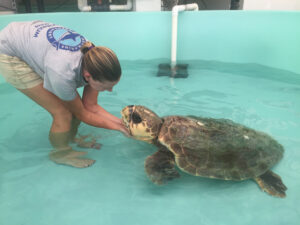
Jenna Rouse with a loggerhead sea turtle. | Photos courtesy Rouse
Jenna Rouse: There was one book in the elementary school library about dolphins, and my name was written on the checkout card over and over and over. It was something I was very passionate about from a young age, and I never gave up on it; I decided that’s what I wanted to do with my life—to work with marine animals in some capacity.
NB: That early fascination with marine life eventually led her through college, zoo internships, dolphin work in the Florida Keys, and finally to Mote in 2010 where she continued working with dolphins before the lab shifted its focus.
JR: Mote realized our sea turtle patients are great rehabilitation candidates. They’re reptiles, they’re very hardy and we just have better success overall focusing our attention on them.
NB: Many of Mote’s sea turtle patients arrive after someone spots them struggling and calls it in.
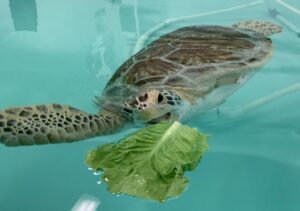 JR: Mote Marine Laboratory Strandings Investigation Program does have a 24 hour pager. Many of our sea turtle patients are found just by local people here in Sarasota—someone’s out on their boat, and they see a sea turtle floating in the distance. They might tool over to get a closer look and realize the animal is struggling.
NB: Once a turtle reaches the rehab center, the threats they are facing usually come from one of a few culprits.
JR: They’re wild animals, so by the time they allow themselves to even be picked up on humans, they’re really, really sick. Oftentimes when we run that blood work, we see a lot of the same things: anemia, dehydration, either very elevated white blood cell count or very low white blood cell count. We can’t always pinpoint what specifically makes them sick. Unfortunately, we do often see boat strike animals come into the hospital in our area since it is a highly boat-traversed area. When it gets cold, since the sea turtles are reptiles, they often have signs of cold stress. Also, we often get animals entangled, so they may have either been tooling around a crab pot trying to look for some free prey, and they get wrapped up in the crab pot lines or monofilament fishing gear that people have discarded.
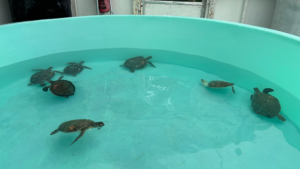 NB: Once a turtle is admitted, caring for it becomes part of Rouse’s daily routine.
JR: There’s some routine days where it’s just cleaning, data entry, looking for projects, and then there’s days where everything hits the fan. We never know what animals are going to come in, we don’t know what their predicaments are going to be, so we just have to be adaptable and ready to react depending on what the needs are. Day to day, overall, it’s just animal care. Food preparation, feeding, water quality, tank maintenance—those are the general things we do every day for the patients in our care, and then more specialized things depending on the animal’s needs like pulling them out of the water and getting a blood sample, doing x-rays, surgery.
NB: After years in the fields, Rouse is still surprised at how much turtles can bounce back from.
JR: The thing that really surprised me most, especially about working with sea turtle patients in a rehab setting, is their resiliency. They will come in with predicaments or lab values that, if you would see on your dog’s blood work or your cat’s blood work, would basically mean “no bueno,.” But these sea turtles are just so resilient—they’re older than dinosaurs—so the things that they can rebound from with just simple supportive care is very amazing and surprising to me.
NB: Perhaps no case illustrates that better than one turtle Rouse still keeps photos of in her office.
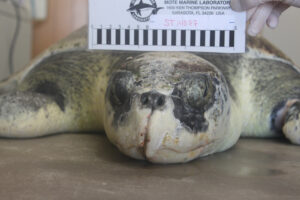
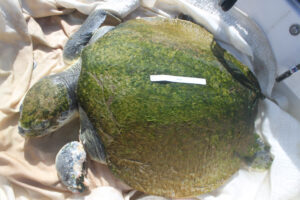
Mufasa the Kemp’s ridley sea turtle. | Photos courtesy Rouse
JR: Her name was Mufasa, and it was an adult Kemp’s ridley sea turtle, which happens to be the most endangered of the seven sea turtle species. To even see an adult is amazing. This animal had so many things stacked against her: She was missing most of her flipper, probably from entanglement. The top and bottom beak, or jaw, was kind-of severed, and the back of her carapace, or top part of her shell, was also severely damaged, probably from a potential boat strike. She was tough. She was one of those animals that was so tough that, even for us to get into the water to lift her out, we had to lower the water all the way down, because if we went in, she would come at us, which is abnormal for a turtle but definitely made me respect her and showed me why she was still alive. Good news was she was released months later. We even took her to a special spot at Ten Thousand Islands, and we were able to release her.
NB: Not every story ends that way, and for Rouse, that can be the hardest part of the job.
 JR: I think probably one of the hardest parts of the job is when you watch an animal decline. Usually, by the time they’re with us for a couple days, we’ll see them turn a corner in a good way. Some of them that just can’t turn that corner, you might see get weaker over time—more lethargic—and that’s hard to watch when you’re really rooting for them.
NB: But when a turtle does pull through, the feeling is great.
JR: Once the release happens, it’s amazing. We’ll just walk them into the water, sit them on the beach and watch them crawl away. It’s just so nice, after watching them in a tank for however many months, to see them swim off.
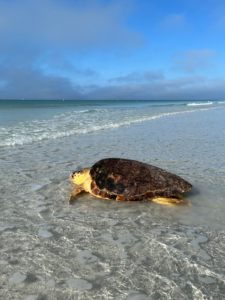
A loggerhead turtle being released into the wild. | Photos courtesy Rouse
NB: Rouse says we can help protect turtles by being aware that we share the beach and the water with wildlife.
JR: There’s plenty of ways we here locally can help sea turtles because they live all around us. One is just responsible boating. Go slow in sea turtle areas, especially this time of year; it’s nesting. Pick up after yourselves. It’s amazing the amount of garbage I see just walking along the bay front. Anything that you bring near the water, you need to dispose of properly. Making it easy on them—they already have so many things stacked against them. Any little bit we can do to help their cause is worth it. They’re amazing.
NB: Back in the tank, this year’s patients are still healing, the latest in a long line of animals, now including manatees, that Mote has given a second chance. If you are in Sarasota or Manatee County and see a distressed manatee, dolphin, or sea turtle, call the Mote Strandings pager at 888-345-2335.
For WSLR News, Noah Bookstein.
WSLR News aims to keep the local community informed with our 1/2 hour local news show, quarterly newspaper and social media feeds. The local news broadcast airs on Wednesdays and Fridays at 6pm.
 It's drive week!
Your gift keeps 96.5 on the air. Be one of the people who make it happen.
Donate Now
It's drive week!
Your gift keeps 96.5 on the air. Be one of the people who make it happen.
Donate Now