SB 1028, which aims to funnel policyholders into the private market, will soon be on DeSantis’ desk. The insurance industry and regulators are against it.
By Nic Steinig
Original Air Date: April 1, 2026
Host: As one of his last acts as a Florida legislator, Sarasota Senator Joe Gruters managed to get a bill he sponsored to land on Gov. Ron DeSantis’ desk. Senate Bill 1028 could raise costs for tenants and owners of condos—including many affordable ones in Sarasota. Nickolas Steinig reports.
Nic Steinig: How much would a resident’s rent or condo fees increase if the owners had to pay 15 percent more for insurance? A fair guess: More than they do now. Senator Joe Gruters’ bill would also centralize the market, potentially benefiting a major donor to Republican campaigns nationwide, as investigative journalist Jason Garcia wrote on his Seeking Rents substack. Last year, Gruters became the chairman of the Republican National Committee, and as such, one of his key responsibilities is fundraising.
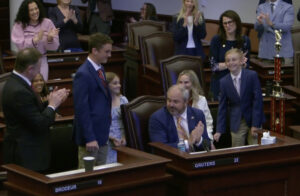
Joe Gruters is leaving the Florida Senate to serve as chair of the National Republican Committee. Fellow senators celebrated his service at a ceremony in early March. | Screen grab The Florida Channel
The proposed law, Senate Bill 1028, sailed easily through both the House and Senate—with the House voting 88-19 in favor. But now, as Garcia first reported, major players in the Florida insurance industry itself are trying to convince the governor not to sign the bill into law.
Both the Florida Surplus Lines Association and the Florida Association of Insurance Agents have made their opposition public. To understand why, one must examine the bill’s fine print. The bill’s alleged intent is to further depopulate Florida’s publicly funded insurer of last resort, Citizens Property Insurance Company, by moving policyholders into the private insurance market.
So far, depopulation of Citizens Property Insurance Company has focused solely on shifting individual personal policies to the private market. This bill would expand that to include commercial policies held by business owners, including residential businesses like condominiums, apartments, HOAs and retirement communities. This process would be facilitated by a newly created clearinghouse that oversees the transfer of insurance policies from the publicly funded to the private sector.
While this bill is similar in concept to previous efforts, insurance regulators and industry brokers have taken issue with a caveat embedded in the law that endured through changes in the Senate. If a policyholder receives an offer from a surplus line insurance company within 15 percent of the cost of an existing Citizens Property Insurance policy, that policyholder will no longer be eligible for insurance under the publicly funded program. That 15 percent rise has already raised eyebrows, but an even bigger concern is about surplus line insurance—insurance which is almost entirely unregulated by the state, but still technically legal to sell, to provide coverage to high-risk ventures.
Here is Insurance Commissioner Michael Yaworsky, elaborating on some of the risks associated with using surplus line insurance at a Senate committee hearing:
Michael Yaworsky: The bargain for exchange belief in the surplus lines market is that the consumer who is going to purchase that type of product is of a sophistication or wealth that they do not necessarily need those state-backed productions. Therefore, there is no form or rate review to ensure that those items comply with Florida law.
In the surplus lines market, all the insurer has to do is provide the manifestation of intent to renew to meet the deadline requirements in that space. They do not have to disclose what the new premium might be—what new terms of coverage might be—what a number of other provisions might be in this place—up until the day before the new policy is set to renew. That can be a significant challenge for a number of consumers that are in this residual marketplace right now that is Citizens.
NS: At the end of the hearing, Gruters had this rebuttal:
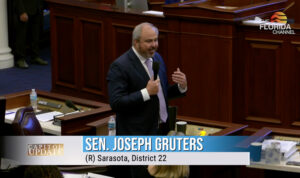
Joe Gruters
Joe Gruters: 40 percent of the commercial market is already written by surplus lines right now. 40 percent. What have we seen just over the last year with insurance rates as a result of the efforts of this body, the governor and others? We’ve seen rates go down. We’ve seen rates go down because we made the changes necessary to drive increased capital into the market, which increases competition, which will ultimately lower rates.
NS: It’s true that about 36 percent of commercial insurance in Florida is currently provided by surplus line insurance companies, but that number is not representative of the financial reality faced by Citizens policyholders. Nearly 70 percent of Citizens’ residential commercial policies are for property built before 1984, according to Citizens Property Insurance Company.
According to Citizens, there are 150 active commercial policies in Sarasota County. If statewide trends hold in Sarasota, about half of those could be residential businesses, such as local apartments, condominiums, retirement homes and other large residential properties.
WSLR reached out to the Downtown Sarasota Condominium Association, a group that coordinates with over 40 local condominiums. While the Association declined to take a stance, they shared concerns expressed by Sarasota condominium associations. These include fears that insurance hikes would force condos and HOAs to raise prices, unease about the risks and complexity of using surplus line insurance and discomfort at being pushed into the private market, where insurance periods are shorter and more difficult to negotiate.
While all this should be a boon for the private insurance industry, and especially for surplus line providers, there is active pushback.

Patrick and Shirley Ryan | Screen grab RSG video
That’s because the key role of administrator for the commercial clearinghouse—which oversees the movement of policies from publicly funded Citizens to the private market—could be awarded to Ryan Specialty, a Chicago-based firm whose founder, Patrick Ryan, and his wife, Shirley Ryan, have contributed over $30 million to Republican congressional committees, according to Seeking Rents. Ryan Specialty also deals in surplus line insurance.
Only a handful of companies could match this bill’s requirements. According to Seeking Rents, Ryan Specialty senior executive Mark Katz edited the bill directly.

Ryan Specialty celebrates its listing on the New York Stock Exchange in July 2021. | Screen grab RSG video
In November, as reported by Seeking Rents, Ryan Specialty donated $750,000 to two political committees, which then distributed the money across several other organizations, with $500,000 being allocated to the Florida Republican Senatorial Campaign Committee. But why pursue the role of clearinghouse administrator, whose task is merely to facilitate the moving of insurance to the private market?
Critics of the bill have indicated that the clearinghouse administrator enjoys a number of privileges that could allow them to consolidate aspects of the market and generate a windfall that leaves their competition far behind. The Florida Surplus Line Association is an organization that coordinates surplus line insurance industry members. WSLR spoke to FSLA Legislative Chair Dave DeMott about the bill. Here’s what he had to say:
Dave DeMott: Having a single intermediary in control of that ballast of business has the potential to create an imbalance on some level. The administrator of this would have access to a fairly large slug of business and the ability to create homes for investment dollars looking at risk-related vehicles. It’s a very difficult backdrop to say that it’s out of pure altruism.
NS: That’s not all. Regulators and competitors are leery that the clearinghouse administrator could commoditize the risk, earning them a killing.
The Governor’s Office confirmed that the bill is still pending and hasn’t yet reached Ron DeSantis’ desk. When it does, he’ll have approximately 14 days to deliberate on it before being forced to sign or veto.
WSLR News reached out to Senator Joe Gruters by phone several times and by email, but did not receive a response.
Reporting for WSLR News, Nic Steinig.
WSLR News aims to keep the local community informed with our 1/2 hour local news show, quarterly newspaper and social media feeds. The local news broadcast airs on Wednesdays and Fridays at 6pm.