The three-year battle at Wellen Park that exposed the power imbalance between Florida homeowners and developers is over.
By Derek Gilliam/Suncoast Searchlight
Original Air Date: January 14, 2026
Host: A three-year legal battle between residents of the Gran Paradiso subdivision and its developer-controlled government has ended. The settlement resolves a fight over irrigation water rates that divided the upscale neighborhood in South Sarasota County’s Wellen Park and exposed the power imbalance between homeowners and special-purpose districts that control essential services. Derek Gilliam with Suncoast Searchlight brings us this story.
 Derek Gilliam: The dispute escalated last year when the West Villages Improvement District shut off irrigation to the neighborhood altogether, browning lawns and water-starving plants as the lawsuit dragged on and a trial date loomed.
But the settlement, which was approved in November, came with some stark conditions.
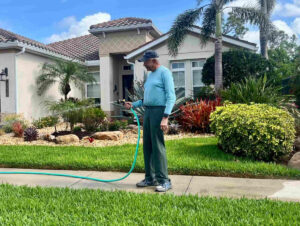
Gran Paradiso homeowner Farhan Sheikh watered his lawn on April 3, just days after the West Villages Improvement District terminated irrigation service for the community. Sheikh said he now needs to use tap water to keep his lush landscaping alive. Photo: Emily Le Coz Suncoast Searchlight
Under the agreement, Gran Paradiso homeowners agreed to surrender their lawsuit, waive legal protections for directors who challenged the district and silence future criticism in exchange for the district supporting restoration of water service with no guarantee Gran Paradiso will have irrigation anytime soon—terms critics describe as punitive and retaliatory.
Gran Paradiso may also have to transfer a valuable piece of property to the West Villages Improvement District or make a large monetary payment to cover some of the district’s legal bills racked up in the dispute, according to written statements to residents.
Six current and former board members of the Gran Paradiso Property Owners Association are excluded from the settlement, leaving them exposed to future lawsuits from the master developer.
The current Gran Paradiso board also said in the written statement to residents that some of its former members were “extremely mean-spirited (and dishonest)” at points in the dispute, appearing to place blame on the prior directors for how the legal fight ended.
Those excluded from the settlement told Suncoast Searchlight they believe the move was intended to stifle opposition and send a warning to other communities considering similar challenges.
Business entities controlled by Toronto-based homebuilder Mattamy Homes Corp. stand to gain nearly $3 billion over the life of the irrigation agreement, according to court documents.
Mattamy did not answer specific questions about the settlement or explain why certain directors were excluded, instead offering a brief statement to Suncoast Searchlight.
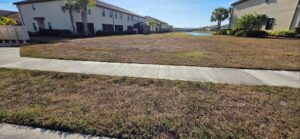
Grass in Gran Paradiso has turned brown after irrigation water was cut off in the Wellen Park neighborhood last March. Photo: Eric Johnson for Suncoast Searchlight
The statement said, “Mattamy Homes has nothing further to add at this time. Our focus remains on supporting the Wellen Park community and working productively with current GPPOA (Gran Paradiso Property Owners Association) leadership.”
But two homeowner association attorneys who spoke with Suncoast Searchlight said the terms appeared highly unusual.
Dan Lobeck, a Sarasota attorney who’s also represented property owners associations his entire career, said the settlement appears lopsided and aimed at retaliation. He called it “an attempt to twist the knife politically.”
Others noted that they had never seen former directors excluded from a settlement unless some kind of verifiable wrongdoing—like stealing association funds—was found.
Alan Tannenbaum, a Sarasota HOA attorney, said “It seems like the ultimate betrayal.”
The imbalance reflects the broader power wielded by Florida’s developer-controlled, special-purpose districts—a mechanism that Suncoast Searchlight exposed last year in its investigation of how these districts have fueled the explosion of home building across Sarasota and Manatee counties, saddled homeowners with debt and stripped them of a voice.
Across the region, developers have used these districts, including the more commonly known “community development districts,” to finance roads, utilities and amenities with tax-exempt bonds, then pass the debt on to homeowners. Over the past five years alone, such districts have collectively taken out $2.9 billion in public bonds, giving private developers nine times the spending power of the city of Sarasota over that span.
Unlike a city, residents in these districts can go years without electing their own representatives. In the West Villages Improvement District, only one homeowner sits on the board. The other four members are appointed by the developer.
That structure was central to what unfolded in Gran Paradiso. The prolonged dispute over irrigation costs divided neighbors and threatened property values, according to residents.
Under the deal that ultimately was approved, Mattamy retained the same irrigation terms imposed from the beginning, plus more than $500,000 in legal fees.
Victor Dobrin, who is among the former directors excluded, told Suncoast Searchlight that the restrictions imposed by Mattamy and The West Villages Improvement District amounted to silencing dissent.
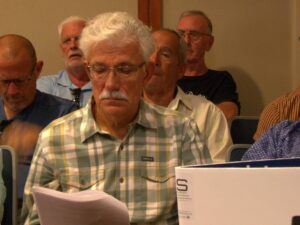
Victor Dobrin, pictured here at a court hearing in Sarasota on April 11, had served on the West Villages Improvement District from 2018 through 2022 and has been a critic of decisions made by the district. Photo: Derek Gilliam, Suncoast Searchlight
Dobrin said: “Are we living in Russia or the United States?” “That is exactly what they’re trying to do. They want us to be quiet and accept them pushing us around.”
Bill Kelly, the current president of Gran Paradiso Property Owners Association, said the board had no choice but to exclude the former directors, as Mattamy would not agree to a settlement under any other terms.
The Gran Paradiso lawsuit stemmed from a 100-year water deal residents argued they never agreed to and feared could cost the district $2.8 billion over its lifetime.
Four of the five supervisors on the West Villages Improvement District, a special purpose government that controls Wellen Park, are appointed by Mattamy.
When Gran Paradiso challenged the arrangement in court, Circuit Judge Hunter Carroll criticized the district during a 2023 hearing for including terms that weren’t in the public interest and ruling that Gran Paradiso would likely prevail at trial on a potential violation of Florida’s open government laws. He went on to call the agreement “palpably obscene.”
Despite that early courtroom win, the slow plod of the legal battle lasted two more years before Mattamy and the West Villages Improvement District cut the neighborhood off from irrigation in March, isolating its pipes from the development’s broader system.
As part of the settlement in November, Gran Paradiso’s current board apologized for starting the legal fight, promised to pay $525,000 in the attorney fees for the Mattamy-affiliated individuals and business entities named in the litigation, and withdrew its claims while also promising to never bring them up again.
In response to questions from the community, the Gran Paradiso board appeared to place blame on some of the excluded directors.
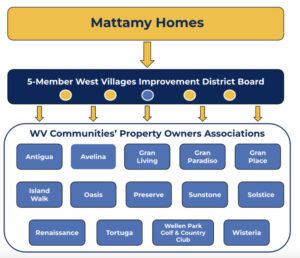
As the majority landowner, Toronto-based homebuilder Mattamy Homes appoints four of the five members of the West Villages Improvement District Board, the special-purpose government that manages infrastructure and services across all of Wellen Park –– previously called West Villages. The other board member is a property owner from one of the 14 communities inside Wellen Park. Chart: Suncoast Searchlight
“The excluded individuals were not known for ‘playing nice and developing a spirit of togetherness,’” the board wrote in response to questions from residents. “To the contrary, some if not all of them, were extremely mean spirited (and dishonest) in their attacks against the WVID supervisors, WVID and Mattamy, in the litigation and on social media and to the press.”
While the settlement agreement has been approved by all parties, according to Kelly, the Gran Paradiso president, there’s one last item for the community to decide.
In December, additional requirements of the settlement started circulating in the neighborhood. The community would also give up a parcel of land near its main gate where the district could build a new 5,000-square-foot headquarters or hand over $300,000 to cover part of the legal fees the district had incurred in the dispute.
That set off another round of social media battles in the already worn down community that continues to heal from years of litigation.
The settlement also doesn’t guarantee irrigation water for Gran Paradiso will be turned back on, only promising that the West Villages Improvement District will support an application to add Gran Paradiso back to its water use permit, which must still be approved by the South West Florida Water Management District.
A town hall meeting to discuss the potential land deal has been scheduled for Tuesday, January 13, and homeowners will then have two weeks to vote on the matter.
Tannenbaum, the Sarasota attorney, said that the Florida Legislature in recent years has only made it harder on residents to hold developers accountable.
Tannenbaum said: “Everything works against the homeowner in Florida when it concerns developers and there’s nothing on the horizon to fix that.”
Reporting for Suncoast Searchlight, Derek Gilliam. To read the full story, go to suncoastsearchlight.org/gran-paradisos-water-settlement-irrigation.
WSLR News aims to keep the local community informed with our 1/2 hour local news show, quarterly newspaper and social media feeds. The local news broadcast airs on Wednesdays and Fridays at 6pm.