To escape one legal battle over beach property, Sarasota County stepped into another.
By Derek Gilliam/Suncoast Searchlight
Original Air Date: December 10, 2025
Host: Sarasota County last month signed off on the final step of a land swap meant to end a years-long court battle over a stretch of sand on Siesta Key—only to find itself stuck in another lawsuit. Derek Gilliam with Suncoast Searchlight reports.
 Derek Gilliam: A year ago, county commissioners agreed to trade a piece of Siesta Key real estate to businessman Michael Holderness in exchange for four sandy lots he owns next to Beach Access 3. The settlement was intended to resolve Holderness’ latest lawsuit accusing the county of turning his private land into a public beach.
For the deal to go through, Holderness required the county to grant him permission to build a more than 5,000-square-foot house on the property he was set to receive in the swap—less than a quarter acre near his beachfront lots. Commissioners granted that approval on November 5, clearing what was expected to be the final hurdle.
But, as first reported by The Sarasota News-Leader, the deal proved controversial.
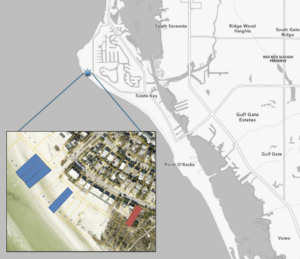
As part of a settlement agreement, Sarasota County approved a land swap involving a parcel it purchased in 2017 (in red) and four lots owned by Siesta Beach Lots (in blue). The deal also required the county to grant a variance allowing Siesta Beach Lots owner Michael Holderness to build a home on the red parcel. Illustration by Suncoast Searchlight using Sarasota County maps
The land the county is giving up—purchased in 2017 for $1.4 million through a park acquisition program—is now valued at nearly $2.8 million by the county property appraiser. The land it gets in return, by comparison, is valued at less than $100,000.
And the variance marked a major reversal. The county had denied similar requests four times over the past three decades—most recently in 2015—because the property lies seaward of the Gulf Beach Setback Line, a protected zone meant to preserve dunes and natural storm buffers. After those denials led to tension with the previous owners, the county bought the land, in part to keep it preserved.
Now a Siesta Key resident, Lourdes Ramirez, has sued the county to unwind the entire agreement. She argued it has no legal authority to dispose of parkland bought with dedicated tax dollars and that it ignored its own development codes to push the deal through.
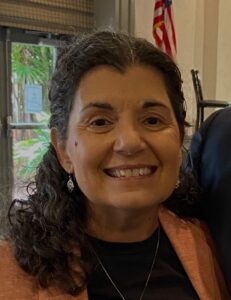
Siesta Key resident Lourdes Ramirez said she will sue Sarasota County to thwart a controversial land swap deal approved by commissioners. Photo courtesy of Lourdes Ramirez via Suncoast Searchlight
Ramirez said, “The county traded $1.4 million worth of parkland for four lots worth about $84,000 total. Taxpayers not only got a bad deal financially, but none of the proceeds that should have gone back into the parkland program were ever returned, despite what our codes require.”
The land swap and its fallout represent the latest in a long series of clashes across Florida by landowners trying to keep their beaches private and citizens who view beach access as their right. Roughly 90% of Sarasota County’s dry sand is privately owned, according to Holderness’ lawsuit.
Sarasota County officials do not comment on pending litigation.
Opponents fear the settlement with Holderness has created a blueprint for how other property owners along beach access points can trigger a similar fight—and get their way if they are unable to build or keep people off their beach.
Through his company Siesta Beach Lots, Holderness bought the four sandy parcels a mile north of the Siesta Key public beach in 2016 and 2017. The lots have been at times fully or partially submerged over the years, according to county aerial images, but have since gained land naturally, with sand now stretching all the way to the Gulf.
But problems started shortly thereafter, according to Holderness and a trio of lawsuits he has since filed under his company’s name.
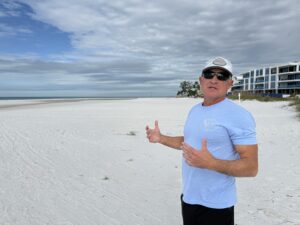
Siesta Beach Lots owner Michael Holderness stands on beachfront property that he currently owns but is expected to trade with Sarasota County after years of litigation about what he can and can not do on the land. In exchange, the county will give him another piece of nearby land. Photo by Derek Gilliam, Suncoast Searchlight
The first flare-up was in 2019 over a flagpole that Siesta Beach Lots erected on one of its parcels. The county argued the pole was actually on the public beach access easement—not on private property—and it removed the flagpole. Holderness sued in the 12th Circuit Court, arguing the county had abandoned the beach access easement and that he owned that slice of sand.
Then came the dispute over a pair of catamarans that Siesta Beach Lots allowed to be kept on one of the lots. The county notified Holderness in 2020 that the boats violated its ordinance against “parking or storing of recreational vehicles or boats on a public right of way or vacant property.” The county ordered Holderness to move the boats or incur fines.
Around the same time, Siesta Beach Lots sought to build a structure on one of the parcels but was blocked by the Gulf Beach Setback Line.
These two issues—the inability to store boats or build a structure—prompted the second lawsuit, again in the 12th Circuit Court.
Both suits dragged on until 2023, when the parties settled by returning to the status quo, basically agreeing to disagree and going their separate ways.
But in 2024, Holderness filed a new lawsuit, this time in the U.S. District Court Middle District of Florida, accusing the county of violating the 5th Amendment of the U.S. Constitution, which, among other things, prevents the government from taking private property for public use.
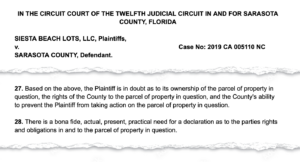
Siesta Beach Lots LLC, owned by Michael Holderness, sued Sarasota County three times — including in 2019 — over land rights associated with portions of beachfront property the company owns on Siesta Key. Illustration by Suncoast Searchlight based on actual court documents
Holderness, through Siesta Beach Lots, claimed the county took his property without buying it, enticed the public to visit it by installing a beach access point sign that read “Enjoy Your Park,” with park rules that do not apply on the private lots surrounding the public access, and that it prevented Siesta Beach Lots from keeping out trespassers.
“The county has effectively converted the privately-owned lots into a public beach by not doing anything meaningful to prevent or restrict the public’s use,” the federal lawsuit states.
After years of depositions and courtroom hearings, the county and Siesta Beach Lots reached a settlement last year, in November 2024. Commissioners accepted the deal—but it hinged on their later approval of a variance allowing Holderness to build on the county’s swapped lot.
That approval came one year later—in November 2025—in an at-times contentious commission meeting where at least one elected official accused staff of withholding critical information about the settlement.
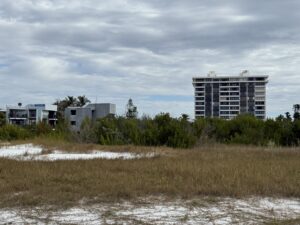
Sarasota County agreed to swap this nearly quarter-acre vacant lot on Siesta Key that it purchased in 2017 for $1.4 million for four beach lots valued at less than $100,000 to settle a lawsuit brought by businessman and beach-lots owner Michael Holderness. Photo by Derek Gilliam, Suncoast Searchlight
Commissioners did not know in 2024, for example, that the land it was trading away had been purchased for preservation through the Neighborhood Parkland Acquisition Program or that it was valued at north of $2 million. Those details were absent from the settlement agreement and staff materials presenting the deal.
Commissioner Tom Knight said he only learned about these things from the most recent staff report ahead of last month’s variance vote.
Knight told Suncoast Searchlight, “Misleading by omission is no better than a lie.”
Ramirez, who also attended the meeting, compared the county’s decision to move forward with the variance—despite clear warning it would violate its own codes—to its controversial approval in 2021 of hotel developments on Siesta Key. She sued the county over that move, too, and won.
Ramirez said, “In both cases, the proposal conflicted with clear zoning regulations, yet [commissioners] chose to move forward anyway.”
Her concerns come as questions mount over what the settlement actually resolved—and what it opened the door to.
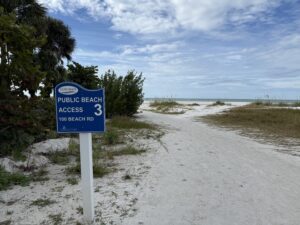
Siesta Key businessman Michael Holderness sued Sarasota County, arguing that county signs encouraged the public to use a section of his private beach near Beach Access 3. To resolve the dispute, the county agreed to a settlement that would transfer ownership of the contested beach to the county in exchange for giving Holderness a different nearby property. Photo by Derek Gilliam, Suncoast Searchlight
In particular, the deal leaves the county exposed to similar claims from other beachfront property owners who could pursue the same tactics to force a land swap or compel a variance. Holderness not only acknowledged it’s a real possibility but said he hopes to help identify such opportunities and facilitate the deals.
He told Suncoast Searchlight he knows of at least one other property owner seeking to install a pool on their property but can’t because of the county’s codes regarding the Gulf Beach Setback Line.
He said, “They have money. They don’t need the county’s money. There’s ways to make deals without taking the county’s money.”
This has been Derek Gilliam for Suncoast Searchlight. To read the full story, go to suncoastsearchlight.org/sarasota-county-siesta-key-land-swap.
WSLR News aims to keep the local community informed with our 1/2 hour local news show, quarterly newspaper and social media feeds. The local news broadcast airs on Wednesdays and Fridays at 6pm.