This week on the Peace & Justice Report, host Tom Walker interviewed event chair E. Scott Osborne.
By Johannes Werner
Original Air Date: March 4, 2026
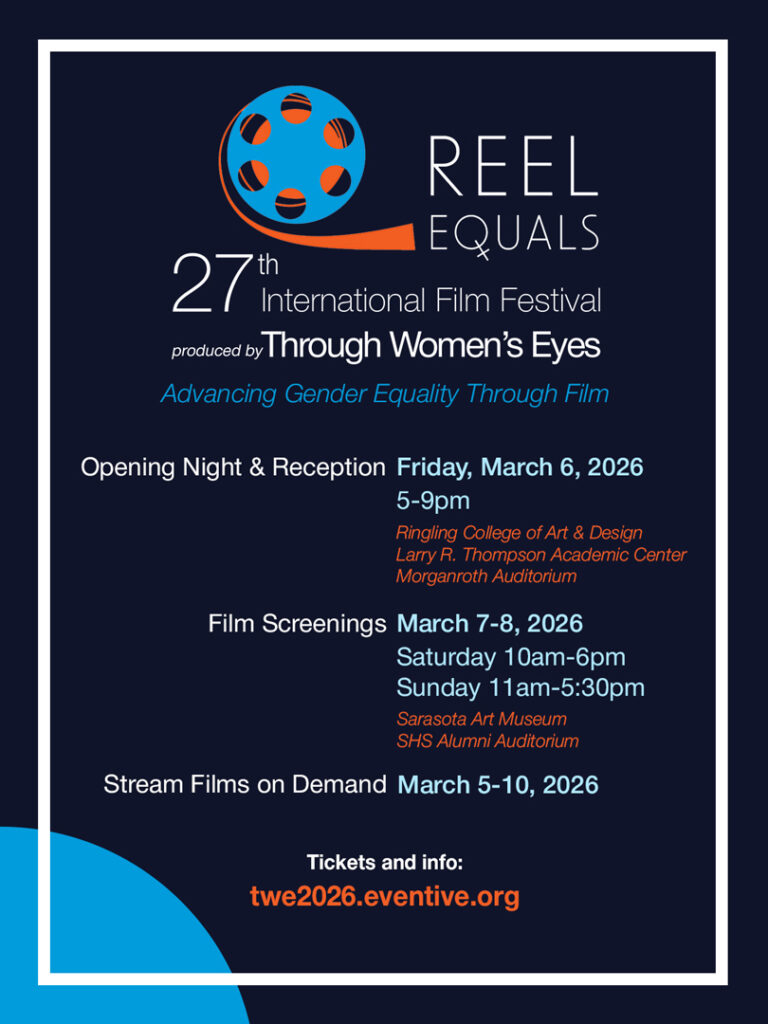
Host: The Through Women’s Eyes film festival starts this Friday. Scott Osborne, chair of the annual event, was interviewed by host Tom Walker on the Peace & Justice Report. Here’s what’s new and hot about this year’s edition.
Johannes Werner: This is the 27th edition, and it will run over five days, including three days with in-person presentations. It’s title is Reel Equals—that’s “reel” with two E’s—and it will offer 25 films from a dozen countries.
Scott Osborne talked about how Through Women’s Eyes got started:
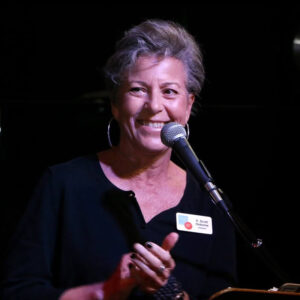
E. Scott Osborne
Scott Osborne: In 1999, a group of women sat around in a condominium at the bayfront in Sarasota, and they looked at some of the most common films and mainstream movies, and they really felt they wanted something different. Many of them had had international experiences or diverse experiences, and they wanted something different. They started exchanging, at the time, DVDs—this was pre-streaming, believe it or not—and sit around living rooms and screen them, selected a few, and convinced Ringling College to loan them a classroom, is how it started, for a little mini-festival, and then pretty quickly moved to New College, which loaned an auditorium, and then The Players Theater, and then Hollywood 20, and it grew from there. From one single film to an entire weekend.
JW: Here’s why she thinks the festival fills a need.
 SO: We have algorithms—for-profit algorithms—that silo us even further and further. The takeaway from all of that is we see fewer and fewer diverse perspectives. We see more and more of the same. We think it’s important to say, “Hey. We’ve got these cool films. We think they show different perspectives you may not have seen, you may not have thought about. Take a look!”
Women are significantly underrepresented in content generation, and that includes journalism, as I mentioned, advertisements, certainly mainstream films, social media, streaming—significantly underrepresented—and getting that point of view in front of people is important. But these are human stories. These are not just for women. They are for everyone. We have films about universal themes, which I’d really love to talk about later, that everyone should see. I said to somebody, “You know, you’ve probably been going to a ‘men’s film festival’ your whole life and you just didn’t realize it.”
JW: The opening night on Friday puts the focus on anxiety—and it will, counterintuitively, feature a comedian. The celebration will be March 6, 5 p.m. at Ringling College’s Morganroth Auditorium.
The reception and discussion will be followed by a screening of Anxiety Club, a documentary by American filmmaker Wendy Lobel.
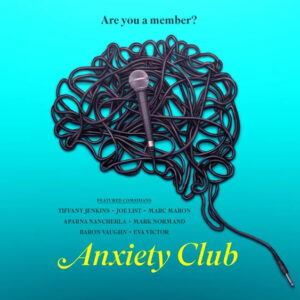
Anxiety Club by Wendy Lobel
SO: Our opener, for one, is actually from the US, but this is an example of a universal theme. It’s about anxiety and humor. It’s a comedy. It looks at stand-up comics dealing with a universal human emotion, which is anxiety. How do they deal with it? It’s funny, it’s charming. All our reviewers watched it, and they all said, “Oh! I know people who should see this.” They’re probably thinking of people who have anxiety—maybe themselves. Who knows? But they’re all saying, “Ah! I know some people who should see this.”
We’re also going to have questions and a little conversation after with one of the featured comedians whose name is Tiffany Jenkins who is actually from Sarasota, and she is now phenomenally popular on social media. She’s had some bestselling books. She’s funny, and she’s very authentic, talking about anxiety and some of the issues that she has struggled with. She will be with us on Friday night.
JW: The next two days—Saturday and Sunday—will be at the Sarasota Museum of Art—in the former brick high school building just south of downtown. A major focus will be on short films. Scott Osborne:
SO: We have a lot of shorts, and that’s anywhere from one minute to 20 minutes. They are often our most interesting. They’re like a short story. You have to pack so much into this little thing that sometimes they’re some of the most interesting.
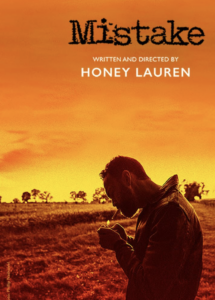
Mistake by Honey Lauren
JW: But there will also be two two-hour feature films. One is “Hello Mother.” It’s set in Mongolia. The closing film on Sunday is the other two-hour feature. Its title is “Mistake.”
Here’s how Osborne describes it.
SO: It starts in the early 1940’s in the U.S. South. You see a family of tobacco farmers, and they have their first child, and the child is born intersex, which is a medical condition where the gender is ambiguous. The physicians literally cannot tell. Again, this affects about one to two percent of the population. As was the science at the time, the doctors say, “You choose. Do you want a boy or a girl?” Something most parents don’t really choose at birth. This transpires over 30 years—I want to be careful not to have spoiler alerts—but you see, from the 1940’s to the 1970’s, how this individual grows up. They get hormone therapy—early days of hormone therapy—to essentially give them a gender. It does not always go well. I will tell you that much. But it is really about how a loving family struggles with someone who does not always look or act like they’re expected—who does not fit stereotypes.
JW: Local organizers will be there for discussion after the film.
The lineup includes three films from Iran.
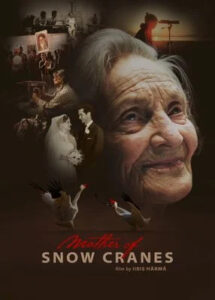
Mother of Snow Cranes by Iiris Härmä
SO: They’re so important because they show what I would call real human perspectives. They are not the headlines. They are not the politics. They are not war. Everyone should follow that, but they show certain slices of life. You see modern-day Tehran in some of them. You see, in another one, a woman’s life who had lived in the U.S. for many years, marries an Iranian man, goes to live in Iran, and it’s almost like—she’s 90-something today. It’s a documentary—it’s almost like a walk through Iranian history, so if you want a little briefer on Iranian history—the fall of the Shah, et cetera—it inadvertently shows you some of that. That’s called Mother of Snow Cranes. But it’s a human story.
JW: Again, Through Women’s Eyes starts Friday night, and you will have a chance to watch in-person movies through Sunday. For more information, go to throughwomenseyes.org.
For WSLR News, Johannes Werner. For the full interview, go to the archive on wslr.org and look for the latest edition of the Peace and Justice Report.
WSLR News aims to keep the local community informed with our 1/2 hour local news show, quarterly newspaper and social media feeds. The local news broadcast airs on Wednesdays and Fridays at 6pm.