A community organizer describes the way Signal neighborhood groups track ICE raids, identify detainees, and help feed locked down families.
Interviewer: Johannes Werner
Original Air Date: February 13, 2026
Host: You are listening to WSLR, LP 96.5 FM in Sarasota and WBPV LP 100.1 FM in Bradenton, and I am news director Johannes Werner. Minneapolis and ICE are still making headlines. Yesterday, Border Czar Tom Homan – he’s the one who practically announced the outlines of Operation Metro Surge on the Socratic Stage at New College last year – said that the remainder of 2,000 ICE agents will be leaving Minneapolis by the end of this month. That’s after almost three months of raids and detentions, many of them of U.S. citizens, after the killing of two citizen observers, and changing the daily lives of hundreds of thousands of the city’s residents.
One of the takeaways from Operation Metro Surge is the pushback by residents. We’re now bringing you a half-hour interview with a community member in Minneapolis who has been close to the protests, vigils, and neighborhood based tracking of ICE activities. Her name is Maryam Mohamad, and she’s of Somali immigrant background. This interview was recorded on Feb. 1. I began the interview by asking her about herself.

Maryam Mohamad
Maryam Mohamad: So I was born in Chicago, Illinois. My parents came here in 1991, 1993. My mom came in 1993, so they’ve been here for over 32, 33 years.
Johannes Werner: They came from Somalia?
MM: Both my parents came from Somalia, and you know, America: I’m an American. That’s my identity. I was born here, I was raised here. I’m as American as anybody else. So it’s a little bit shocking to feel othered or unwelcome and the only country that I’ve ever lived in, in the only country that I’ve ever known.
JW: So what’s going on right now and what are you exactly doing?
MM: So a lot of what I’m doing is taking pictures, taking videos, being at the protests, joining the vigil sites. The day that Renee Goode was killed by an ICE agent, I was there at her vigil site, the scene of her death. Same with the day that Alex Pretti was killed by an ICE agent about a week ago. I’m talking to people, bringing what I can, some water, some hot hands – those things that warm up your hands because it’s so cold outside. There are other people who are doing far more than I am, who are organizing, going grocery shopping for families who feel afraid to go to the grocery store, who necessarily can’t leave their homes without fear of being apprehended by ICE agents, regardless of their immigration status. There’s now a different type of fear. I feel that at the beginning of all of this, of Operation Metro Surge, the fear of leaving your home was mostly for those who may not have status as American citizens. Now we know that ICE agents are racially profiling people based on their looks and detaining them regardless of their immigration status. So the fear has spread outside of immigrant communities to just everybody in the Twin Cities area.
JW: How would you describe how this tracking and resistance is organized? Can you help us understand what the networks are? Do you belong to a specific group?
MM: Yes. So, many of these networks are neighborhood based. It’s you, your neighbors, maybe a few people who work in your neighborhood, on Signal chats. These are small group chats, probably most of them like 50 people. These aren’t wide networks, because there is a little bit of need to know who you are to be in these chats. And who knows you better than your neighbors? So people are organizing. When they see an ICE vehicle, they ask people to be there, to document what’s going on and to also document who is being apprehended, who is being detained, because there’s not a lot of transparency into these operations. If we are not the ones keeping track of who is being detained and how to get them back out, then we’re not sure who will be able to know where they end up. There have been a few cases actually where people who are arrested by ICE agents – they first go to the [Bishop Henry] Whipple ICE facility here in Fort Snelling, which is an unorganized territory that belongs to the federal government within Minnesota. And then, there have been cases that we’ve heard that the people who get brought to the Whipple ICE facility then get sent away, sometimes to Missouri, sometimes to Texas. And if there’s not people in their neighborhood who are keeping track of these people, knowing that they were detained in the first place, it is very difficult to know where they end up.
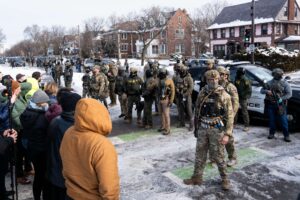
ICE agents and bystanders in Minneapolis after the Jan. 7 shooting of Renee Good. Photo: Chad Davis via Wikimedia Commons
JW: Help me understand – you live in a neighborhood, you’re part of one of these Signal groups. Help me understand how this happens from your perspective.
MM: Yes. The Signal chats, I would say, at the beginning were very uncoordinated. It was just moving to this encrypted platform to ensure that whatever we’re talking about is protected information. So a neighbor will tell you, ‘Hey, do you wanna join the Signal chat?’ There’s about 10 or 15 other people in it. Now, these have grown to like 50, 75 people. And at first, I just said yes, because I wanted to help the best that I could. So at first, it was very spur of the moment, not very organized. Now these with time, with more effort, with more organization, there’s like a vetting process. You have to know people in the chat. They have to know you. You have to ask them in person if you can join. Before, people were just sending links to each other all over the place. It’s not that anybody in these chats is doing anything illegal, we are doing our protected rights as Americans in observing federal investigations. We want to know why they choose to arrest the people that they arrest. We want to be able to have other people there on the scene, to ensure that nobody’s getting hurt. I would say, one really good thing about being on the scene is you can sense that the ICE agents are far less likely to beat up on this person that they’re arresting. They’re far less likely with other observers to be violent. They’re far less likely to say things that they don’t want recorded. One powerful thing that we’ve had is our phone cameras, and any instance in which the level of violence can be reduced is good. So that’s been the main function of these group chats, is to have people on the scene, help reduce the level of violence and also document exactly what’s going on.
JW: Give me an example of how things happen. Something happened Saturday, you were out and about. There’s so many elements to this. There’s ICE tracking, there’s response, there’s following up with detainees, there are vigils and protests. So what happened on Saturday? Just give me an example here.
MM: Saturday was a very large-scale protest. So that’s where I was that day. I was not observing ICE agents. I was attending the protest to have the voices of people across the state. People I was talking to said they had driven two hours into the Twin Cities to come protest, because they were upset with what was going on. They don’t like seeing people who are getting arrested and their children are crying, begging the ICE agents not to arrest them. So Saturday, I mostly was within a huge crowd. I have not seen the estimates yet, but the crowd was very large scale, very big, at least tens of thousands of people marching in downtown Minneapolis with their signs and everything. Now, getting back to the Signal chats, let me give you an example of what happens. There are observers who drive around the neighborhoods to try to identify ICE vehicles. One way we can identify is by the type of car. Yes, that gets tricky, but a lot of the times ICE vehicles are unmarked. They do not say ‘Department of Homeland Security’ on the side. They do not say ‘ICE’ on the side. One of the ways we can tell, is they might not have any license plates. Their windows might be too tinted to be legal in the state of Minnesota. A neighbor would know that, we would know the tinting laws, and ICE is allowed to tint all of their windows. We can see that there’s men in tactical gear getting in and out of these vehicles. So when somebody who’s driving around identifies that there is a confirmed ICE vehicle in the neighborhood, then they take to the group chat to let people know – ‘Hey, I’m on this and this intersection, and there’s a confirmed ICE vehicle’. If they’re just sitting in their car, we’re not bothering them. They’re sitting in their car. Nobody’s apprehending anyone. There’s no need for any action. If we notice that they are knocking on somebody’s door, that’s when people ask people in the group chat, ‘Please come to this intersection. They’re knocking on this door and we just wanna make sure there are, there are observers here’.
JW: Is this what Renee Good was involved in when she was killed?
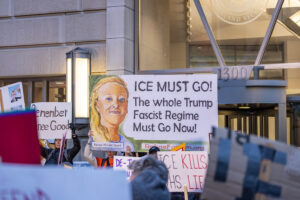
Protest at the headquarters of US Customs and Border Protection in Washington, D.C. Photo: Jason Gooljar
MM: Yes, she is a, she was a confirmed observer. She was there to see what they were doing. She was in her vehicle at the time where she was killed. And there are a lot of people still, despite the fear that they might be shot and killed by ICE, that are still doing this work because it’s very important to ensure that our neighbors are safe. When there is a confirmed ICE vehicle, when there is an arrest happening, that is when people bring out their whistles, they start whistling to inform people in the neighborhood that there is an ICE presence, to let people know who might be afraid to stay at home and to also let people know who are observers to come outside. So a lot of the times, the observers are blowing their car horns, blowing their whistles, recording on their phones, and sometimes even asking the ICE agents, ‘Hey, can you please explain to us why you are arresting this person? Do you have a warrant for this person’s arrest?’ Basic information and questions, to give us more insight into why this person is being detained.
JW: The Trump administration has painted some of the participants in these networks as domestic terrorists. Can you describe to us who is part of these networks and the Signal chats? Are we talking about young radicals, college students? Who is taking part in this?
MM: Well, it depends on the neighborhoods, but I will say that there are people of all races, all ages, that are part of these group chats. This is not young radicals or young college students who might be a little bit too … I’m not entirely sure what the word is … overzealous in their response with these ICE agents. These are people who live in these neighborhoods – your neighbors. You don’t want to see them – somebody who works hard, gets up at five o’clock in the morning – get arrested and taken away from their family, simply because they’re a green card holder. So this has really brought together people of all walks of life. This is not, again, overzealous radicals. No. These are regular, everyday Americans who just want to make sure that the people that they live next to are safe, and that the families that they live next to can stay together. The painting of these community networks as domestic terrorists is almost laughable. There’s no weapons. These are unarmed people who in no way, shape or form, aim to physically assault or hurt ICE agents. What we’re just trying to do is gather information and hope that, with observers and video recording, that an arrest doesn’t escalate to a higher level of violence. That’s really all this is about in the group chat. Sometimes people will be requesting aid. Like, ‘Hey, you know, there’s a family who hasn’t been able to leave their house in a couple days. Can we get them some grocery items?’ There are a lot of mutual aid networks right now who are trying to help people pay their rent in case they haven’t been at work for a few weeks. The city council in Minneapolis has been working towards asking Gov. Tim Walz for an eviction moratorium, knowing that there are so many people afraid to leave their homes. So these are more like resource networks and information gathering networks, and not some underground domestic terrorist groups. These are just communities and neighbors.
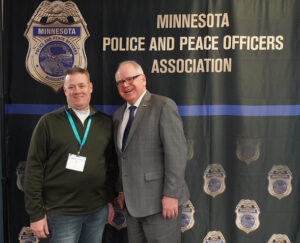
Minnesota Gov. Tim Walz. Photo: Office of Governor Tim Walz
JW: Maryam, can we go back to your life and how it has changed in the course of Operation Metro Surge? What was your regular day-to-day life, and what is it like right now?
MM: I would say the biggest change for me right now is having to carry my birth certificate, my passport, and my driver’s license with me everywhere I go. I’ve never had to do that in my entire 31 years of living here, being a natural born U.S. citizen, and sometimes it even shocks me how normalized that has become in my day-to-day. Sometimes, when I’m opening my purse and I’m reaching in to grab my wallet, I see my passport and my birth certificate there, and it, it hits me a little bit like, my goodness, how far … how so much has changed in such a short amount of time. Also, Minneapolis is a very walkable city. You can walk around to go to the grocery store. You can walk to the bus. That’s what I do. I don’t drive, I walk. I take public transportation and the frequency of which I am doing that has definitely been reduced. In a protest or group setting, there are a lot of people around, in which then I feel safe to be outside, because I know that there’s power in numbers, safety in numbers. But I am a single person, and I used to go outside, walking around every single day. I don’t feel safe doing that alone anymore. There’s also a sort of suspicion that I feel when there’s a certain type of big car with tinted windows driving by me that I’ve never felt before in my life. I’ve never felt a sense of ‘Who’s in that car, who are those people?’ So there’s a level of suspicion, there’s a level of fear, and again, there’s a level of being othered in the country that you were born in.
JW: Speaking of being othered – you were born in the United States, and the Somali community is a target right now. The rhetoric from the Trump administration has been about Medicaid fraud, providing all kinds of targets within the Somali immigrant community. What’s your sense, why is ICE in Minneapolis, and what exactly are they looking for?
MM: In regards to the Medicaid, Medicare fraud, there have been investigations that have happened. People have been charged, sentenced, and have been sent away to prison for federal crimes of fraudulently using taxpayer dollars. There are ongoing investigations of these instances of Medicaid fraud. I believe the number of those alleged to have done these crimes has grown to about 75 people. There are about 80,000 Somali people in the State of Minnesota. So, for 80,000 people to have to answer for the crimes of less than 100 people is a little bit ridiculous, and it feels like a reason to target this community. I believe that at the time of this recording, 90% of Somali people are American citizens. So calling this an immigration issue when it comes to Somali people is really quite ridiculous. And because they can’t say that we’re here illegally, it feels like using the fraud crime claims against us is a way to justify this show of force, as saying that we’re criminals instead. Right? They can’t say that we’re illegal immigrants, so instead they say that we are criminals to justify this show of force. Now seeing that these are used as pretext to target the Somali community, there’s only a few other reasons why I could see why the president of the United States chose Minnesota for Operation Metro Surge. Some of these are my assumptions. I can’t really get into the mind of the president, but one of the first assumptions is that Gov. Tim Walz was Kamala Harris’ running mate during the 2024 election. And despite winning that election, I feel like President Trump has a vengeful side to him where he doesn’t like his perceived political enemies to go on with the rest of their lives. He also has publicly had spats or issues with Rep. Ilhan Omar, who is a Somali woman here, and her district in Minneapolis is the fifth Congressional district. And also, I would say that Minneapolis is a sanctuary city. It is a city where immigrants feel safe.
JW: And who are those ICE agents targeting right now? In practical terms, who are they looking for? Is there a profile?
MM: We don’t know. It is people who are here in the United States of America who are pursuing their citizenship. We know that people who have green cards or permanent residency status in America have been targeted for deportation. We also know that there is a lot of racial profiling going on, so it almost doesn’t matter what your immigration status is. If you look Hispanic, Latino, if you look Somali, if you look Hmong – there’s a large Hmong Asian population here – they will target you, arrest you, detain you. And then they will let you go. I’ve seen many instances of American citizens who are Somali get detained for some hours at the Whipple ICE facility, and then hours later – we’re talking about 5, 6, 7, 8 hours later – then they are let go. That to me is quite mind boggling as well, because we know they have a database that they can look up somebody’s name and see whether or not this person is a U.S. citizen. There’s no need to be sending people to Whipple ICE facility and detaining them for that period of time. They can confirm if a person is a U.S. citizen. They choose not to. So it’s very weird, because there’s not that much transparency into their process
JW: Of all places, it was here in Sarasota, at New College of Florida at a public event, that Tom Homan, the Border Czar stated – this was spring last year – and I am paraphrasing, ‘We have to move into sanctuary cities, in order to find the criminals. If local law enforcement, local authorities stand in our way, there will be collateral damage, and innocent undocumented immigrants will be deported. It will be your fault, local authorities, if this is going to happen’. We see this now happening. What’s your response to Tom Homan’s position of, ‘We want to find the criminals and deport them, and everything that happens surrounding this, is collateral damage’?
MM: So the Department of Homeland Security is not a entity that conducts criminal investigations in the Twin Cities. The Minneapolis Police Department, the St. Paul Police Department are the law enforcement entities that are conducting criminal investigations into people, to arrest them and charge them with crimes. We have law enforcement here to do that job. We do not need federal agencies in our cities to do that job. We have our own police departments conducting that work. We have our own district attorneys and attorney general’s office doing that work. So when the question of ‘We’re looking for criminals’ comes up, I find it to be absolutely and utterly ridiculous. Our police department conducts investigations and arrests criminals. If this criminal is found to be here in America illegally, there is a process for deportation once this person has had their trial and found guilty. So the processes are in place already. We have been doing this for the last probably 40 years, 50 years in the United States of America. So when Tom Homan makes statements like that, essentially saying that ICE is a law enforcement agency, I find it to be an excuse of sorts to come and brutalize immigrant communities and populations and people of color.
JW: Speaking of local law enforcement, there’s this weird reversal going on. Minneapolis was the site of a local cop killing George Floyd. The history of this is, federal agencies then move in to fix the mess. What’s the relationship between local activists on the ground and local law enforcement at this point, versus the federal agencies that are coming into the city?
MM: The relationship between local communities and Minneapolis Police Department and St. Paul Police Department hasn’t really changed. The local law enforcement agencies here have still been aiding ICE and federal government agencies in their, I guess you could call it in their operations. So there’s still this disconnect there with the communities and local law enforcement, wondering why the local law enforcement has not done more to protect the local community. There was a news story. I believe it was Blaine, but I’m not entirely sure. It’s a city about 15 minutes north of Minneapolis where a woman was following an ICE vehicle safely behind them, and all four agents pulled over to the side of the road, jumped out of their cars, and started pointing guns at her. The mayor of that town called for the arrests of these ICE agents, for endangering people in public. You can’t just point guns at people because they’re following your car. So we know that the mayor of Minneapolis has that power, that institutional power to ask the same of the ICE agents who were a part of the killings of Renee Good and Alex Pretti. We know he has not done that yet. So the relationship still is strained. I will say, when there is a protest or when there is a vigil, when I was at the Alex Pretti vigil, there was Minneapolis police blocking off the roads, making sure nobody drove into the street where people were gathering. So they do protect the people who are there, peacefully protesting. So for that, I commend them. And that is a good show of community, because the Minneapolis police officers, they live here. They live here too. They’re our neighbors too. I wish there was more being done on their part to help protect people. However, yes, that relationship still remains very much strained.
JW: So after two months of of Operation Metro Search, what’s your personal outlook and hope for the future? And what’s your outlook and hope for the community?
MM: Personally, I hope that ICE agents do leave the Twin Cities. I hope that they don’t invade or occupy another city in the United States. I hope no other community has to ever endure anything like we’ve endured for the last two months. But I still have hope. I know America is a country full of very good people, hardworking people who want to watch the Super Bowl on Sunday. These are good people who want to enjoy their lives, and I understand that there is a collective trauma that we are going to have to work through if and when ICE does leave the Twin Cities. But I truly believe that there is a light at the end of the tunnel, and we will be able to do that work to heal as a city. You mentioned the killing of George Floyd at the hands of Derek Chauvin in 2020. Those protests were a lot more destructive. There was a lot of property damaged, and we had to live in a community that looked like a war zone for many years after that, and it took a very, very long time to rebuild and heal from that era in our city. But we did. We did. We rebuilt those places. We rebuilt our community, and we healed from that trauma. And I believe we could do it again.
JW: And for you personally? I’m surrounded by people who say, ‘Oh, everything is terrible. I’m going to move to Ireland or Portugal or Costa Rica, Canada. What’s your personal perspective?
MM: No, I’m not going anywhere. I’m an American. This is my country, and I’m willing to stay here through the good and the bad. I’m willing to see this through for a better time, a better era, so we can have a better future for our children. I understand the want to run away. There’s fight, flight, or freeze. I don’t have that flight response. I don’t have that freeze response. I have a fight response. I want to make sure that this country gets to a better place.
JW: You have been listening to an interview with Maryam Mohamad, a community member in Minneapolis who has been engaged in ICE tracking. Speaking of immigration enforcement: Tomorrow, WSLR’S Talk of the Town with host Carrie Seidman will feature the Sarasota Sheriff, a former Orange County Sheriff and gubernatorial candidate, and an immigrant advocate talking about immigration enforcement in Sarasota and Orlando. The event at the Fogartyville Community Center is booked, but you can listen to it live on 96.5 FM or on wslr.org. You can also watch the livestream on the Fogartyville YouTube channel.
Thank you for listening to WSLR News. I am News Director Johannes Werner. Coming up right now: The Progressive Paige Turner – Marianne Barisonek interviews book authors. Stay tuned!
WSLR News aims to keep the local community informed with our 1/2 hour local news show, quarterly newspaper and social media feeds. The local news broadcast airs on Wednesdays and Fridays at 6pm.
 It's drive week!
Your gift keeps 96.5 on the air. Be one of the people who make it happen.
Donate Now
It's drive week!
Your gift keeps 96.5 on the air. Be one of the people who make it happen.
Donate Now