It was ‘all hands on deck’ for a recent drill that simulated a crash landing.
By Ramon Lopez
Host: In March 2000, two small planes collided on a runway at Sarasota Bradenton International Airport, killing four people in a fiery explosion. And in February 2023, two full-size jetliners nearly collided on a runway there. But there’s never been a fatal commercial airline accident at Sarasota Bradenton International, commonly known as SRQ, the industry’s airport code. And officials there hope to keep it that way. Ramon Lopez reports.
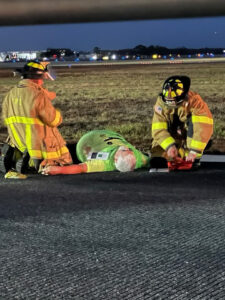
Volunteers played roles as victims or distressed family members. Photos: Lopez
Ramon Lopez: There has been no major accident involving aircraft at Sarasota Bradenton International Airport since 2000. But should there be one, SRQ personnel say they are ready, with some minor tweaking.
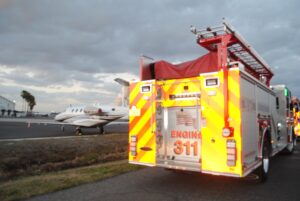
It was an ‘all-hands-on-deck’ affair there last week as hundreds of airport and area first responders and citizen volunteers converged to practice how to handle a passenger jet crash. The airport’s short runway was closed for about three hours to make room for emergency response vehicles and a passenger jet loaned to the airport for the night by Allegiant. The crash disaster drill was conducted as planes continued to take off and land.
Rick Reiman, a 32-year industry veteran, who normally works in SRQ’s real estate department, participates for fun and personal interest. The airport’s brand new CEO, Paul Hoback, was also there. He was an observer this time, though he’s no
stranger to such exercises, having previously worked at Pittsburgh International for 25 years.
Hoback said there’s no question about the need for airport disaster drills and detailed ‘crash books’ for both airline and airport personnel. 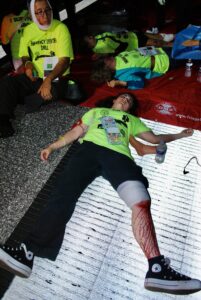
Paul Hoback: Running drills like this [is] absolutely paramount, to make sure that we’re ready for any kind of event that might take place. We actually make sure that they’re very realistic. We had a live fire that was in a dumpster, a controlled fire, right now. But we want to see how our fire departments respond, what’s the timing of how fast they get out there, to be able to put that fire out and then start moving, doing some triage, and moving the simulated injured passengers from that aircraft, away from danger.
RL: Vicky Hall was among the several hundred ‘victim’ volunteers who were happy to help out.
Vicky Hall: It’s kind of a fun thing to do, and to be out on the runway in a place you’d never get to go before. And also, to see what happens when they have a disaster. I’ve been a nurse and an EMT for a long time. Hopefully an airline crash won’t happen at the airport. But we know they do, and they need to know what’s gonna happen before it really does. They need to be able to practice.
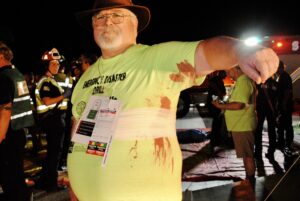 RL: The FAA requires such accident exercises for commercial airports, like SRQ, every three years. This, so the federal aviation agency and airport management know everything’s up to snuff. And as shown in this disaster drill, fire departments and law enforcement in both counties neighboring the airport, and from the City of Sarasota will also respond to a major aircraft accident, as part of a mutual aid pact.
The idea is to anticipate all post-crash scenarios, including major aircraft blazes, severe passenger injuries, fatalities, and according to Reiman, ‘fence hoppers’ who would breach airport security to get a close-up view of the ongoing search and
rescue activities.
In the exercise, the jetliner with 142 passengers on board was making a normal approach when something went wrong. A wing hit the tarmac, the aircraft careened off the runway and caught fire. Airport firefighters have three minutes to respond to a crash anywhere on the airport.
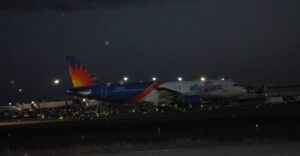
Allegiant provided a jet for the drill that closed SRQ’s short runway. Photos: Lopez
As the search and rescue operation progressed on the tarmac, Southwest Airlines personnel supported family members at a secluded area of the main terminal. They were desperate to learn the fate of the passengers. Some were angry and
hysterical. Others were crying. Airport and area municipal fire personnel responded to extinguish the aircraft fire,
EMS provided first aid to survivors and transport to area hospitals. An EMS helicopter arrived to rush badly burned passengers to area trauma hospitals. In all, there were 28 fatalities and numerous seriously injured passengers.
After all the injured passengers were taken care of, the passenger jet was removed, the active runway is cleared of debris and re-opened for flight ops. And a “Go Team” of accident investigators from the National Transportation Safety Board began their work with help from FAA, airline and airport personnel.
The disaster drill concluded with a lengthy debrief of all first responders. A detailed after-action report will then be produced.
Lionel Guilbert, the airport’s Senior VP of Operations and Public Safety, said the drill was an overall ‘success’. But he told WSLR things can change on how family members are handled.
 Lionel Guilbert: I think it went really well. There’s always room for improvements on different aspects of the drill. Everything on scene looked really good. We have simulated a friend and family center, and I was getting some reports that there could be some improvement there. But that’s why we do these things, to see where we have some weak points and improve on them.
RL: It should be noted that last October, IATA – the international air carrier organization – revised its family assistance protocol because of lessons learned from recent fatal airline accidents. Families said official support fell short of
expectations. IATA says, “Accidents are rare. But when they happen, people are affected—not only those onboard, but those waiting on the ground. Those who are impacted must feel supported, informed and respected.” It said better family assistance
training will ensure front-line employees gain practical experience on providing emotional and logistical support under real-world conditions.
At SRQ, this is Ramon Lopez for WSLR News.
WSLR News aims to keep the local community informed with our 1/2 hour local news show, quarterly newspaper and social media feeds. The local news broadcast airs on Wednesdays and Fridays at 6pm.
 It's drive week!
Your gift keeps 96.5 on the air. Be one of the people who make it happen.
Donate Now
It's drive week!
Your gift keeps 96.5 on the air. Be one of the people who make it happen.
Donate Now